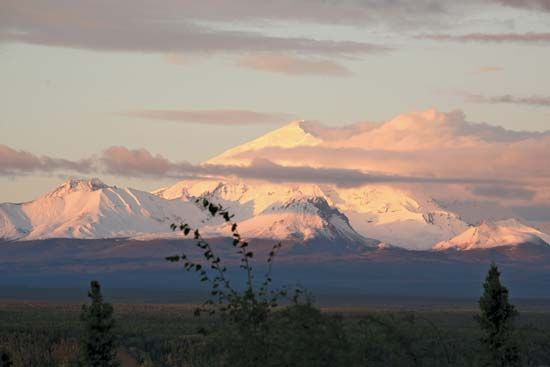
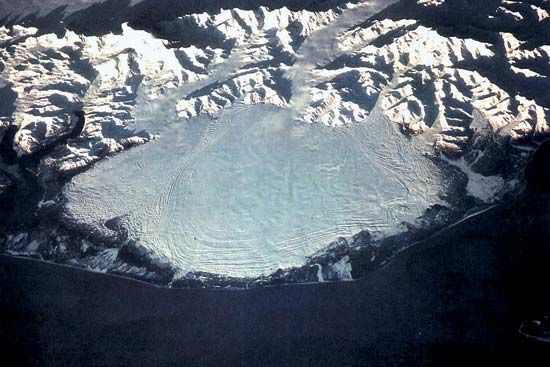
Malaspina Glacier
The Malaspina Glacier is classified as a piedmont glacier, which is the largest of its kind in the world. This type of glacier is formed by the convergence…
How was the Malaspina Glacier formed, and what type of glacier is it?
The Malaspina Glacier is classified as a piedmont glacier, which is the largest of its kind in the world. This type of glacier is formed by the convergence of the ends of valley glaciers at the base of mountains, creating a large lobe of ice that spreads out over level terrain.12
Located in southeastern Alaska along the southern base of Mount St. Elias, the Malaspina Glacier is a segment of the St. Elias Mountains glacier system. It covers approximately 1,500 square miles (3,900 square km) and reaches thicknesses exceeding 1,000 feet (300 metres). The glacier is situated within the Wrangell–St. Elias National Park and Preserve, which is part of a designated World Heritage site.1
What are the unique features of the Malaspina Glacier that make it stand out among other glaciers?
The Malaspina Glacier is distinguished by several unique characteristics that set it apart from other glaciers:
- World’s Largest Piedmont Glacier: It is the largest example of a piedmont glacier in the world. This rare formation occurs when a mountain-valley glacier reaches level terrain and spreads out into a broad, fan-shaped lobe of ice.1
- Scale and Extent: As the most extensive individual ice field in Alaska, it covers approximately 1,500 square miles (3,900 square km). It flows for 50 miles (80 km) along the base of Mount St. Elias.1
- Significant Thickness: The glacier is remarkably deep, with ice thicknesses reaching over 1,000 feet (300 metres).1
- Historical Significance: It was named in honor of Captain Alessandro Malaspina, who conducted explorations of the Alaskan coastline in 1791.1
- Protected Status: It is a key feature of the Wrangell–St. Elias National Park and Preserve, which is part of a larger World Heritage site encompassing multiple parks across the U.S. and Canada.1
What is the size of the Malaspina Glacier, and how does it compare to other glaciers in North America?
The Malaspina Glacier is a massive piedmont glacier located in southeastern Alaska, covering approximately 1,500 square miles (3,900 square km). It is recognized as the most extensive individual ice field in Alaska and the largest glacier of its type in the world.1
When compared to other glaciers in North America, the Malaspina stands out for its immense scale and unique formation. While many glaciers in the region are classified as alpine or valley glaciers, the Malaspina is a piedmont glacier, formed where the terminus of a mountain-valley glacier spreads out over level terrain into a broad, fan-shaped lobe.14
In the maritime environment of southern Alaska, it is often discussed alongside other massive ice features. For instance, the Bering Glacier is another significant piedmont glacier in the region, covering approximately 5,800 square km (2,200 square miles), which is larger in total area than the Malaspina. Despite these variations in size, the Malaspina remains a defining feature of the St. Elias Mountains glacier system, characterized by its significant thickness of over 1,000 feet (300 metres).51
What role does the Malaspina Glacier play in the local ecosystem and environment?
The Malaspina Glacier serves as a critical component of the vast wilderness within the Wrangell–St. Elias National Park and Preserve. While the provided search results do not detail specific biological interactions or localized ecological roles, the glacier is a defining feature of a protected World Heritage site that supports a diverse range of habitats and species.13
The surrounding region, which includes the St. Elias Mountains, sustains a variety of vegetation, ranging from coastal spruce-hemlock forests and floodplain forests to alpine sedges and grasses. This environment provides essential habitat for numerous wildlife species, including caribou, brown and grizzly bears, Dall sheep, moose, wolves, and beavers, as well as various waterfowl and marine mammals. By anchoring this massive, protected landscape, the Malaspina Glacier contributes to the preservation of one of North America’s most significant natural areas, facilitating wilderness-oriented activities and maintaining the integrity of these complex ecosystems.31
Sources
- Malaspina Glacier — Encyclopædia Britannica
- piedmont glacier — Merriam-Webster
- Wrangell–Saint Elias National Park and Preserve — Encyclopædia Britannica
- glacier - Mass balance of mountain glaciers — Encyclopædia Britannica
- Arctic - Other glacier groups — Encyclopædia Britannica
Published on · 3 min read