Malay Archipelago
The Malay Archipelago is a vast group of islands located in Southeast Asia. It encompasses the entirety of several nations and includes portions of others.
What are the major countries and territories that are part of the Malay Archipelago?
The Malay Archipelago is a vast group of islands located in Southeast Asia. It encompasses the entirety of several nations and includes portions of others.12
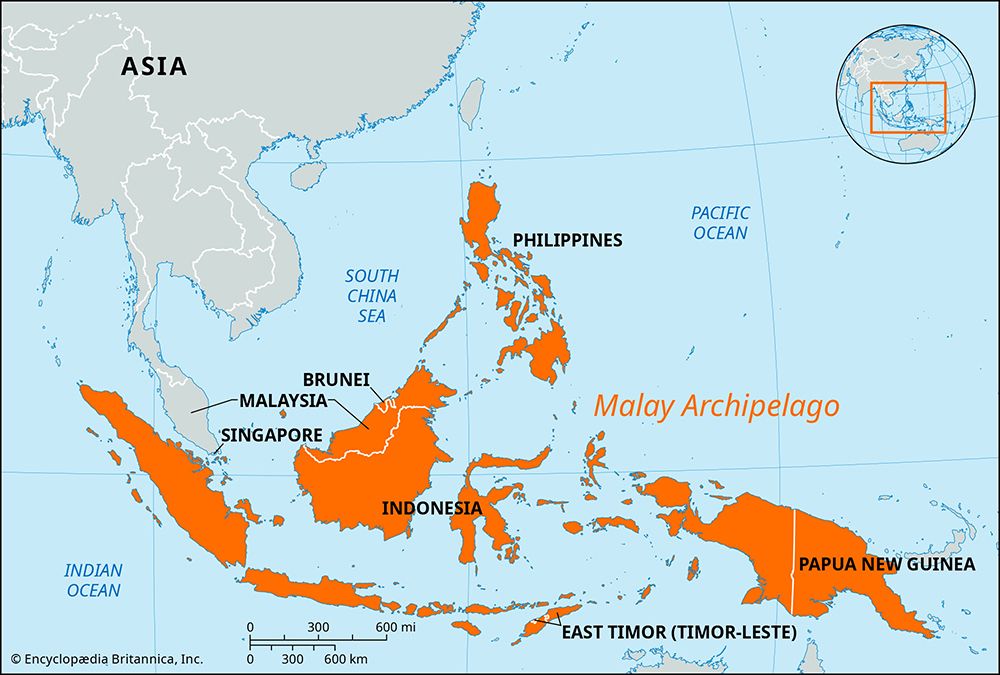
The major countries and territories that are part of the archipelago include:
- Indonesia: Comprising more than 17,000 islands, including major landmasses such as Sumatra, Java, Borneo, Sulawesi, the Moluccas, and the western half of New Guinea.132
- Philippines: Consisting of approximately 7,000 islands.12
- Brunei: Located on the northern coast of the island of Borneo.1
- East Timor: Situated on the eastern portion of the island of Timor.12
- Singapore: An island nation included within the archipelago.12
- Malaysia: Portions of the country, specifically East Malaysia on the island of Borneo, are part of the archipelago.124
- Papua New Guinea: Portions of the country are included in the archipelago.12
What is the Malay Archipelago and where is it located?
The Malay Archipelago is the world’s largest group of islands, situated in Southeast Asia between the Pacific and Indian oceans. It serves as a geographical bridge between mainland Asia and Australia, extending over 3,800 miles (6,100 km) along the Equator5.1
The archipelago consists of more than 17,000 islands belonging to Indonesia and approximately 7,000 islands belonging to the Philippines. It also encompasses the nations of Brunei, East Timor, and Singapore, as well as portions of Malaysia and Papua New Guinea.21
Structurally, the region is divided into the Sunda Shelf, the Sahul Shelf, and an area of active tectonic activity between them. The islands are characterized by a tropical climate with high temperatures and significant rainfall, supporting a rich diversity of flora and fauna.1
What are some of the most significant historical events that have occurred in the Malay Archipelago?
The history of the Malay Archipelago is defined by its role as a vital maritime crossroads, shaped by trade, the spread of religion, and colonial influence.
Early Empires and the Spread of Islam
Between the 7th and 13th centuries, the Srivijaya empire, based in Sumatra, dominated regional sea trade and served as a center for Mahayana Buddhism. By the 15th century, the rise of the Sultanate of Malacca transformed the region into a major commercial hub. Malacca became a primary center for the propagation of Islam, which spread through the archipelago via Arab and Indian merchants, eventually shaping the cultural and ethnic identity of the Malay people.678
European Intrusion and Colonialism
The 16th century marked the beginning of European intervention when the Portuguese captured Malacca in 1511. By 1641, the Dutch East India Company seized control of the city, establishing dominance in the region. Over the following centuries, various sultanates emerged and competed for trade, while migration from Sumatra, Celebes, and Java contributed to the region’s diverse social fabric.910
World War II and Modern Nationhood
The Japanese occupation (1942–1945) during World War II caused significant economic disruption and fueled nationalist movements. Following the war, the region saw a push for independence and political reorganization, leading to the formation of the Federation of Malaysia in 1963, which unified Malaya, Sarawak, and Sabah.11
What are some of the unique cultural and linguistic features of the Malay Archipelago?
The Malay Archipelago is a region of profound cultural and linguistic diversity, shaped by centuries of maritime trade, religious shifts, and migration.
Linguistic Landscape
The archipelago is home to a vast array of Austronesian languages. Malay has historically served as the region’s primary lingua franca, facilitating international commerce across the Strait of Malacca. Due to this role, it was adopted as the basis for national languages in Indonesia, Malaysia, and Brunei. The languages of the region often reflect historical contact; for instance, Sanskrit loanwords are prevalent in Malay and Javanese, while later Arabic and Persian influences reflect the spread of Islam.12
Cultural Traditions and Social Customs
Malay culture is characterized by a blend of indigenous, Hindu-Buddhist, and Islamic influences. While the Malay people are predominantly Muslim, remnants of earlier Hindu rituals persist in certain state ceremonies and marriage traditions.13
- Festivities: Cultural life is marked by diverse religious holidays, such as Eid al-Fitr and Eid al-Adha, alongside celebrations like Chinese New Year and Diwali, reflecting the region’s multi-ethnic population.6
- Performing Arts: The gamelan ensemble and shadow puppet plays like the wayang kulit are iconic artistic expressions that demonstrate the deep historical connections between the islands.1415
- Cuisine: Traditional Malay food often centers on rice, such as nasi lemak, while the broader culinary landscape of the archipelago is a vibrant fusion of Chinese, Indian, and indigenous flavors.6
Sources
- list of islands - Brunei — Encyclopædia Britannica
- Malay Archipelago — Merriam-Webster
- list of islands - Indonesia — Encyclopædia Britannica
- Malaysia - Relief — Encyclopædia Britannica
- Malay Archipelago — Encyclopædia Britannica
- history of Malaysia - Early European intrusions and emerging sultanates in Malaysia — Encyclopædia Britannica
- Srivijaya empire — Encyclopædia Britannica
- Malaysia - Early European intrusions and emerging sultanates — Encyclopædia Britannica
- Malaysia - The advent of Islam — Encyclopædia Britannica
- history of Malaysia - Political transformation — Encyclopædia Britannica
- history of Malaysia - The advent of Islam — Encyclopædia Britannica
- Austronesian languages - Major languages — Encyclopædia Britannica
- Malaysia - Daily life and social customs — Encyclopædia Britannica
- Southeast Asian arts - Malaysia — Encyclopædia Britannica
- Austronesian languages - Size and geographic scope — Encyclopædia Britannica
- musical performance - Southeast Asia — Encyclopædia Britannica
- Malay language — Encyclopædia Britannica
- Malay — Encyclopædia Britannica
- Malaysia - Religion of Malaysia — Encyclopædia Britannica
Published on · 3 min read