Mammillaria
Mammillaria is a large genus of approximately 200 species of low-growing cacti native to the Western Hemisphere, with the highest concentration found in…
What is Mammillaria?
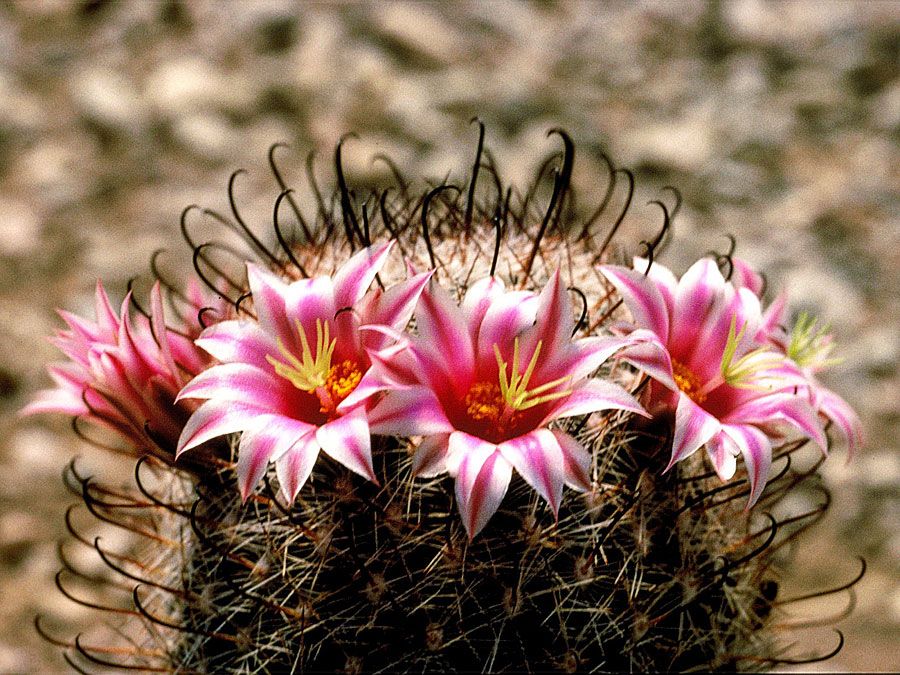
Mammillaria is a large genus of approximately 200 species of low-growing cacti native to the Western Hemisphere, with the highest concentration found in Mexico.123
These plants are typically small, globose, or cylindroid in shape and are characterized by tubercles—projections arranged in spiral rows—that are not connected into ribs. The areoles, which are specialized buds located at the tips of these tubercles, bear either straight or hooked spines. Small, colorful flowers emerge from the base of the tubercles in rings around the plant.231
Commonly known as pincushion, fishhook, or snowball cacti, many species are popular for indoor or outdoor cultivation due to their manageable size, often remaining under 30 cm (12 inches) in height. Some varieties, such as the old woman cactus (Mammillaria hahniana) and feather cactus (M. plumosa), are noted for their woolly or hairy appearance.134
What are the main differences between tubercles and ribs on a cactus?
The surface of a cactus stem is often characterized by specific structural patterns that aid in water storage and environmental adaptation. The primary differences between tubercles and ribs are as follows:
- Tubercles: These are distinct, protruding, nipple-like or conical projections on the stem surface. They are not connected into continuous lines or ridges. In many species, such as those in the genus Mammillaria, the areoles—the specialized buds that produce spines and flowers—are located at the tips of these individual tubercles.
- Ribs: These are continuous, vertical, or spiral ridges that run along the length of the cactus stem. Unlike tubercles, which are discrete bumps, ribs form a structural framework that allows the stem to expand and contract as the plant absorbs or loses water.
Both structures serve to increase the surface area of the stem and provide a base for areoles, which are the defining feature of the Cactaceae family. The presence of either tubercles or ribs is a key characteristic used to distinguish between different types of cacti.
How do desert plants like Mammillaria store water to survive?
Desert plants like Mammillaria and other cacti have evolved specialized physiological and structural adaptations to survive in arid environments by efficiently managing water storage and loss.
Water Storage
Cacti are succulent plants, meaning they possess thick, fleshy tissues designed to store water. In most species, the stem serves as the primary storage organ. The bulk of the stem consists of thin-walled storage cells containing mucilaginous substances, which help retain moisture and prevent water loss. Additionally, many cacti have thin, fibrous, and shallow root systems that spread widely to quickly absorb superficial moisture from infrequent rainfall.78
Minimizing Water Loss
To conserve water, these plants have evolved several strategies:
- Reduced Surface Area: In most species, leaves are absent, greatly reduced, or modified into spines. This minimizes the surface area available for transpiration.8
- Crassulacean Acid Metabolism (CAM): Unlike most plants, cacti open their stomata only at night to take in carbon dioxide. During the day, the stomata remain closed to prevent water loss. The carbon dioxide is stored as malic acid in the vacuole and is released during the day for photosynthesis while the plant is sealed off from the hot, dry air.76
What are some other popular types of cacti for indoor gardens?
Many cacti are popular choices for indoor gardens due to their unique forms and ability to thrive in bright, sunny locations with minimal water. Beyond the well-known Mammillaria (pincushion cactus), several other varieties are frequently cultivated as houseplants:6
- Small and Compact Cacti:
- Epithelantha (button cactus): A tiny, spherical cactus.6
- Parodia (Tom Thumb cactus) and Rebutia (pygmy cactus): These are favored for their ability to bloom even when they are very young and small.6
- Gymnocalycium (chin cactus): Known for its distinct, often ribbed appearance.6
- Notocactus (ball cactus): A classic globular cactus.6
- Distinctive and Columnar Forms:
- Epiphytic Cacti:
- Other Varieties:
- Opuntia (prickly pear): Includes popular varieties like the “bunny ears” cactus.6
Sources
- Mammillaria — Encyclopædia Britannica
- mammillaria — Merriam-Webster
- fishhook cactus — Encyclopædia Britannica
- houseplant - Succulents — Encyclopædia Britannica
- cycadophyte - Stem — Encyclopædia Britannica
- cactus — Encyclopædia Britannica
- succulent — Encyclopædia Britannica
- plant - Specific variations in photosynthesis — Encyclopædia Britannica
Published on · 3 min read