Maxillaria
Maxillaria is a large genus of tropical American orchids belonging to the family Orchidaceae. While the taxonomy of the group remains contentious, it…
What is Maxillaria?
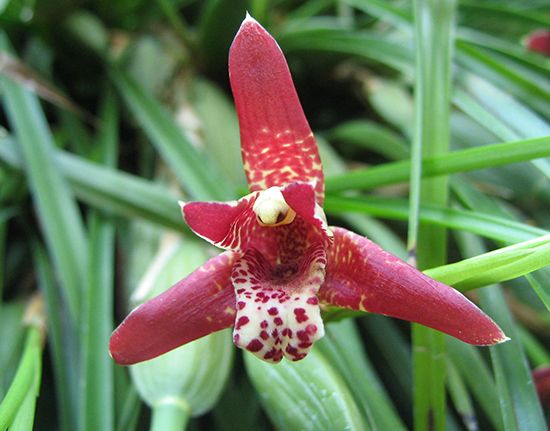
Maxillaria is a large genus of tropical American orchids belonging to the family Orchidaceae. While the taxonomy of the group remains contentious, it traditionally encompasses more than 300 species. Most of these plants are epiphytic, meaning they grow on other plants, and they are typically found at high altitudes.1
The genus is characterized by a diverse range of forms, with some species standing under 5 cm (2 inches) tall and others reaching nearly a meter (about 3 feet). They generally feature thick, leathery leaves and pseudobulbs spaced along a creeping rhizome. Their solitary flowers typically emerge on short stalks from the base of the pseudobulbs. The name is derived from the Latin word maxilla (jaw), referring to the resemblance of part of the flower to a chin. Several species, such as the coconut orchid (Maxillaria tenuifolia), are popular in cultivation for their fragrance and vibrant colors.12
What does it mean for a plant to be epiphytic?
An epiphyte is any plant that grows upon another plant or object solely for physical support. These plants are not parasitic; they do not derive water or nutrients from their host, nor do they possess the specialized organs known as haustoria that parasitic plants use to penetrate a host’s vascular system.34
Because they lack an attachment to the ground, epiphytes are sometimes referred to as “air plants.” They primarily inhabit moist tropical regions, where growing high in the tree canopy allows them to access sunlight that would otherwise be blocked by dense forest foliage. They obtain water from rain and atmospheric moisture, often absorbing it through their roots or specialized leaves, while gathering nutrients from organic debris that collects on their supporting structures.53
Common examples of epiphytic plants include many species of orchids, ferns, mosses, and members of the pineapple family.
How do pseudobulbs help orchids survive?
Pseudobulbs are thickened, bulbous stem structures found in many orchid species, particularly those that are epiphytic. These structures serve as vital storage organs for the plant, allowing it to survive in environments where water and nutrient availability may be inconsistent or seasonal.678
By storing water and nutrients within these enlarged stems, orchids can endure periods of drought or limited resources, which is a significant advantage for plants growing high in the tree canopy without access to soil-based water reserves. Morphologically, pseudobulbs vary in structure—ranging from those composed of multiple internodes to those consisting of a single internode—and they often work in tandem with a creeping rhizome to support the plant’s growth habit.698
What are some other popular types of orchids?
The orchid family (Orchidaceae) is incredibly diverse, comprising approximately 26,000 species across 880 genera. While many are grown for their ornamental value, they vary significantly in their growth habits and structural characteristics.106
Some popular and notable orchid genera include:
- Phalaenopsis: Commonly known as the moth orchid, these are popular houseplants prized for their long-lasting, showy flowers and relative ease of care.1011
- Cattleya: Often referred to as the “corsage orchid,” this genus is famous for its large, fragrant, and vibrant blooms.10
- Cymbidium: These are highly valued in the horticultural trade for their long, arching sprays of flowers.10
- Dendrobium: A large and diverse genus that includes many species popular in cultivation, ranging from miniature to large, cane-like plants.10
- Vanda: Known for their striking, often fragrant flowers and their tendency to grow as epiphytes with long, aerial roots.10
- Oncidium: Frequently called “dancing-lady” orchids due to the shape of their flowers, which often appear in large, branching sprays.10
Other distinct groups include the lady’s slipper orchids, known for their unique pouch-like labellum, and the vanilla genus, which is of significant economic importance as the source of the popular flavoring.10
Sources
- Maxillaria — Encyclopædia Britannica
- maxillaria — Merriam-Webster
- Did you know? — Merriam-Webster
- epiphyte — Encyclopædia Britannica
- parasitic plant — Encyclopædia Britannica
- orchid - Growth forms — Encyclopædia Britannica
- bucket orchid — Encyclopædia Britannica
- pseudobulb — Merriam-Webster
- Bulbophyllum — Encyclopædia Britannica
- list of plants in the family Orchidaceae — Encyclopædia Britannica
- orchid - Structural diversity — Encyclopædia Britannica
- houseplant — Encyclopædia Britannica
- moth orchid — Encyclopædia Britannica
Published on · 3 min read