Manakin
Manakin birds are primarily found in the tropical forests of the Americas. They are highly abundant in these regions, sometimes accounting for nearly…
Where are manakin birds typically found in the wild?
Manakin birds are primarily found in the tropical forests of the Americas. They are highly abundant in these regions, sometimes accounting for nearly one-third of all bird species present in mature tropical forests.1
While they are widespread throughout these tropical environments, they can be challenging to observe due to their small size, rapid flight, and tendency to remain within patches of dense vegetation. These birds play a vital role in their ecosystems by consuming large quantities of fruit and dispersing seeds across the forest, which is essential for maintaining tropical plant diversity.1
It is important to note that manakins are distinct from “mannikins,” which are unrelated birds found in the Old World.1
What unique courtship behaviors do male manakins exhibit?
Male manakins are renowned for their elaborate and exuberant courtship displays, which often take place in communal gathering areas known as leks. These displays are designed to attract and arouse females through a combination of visual and auditory signals.12
Key Courtship Behaviors
- Acoustic Displays: Males produce remarkably loud, firecracker-like snaps by rapidly clapping their wings together over their backs. Some species also use modified wing feathers to create rasping or crackling sounds.1
- Cooperative Dances: In some species, males work together in complex, synchronized performances. For example, blue-backed manakins perform an intricate circular dance that resembles a rotating fireworks wheel, while long-tailed manakins in Costa Rica perform sequential cartwheels over one another on a horizontal perch.1
- Individual Acrobatics: Males of the genus Manacus clear specific areas of the forest floor, using nearby saplings as perches to perform acrobatic displays for visiting females.1
- Hierarchical Systems: In species like the long-tailed manakin, males maintain a strict hierarchy. While multiple males may participate in a dance, the dominant “alpha” male typically monopolizes mating opportunities, sometimes for over a decade.1
How do manakins contribute to seed dispersal in their ecosystems?
Manakins play a vital role in maintaining tropical plant diversity through their habits as frugivores. By consuming large quantities of fruits from various trees and shrubs, these birds act as essential agents of seed dispersal across the forest landscape.1
Their contribution to plant propagation occurs in two primary ways:
- Wide Distribution: Due to their high mobility, manakins transport seeds over fairly large distances as they move through the forest, allowing plants to colonize new areas.1
- Enhanced Germination: For some plant species, the digestive process is a biological requirement for sprouting. As a seed passes through the bird’s digestive tract, its outer coat is scratched or scarified. This process allows moisture to penetrate the seed once it is deposited in the soil, which is necessary for the seed to germinate.1
This mutualistic relationship ensures that manakins receive sustenance while simultaneously facilitating the survival and spread of the plants they consume.13
What is the average size and lifespan of manakin birds?
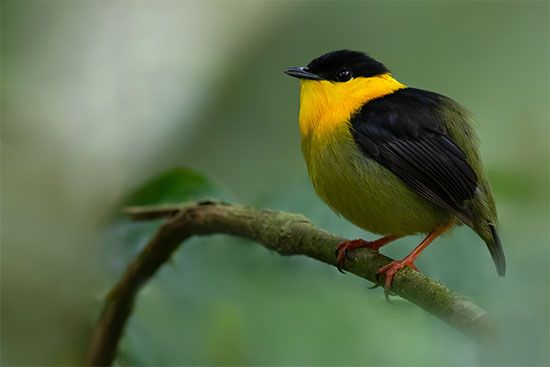
Manakins are small, stubby birds characterized by their compact size and short tails. They typically measure between 8.5 and 16 cm (3.5 to 6.5 inches) in length and weigh between 10 and 40 grams (0.35 to 1.4 ounces).1
Regarding their lifespan, while specific average longevity data for all species is not universally defined, the complex social structures of these birds provide some insight into their potential age. In species such as the long-tailed manakin, a dominant alpha male can maintain his status and monopolize mating opportunities for 12 years or more, indicating that these birds can live for over a decade in the wild.1
Sources
- Manakin — Encyclopædia Britannica
- coloration - Reproductive signals — Encyclopædia Britannica
- frugivore — Encyclopædia Britannica
Published on · 3 min read