Ostrich
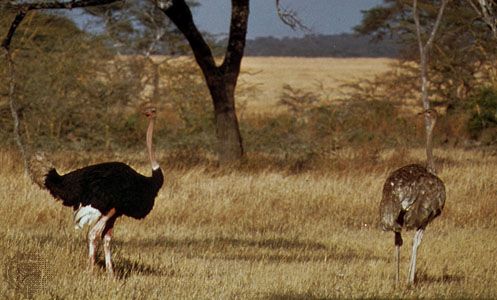
The ostrich (Struthio camelus) is recognized as the fastest bird on land, capable of reaching speeds of 72.5 km (45 miles) per hour.
How fast can ostriches run, and why are they considered the fastest bird on land?
The ostrich (Struthio camelus) is recognized as the fastest bird on land, capable of reaching speeds of 72.5 km (45 miles) per hour.12
It is considered the fastest runner among birds because of its specialized physical adaptations for terrestrial locomotion. Unlike birds that have evolved for flight, the ostrich is a flightless bird with powerful, muscular thighs and legs. Its unique bipedal anatomy features a two-toed foot, where the main toe has developed into a structure similar to a hoof, providing the stability and leverage necessary for high-speed running across open savanna. These anatomical modifications allow the ostrich to rely on its speed as a primary defense mechanism to escape predators.12
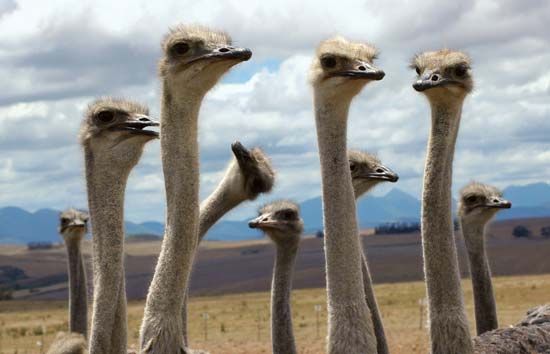
Where are ostriches primarily found in the wild, and how have they adapted to their natural habitat?
Ostriches are found exclusively in the open country of Africa, with populations ranging across regions from Morocco to Sudan, as well as in eastern and southern Africa.2
These birds have evolved several key adaptations to thrive in their natural habitat:
- Locomotion and Defense: As flightless birds, ostriches rely on their powerful, two-toed legs to reach speeds of up to 72.5 km (45 miles) per hour to escape predators. Their main toe is developed almost like a hoof, providing stability for running across open terrain.2
- Dietary Resilience: They primarily consume vegetation but also eat insects. Notably, they are adapted to survive without water for long periods.2
- Size and Morphology: Consistent with the evolutionary trend of flightless birds, ostriches have increased in size, which helps them navigate their environment. They possess large eyes for keen vision and a unique neck structure that allows them to lie flat on the ground to escape detection, a behavior that has led to the common misconception that they bury their heads in the sand.42
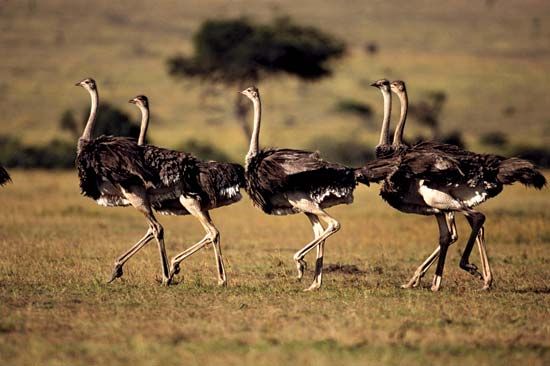
How do ostriches use their wings, even though they can’t fly?
Although ostriches are flightless birds, their wings remain a functional part of their anatomy. While they do not use them for flight, ostriches utilize their wings for several important purposes:
- Balance and Steering: When running at high speeds—up to 72.5 km (45 miles) per hour—ostriches use their wings as stabilizers. By spreading or maneuvering their wings, they can maintain balance and make sharp, quick turns while navigating open terrain to escape predators.5
- Courtship Displays: During the breeding season, males use their wings, which feature distinctive white plumes, as part of their elaborate courtship displays to attract females.5
- Temperature Regulation: The wings can be used to help regulate body temperature, allowing the bird to dissipate heat or provide shade for their bodies when necessary.
While the wings of flying birds are highly modified for the mechanics of flight, the ostrich’s wings have evolved to support its terrestrial lifestyle, serving as essential tools for agility and social interaction rather than aerial locomotion.5
How do ostriches defend themselves against predators?
Ostriches rely on a combination of speed, physical defense, and camouflage to protect themselves from predators, such as humans and large carnivores.
- Evasion: Their primary defense is their ability to run. Using their powerful, two-toed legs—which are uniquely developed with a main toe that functions like a hoof—they can reach speeds of up to 72.5 km (45 miles) per hour to escape threats.2
- Physical Combat: If an ostrich is cornered and cannot flee, it is capable of delivering dangerous, powerful kicks to defend itself.2
- Camouflage and Concealment: To avoid detection, both adults and chicks may lie flat on the ground with their necks outstretched. This behavior helps them blend into their surroundings and has contributed to the common, though mistaken, belief that ostriches bury their heads in the sand when threatened.2
Sources
- The Fastest Animals on Earth — Encyclopædia Britannica
- Ostrich — Encyclopædia Britannica
- Bird - Walking and hopping — Encyclopædia Britannica
- Bird: Top Questions — Encyclopædia Britannica
- Bird - Skeleton — Encyclopædia Britannica
- Reproductive behaviour - Birds — Encyclopædia Britannica
Published on · 3 min read