Peacock
In the courtship displays of the blue and green peacock, the male utilizes his elaborate train—a 150-cm (60-inch) structure formed by elongated upper tail…
How do peacocks use their colorful feathers in courtship displays?
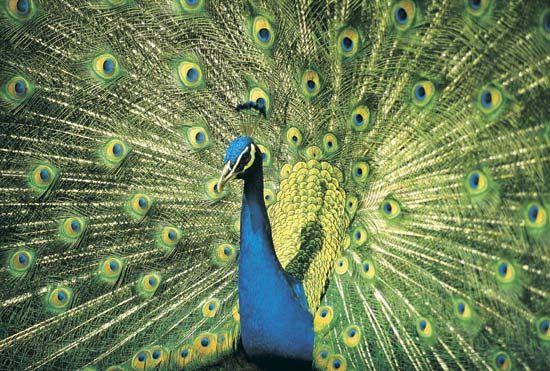
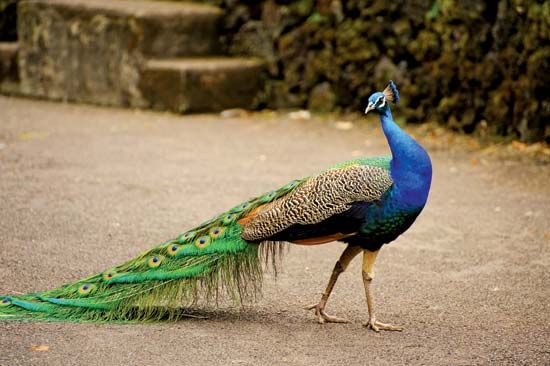
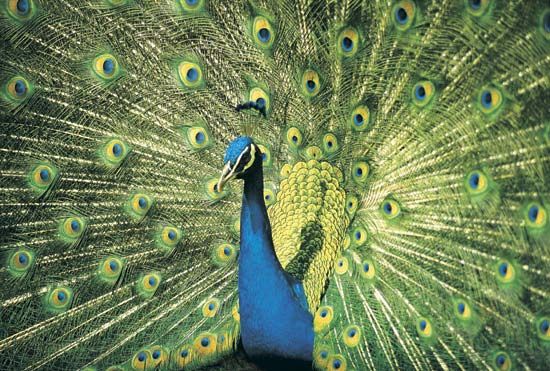
In the courtship displays of the blue and green peacock, the male utilizes his elaborate train—a 150-cm (60-inch) structure formed by elongated upper tail coverts—to attract potential mates. During the display, the cock elevates his tail, which lies beneath the train, to lift and project the feathers forward.1
At the climax of this performance, the male vibrates his tail feathers. This action creates a shimmering visual effect across the iridescent, eyespot-patterned feathers and produces a distinct rustling sound. These displays are a classic example of epigamic selection, where the cumulative effects of female preference have driven the evolution of such ornamental structures. By showcasing his train, the male provides an honest indicator of his relative fitness; the brightness of his coloration and the vigor of his display serve as signals to the female regarding his genetic quality and health.12
What is the difference between a peacock and a peahen?
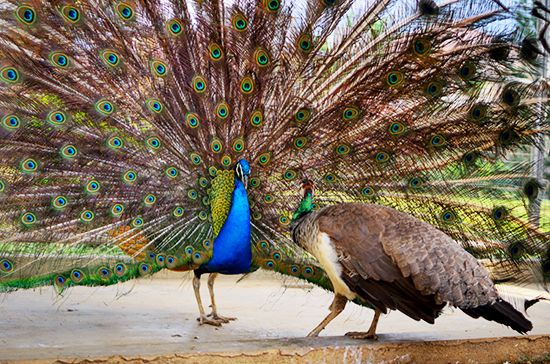
The terms “peacock” and “peahen” refer to the male and female of the same species, respectively; collectively, they are known as peafowl. This distinction is a clear example of sexual dimorphism, where the sexes differ significantly in appearance.72
In the two most recognizable species—the blue peacock and the green peacock—the differences are pronounced:
- Peacock (Male): The male is famous for his brilliant, iridescent plumage and an enormous train of elongated upper tail coverts, which can reach 150 cm (60 inches) in length. These feathers are tipped with distinctive eyespots used in elaborate courtship displays.7
- Peahen (Female): While nearly as large as the male, the peahen lacks the long, ornamental train and the specialized head crests found on the male. Her coloration is more subdued, typically consisting of green and brown tones, which provides camouflage while she incubates her eggs on the ground.7
What is the scientific name for peacocks and which bird family do they belong to?
Peacocks belong to the pheasant family, known scientifically as Phasianidae, which falls under the order Galliformes.211
There are three distinct species of peafowl, each with its own scientific name:
- Blue (or Indian) peacock: Pavo cristatus2
- Green (or Javanese) peacock: Pavo muticus2
- Congo peacock: Afropavo congensis2
While the blue and green species are classified within the genus Pavo, the Congo peacock is categorized in the genus Afropavo.2
Are there different species of peacocks, and if so, how do they differ?
There are three distinct species of peafowl, all belonging to the pheasant family, Phasianidae. They differ primarily in their geographic range, physical appearance, and conservation status.2
- Blue (Indian) Peacock (Pavo cristatus): Native to India and Sri Lanka, this species is the most recognizable. Males feature metallic blue-green body feathers and a long, iridescent train. It is currently classified as a species of least concern.2
- Green (Javanese) Peacock (P. muticus): Found from Myanmar to Java, this bird has green and bronze body feathers. Unlike the blue peacock, it cannot tolerate cold climates and is known for an aggressive disposition in captivity. It is an endangered species due to habitat loss and overhunting.2
- Congo Peacock (Afropavo congensis): Discovered in 1936, this species inhabits the Democratic Republic of the Congo. It is smaller than the Pavo species, lacks the long train, and is classified as vulnerable.2
We could dive deeper into the unique courtship displays of these birds or explore their specific habitat requirements.
Sources
- Animal social behavior - Social interactions involving sex — Encyclopædia Britannica
- Peacock — Encyclopædia Britannica
- peacock spider: Top Questions — Encyclopædia Britannica
- Galliform - Courtship and mating — Encyclopædia Britannica
- Reproductive behaviour - Displays — Encyclopædia Britannica
- Pelecaniform - Courtship behaviour — Encyclopædia Britannica
- peacock pheasant — Merriam-Webster
- Sexual dimorphism — Encyclopædia Britannica
- Did you know? — Merriam-Webster
- peafowl — Merriam-Webster
- Phasianidae — Encyclopædia Britannica
- Pavo — Merriam-Webster
Published on · 3 min read