Manatee
Manatees have evolved several specialized adaptations to thrive in aquatic environments. To manage their diet of low-energy aquatic plants, they possess…
What adaptations have manatees developed for their aquatic lifestyle, and how do these compare to other marine mammals?
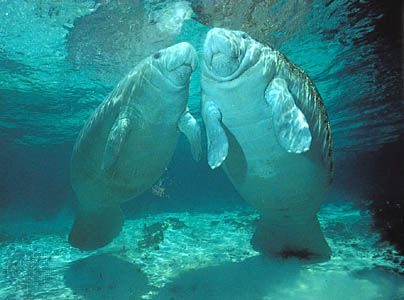
Manatees have evolved several specialized adaptations to thrive in aquatic environments. To manage their diet of low-energy aquatic plants, they possess prehensile lips with sensory bristles for food manipulation and an exceptionally long intestine for hindgut digestion. Unlike most mammals, they exhibit continuous tooth replacement, which protects them against the abrasive effects of ingested sand and silica.1
Physically, manatees maintain buoyancy and horizontal orientation through dense, marrow-less ribs and lungs oriented parallel to the water’s surface. While other marine mammals often consume high-energy prey like fish or krill, manatees rely on bulky vegetation, necessitating a low metabolic rate and the ability to store significant fat for fasting. Furthermore, manatees are highly efficient breathers, replenishing about 90 percent of their lung air in a single breath, compared to only 10 percent in humans.12
Where are manatees typically found, and what types of habitats do they prefer?
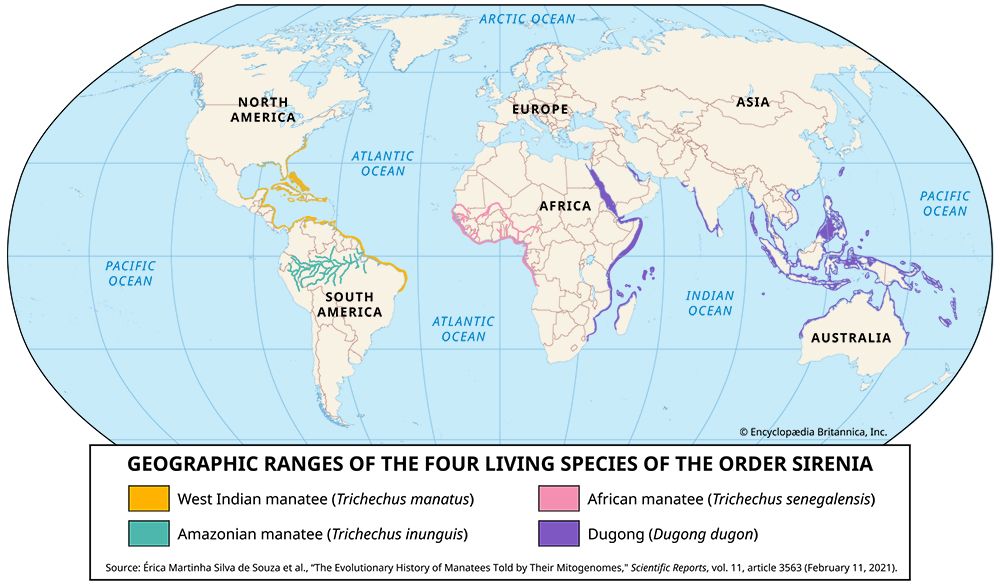
Manatees are found in tropical and subtropical regions along Atlantic coasts and within associated inland waters. Their habitat preferences vary by species:5
- West Indian Manatee (Trichechus manatus): This species, which includes the Florida manatee, inhabits nearshore waters, lagoons, estuaries, and rivers across the Caribbean, Mexico, Central America, and northern South America.5
- Amazonian Manatee (T. inunguis): Found exclusively in fresh water, this species inhabits the Amazon River and its drainage systems, including seasonally inundated forests.5
- West African Manatee (T. senegalensis): These manatees occupy coastal areas and slow-moving rivers ranging from Senegal to Angola, often traveling far inland.5
Manatees are sensitive to water temperature and often aggregate in warm water sources, such as power plant outflows or freshwater seeps, during cold weather. In the Amazon, they migrate in response to water-level fluctuations, sometimes becoming isolated in pools during dry seasons.6
What are some unique behaviors or characteristics that distinguish manatees from other sirenians like dugongs?
While manatees and dugongs share the order Sirenia, they possess distinct physical and behavioral differences that set them apart:
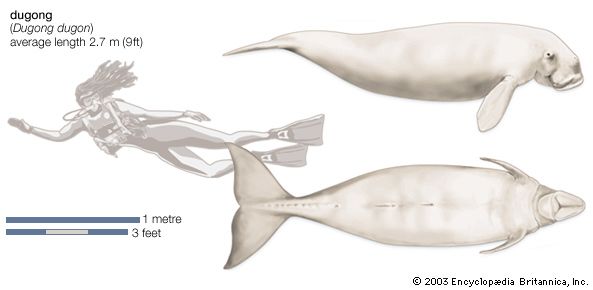
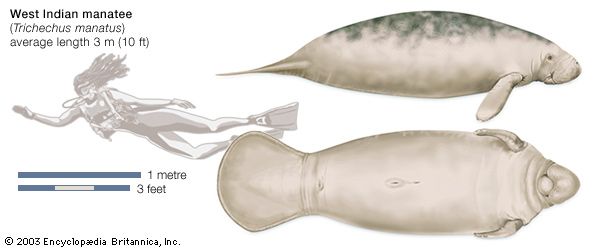
- Tail Shape: Manatees have a rounded, paddle-shaped tail, whereas dugongs possess a deeply notched, fluke-like tail similar to that of a whale.7
- Dentition: Manatees lack incisors and feature a continuous, lifelong replacement of molars that move forward in the jaw as older teeth wear down. In contrast, dugongs have a finite set of molars and possess incisors that erupt as tusks in males.7
- Habitat: Dugongs are exclusively marine, inhabiting coastal waters of the Indian and Pacific Oceans. Manatees are more versatile, occupying both marine and freshwater systems.7
- Skeletal Anatomy: Manatees have only six neck vertebrae, differing from the seven typical of most mammals.7
Both animals are descendants of terrestrial hoofed mammals and share adaptations like dense, marrow-less bones for buoyancy and prehensile lips for manipulating vegetation.78
How long can manatees live, and how does their lifespan compare to other marine mammals?
Manatees are long-lived animals, with age estimates based on growth rings in their ear bones indicating life spans of up to 59 years in the wild. In captivity, at least one individual has been documented to survive for more than 69 years.3
When compared to other marine mammals, manatees share a similar longevity profile with their closest relative, the dugong, which can also live up to 73 years. Both species are characterized by slow reproductive rates, which makes their populations particularly vulnerable to human-related mortality, such as habitat degradation, accidental entanglement in fishing nets, and collisions with watercraft.831
Because manatees and dugongs reproduce slowly and have low metabolic rates, they are unable to quickly recover from population losses, a challenge shared by many other long-lived marine mammals that face environmental pressures.3861
Sources
- manatee - Form and function — Encyclopædia Britannica
- manatee - Evolution and paleontology — Encyclopædia Britannica
- manatee - Natural history — Encyclopædia Britannica
- siren — Encyclopædia Britannica
- manatee — Encyclopædia Britannica
- manatee - Conservation status — Encyclopædia Britannica
- sirenian — Encyclopædia Britannica
- dugong — Encyclopædia Britannica
Published on · 3 min read