Dugong
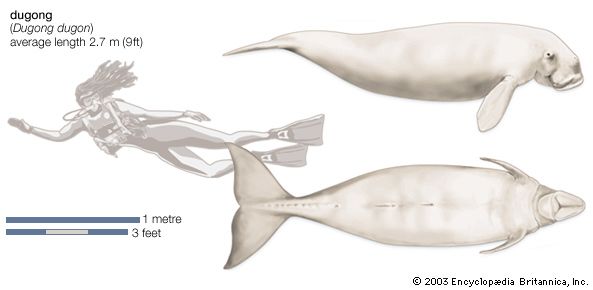
Dugongs are not closely related to whales; rather, they belong to the order Sirenia, which includes manatees and the extinct Steller’s sea cow. While dugongs…
How are dugongs related to other marine mammals like manatees and whales?
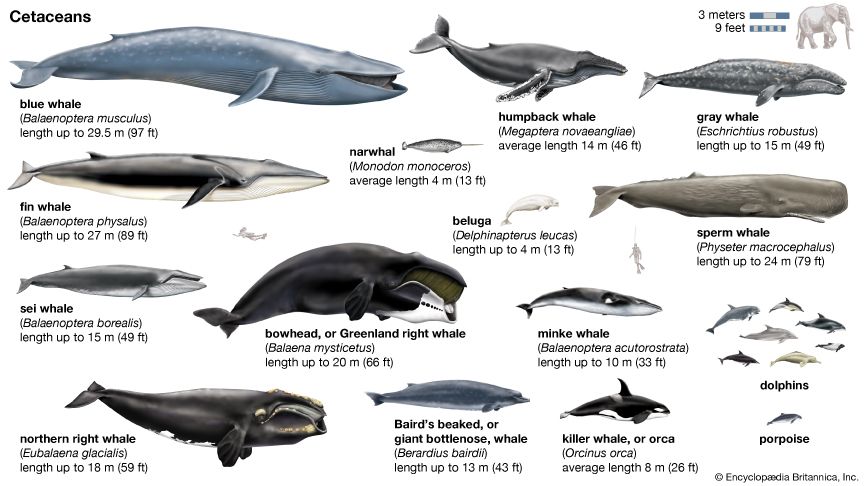
Dugongs are not closely related to whales; rather, they belong to the order Sirenia, which includes manatees and the extinct Steller’s sea cow. While dugongs and whales share similar streamlined body shapes and flukes due to convergent evolution—an adaptation to life in the water—they descend from entirely different terrestrial ancestors.123
Dugongs and manatees are closely related, both falling under the order Sirenia, but they belong to distinct families: Dugongidae and Trichechidae, respectively. Their closest living terrestrial relatives are actually elephants, as both groups share a common ancestry with ancient hoofed mammals known as tethytheres.143
In contrast, whales (cetaceans) evolved from early artiodactyls, a group of even-toed hoofed mammals. Because marine mammals like sirenians, cetaceans, and pinnipeds entered the marine environment independently, they do not form a single unified evolutionary group.52
What are the main threats to dugong populations, and what conservation efforts are in place?
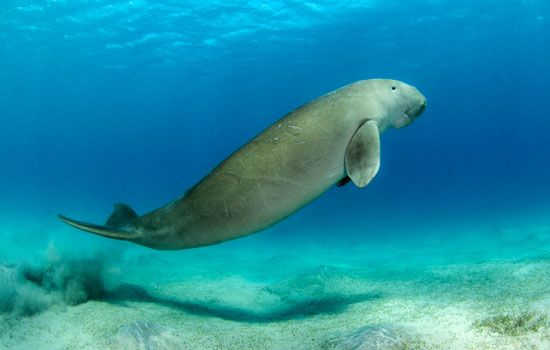
Dugong populations face significant threats that jeopardize their long-term survival, primarily due to their slow reproductive rates, which cannot compensate for high mortality levels. The International Union for Conservation of Nature has classified the species as vulnerable since 1982.4
Primary Threats
- Habitat Degradation: The loss of seagrass meadows, which serve as their primary food source, is a critical concern.4
- Human Activity: Despite being protected by law throughout their range, dugongs remain at risk from illegal hunting for meat, hides, and oil. Additionally, they face threats from accidental entanglement in fishing nets and collisions with boats.4
- Natural Predation: While less significant than human-driven factors, killer whales, sharks, and crocodiles are known predators of the species.4
Conservation Efforts
While dugongs are now legally protected across their range, these measures have not always been sufficient to prevent local extinction. In some regions, populations have failed to recover from past exploitation, leading to functional extinction in areas such as Chinese waters.4
What role do dugongs play in maintaining seagrass ecosystems?
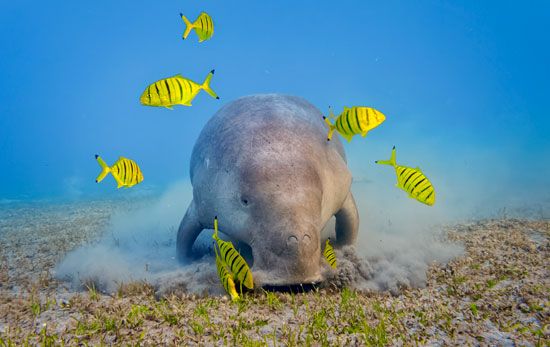
Dugongs play a vital role in the health and maintenance of seagrass meadows. By grazing on these underwater plants, they act as natural gardeners of the seafloor.
One of the most significant ways they influence their environment is through their feeding behavior. When dugongs graze in herds, they often consume seagrass in a way that may help maintain the meadows at their most nutritious stages of growth. As they feed, they leave distinct trails along the seafloor, which are evidence of their constant interaction with the ecosystem. By selectively foraging and moving through these habitats, they contribute to the dynamic cycle of seagrass regeneration and productivity.4
How have dugongs influenced human culture and mythology in regions where they are found?
Dugongs have significantly influenced human culture and mythology, primarily through their role as the likely inspiration for legends of mermaids and Sirens.48
Historical sightings of these marine mammals by early seafarers are widely believed to have given rise to these myths. This connection is often attributed to the way dugongs—and their relatives, the manatees—suckle their young in a manner that resembles human behavior when observed above the water’s surface.498
Beyond their mythological significance, the dugong itself is culturally rooted in the regions it inhabits. The name “dugong” is derived from the term dugung, which originates from Cebuano or a related Austronesian language of the central Philippines. Historically, these animals were also deeply integrated into the material culture of coastal societies, where they were heavily hunted for their meat, hides, and oil.74
Sources
- sirenian — Encyclopædia Britannica
- manatee - Evolution and paleontology — Encyclopædia Britannica
- What Is a Marine Mammal? — Encyclopædia Britannica
- dugong — Encyclopædia Britannica
- cetacean — Encyclopædia Britannica
- Tertiary Period - Large marine animals — Encyclopædia Britannica
- dugong — Merriam-Webster
- mermaid — Encyclopædia Britannica
- mermaid: Top Questions — Encyclopædia Britannica
Published on · 3 min read