Maned Rat
The maned rat (Lophiomys imhausi) is a unique rodent native to the dry forests and mountain woodlands of East Africa, including regions in South Sudan…
What role does the maned rat play in its ecosystem?
The maned rat (Lophiomys imhausi) is a unique rodent native to the dry forests and mountain woodlands of East Africa, including regions in South Sudan, Ethiopia, and Tanzania.1
Regarding its specific role in the ecosystem, the natural history of this animal has not been thoroughly studied, and there is currently limited information available regarding its precise ecological function or interactions within its habitat. We do know that it is a nocturnal climber that dens in rocky areas, tree roots, and ravines, and its diet in the wild consists primarily of leaves, fruits, and tender shoots. As the sole living representative of the subfamily Lophiomyinae, it remains a subject of scientific interest due to its distinct physical characteristics, such as its specialized mane and unique skull structure.1
What is the diet of the maned rat, and how does it forage for food?
The maned rat (Lophiomys imhausi) is a nocturnal rodent that primarily consumes leaves, fruits, and tender shoots in the wild. While its natural foraging behaviors remain understudied, observations in captivity indicate that the species is also capable of consuming root vegetables, cereals, insects, and meat.1
When eating, the maned rat exhibits a distinct posture, sitting on its haunches and using its front feet to manipulate its food. Although it is a capable climber, the animal is known to move slowly as it navigates its environment in search of sustenance.1
What are the distinctive physical characteristics of the maned rat?
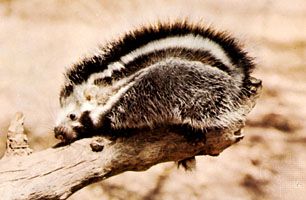
The maned rat (Lophiomys imhausi) is a large rodent characterized by a striking appearance that resembles a porcupine. Its most notable physical features include:
- Mane: It possesses a mane of long, coarse, black-and-white-banded hairs that starts at the top of the head and extends past the base of the tail. This mane is erected when the animal is disturbed and is bordered by a broad white band covering a glandular area of skin.1
- Coat: The body is covered in long, thick, silky fur featuring black or white stripes and blotches, while the underparts are covered in shorter, grayish-white fur.1
- Size and Build: It is a large rodent, weighing up to 2.7 kg (6 pounds), with a body length of 25 to 36 cm (10 to 14 inches) and a tail length of 14 to 21 cm (6 to 8 inches). It has short limbs and small ears.1
- Skull Structure: A unique anatomical trait of the subfamily Lophiomyinae is a granulated, bony, caplike growth that covers the entire top of the skull.1
Are there any cultural or folkloric beliefs associated with the maned rat in its native regions?
The provided information does not contain details regarding cultural or folkloric beliefs associated with the maned rat in its native regions. The available data focuses on the animal’s physical characteristics, habitat, diet, and evolutionary history.1
Sources
- maned rat — Encyclopædia Britannica
Published on · 2 min read