Potto
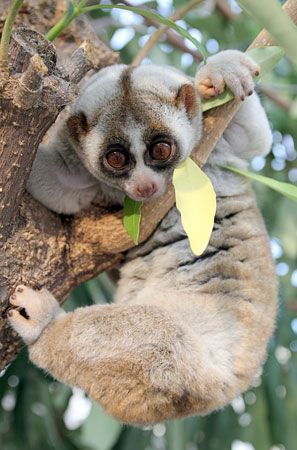
The potto (Perodicticus potto) is a nocturnal, slow-moving primate native to the rainforests of tropical Africa. Its diet consists of fruit, small animals…
What is the diet of a potto and how does it obtain its food?
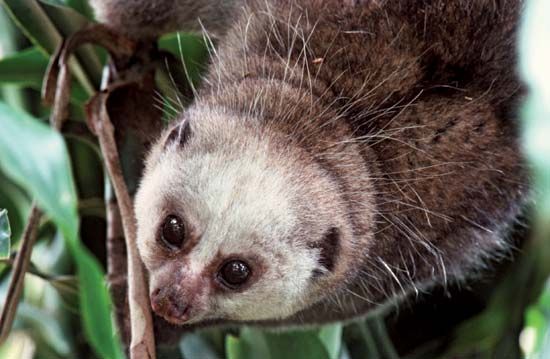
The potto (Perodicticus potto) is a nocturnal, slow-moving primate native to the rainforests of tropical Africa. Its diet consists of fruit, small animals, and insects, with a particular preference for larvae.1
As a specialized tree dweller, the potto obtains its food by navigating the forest canopy. It possesses a strong grip, allowing it to cling tightly to branches while foraging. Although it is generally slow-moving, the potto is capable of moving through the branches with a smooth, gliding gait that helps it remain inconspicuous while searching for sustenance.1
How do scientists study pottos in the wild, given their elusive nature?
Sorry, the Britannica knowledge base does not contain information regarding the specific scientific methods used to study pottos in the wild.
What cultural significance do pottos have in the regions where they are found?
Sorry, the Britannica knowledge base does not contain information regarding the cultural significance of pottos in the regions where they are found.
How do pottos compare to other primates in terms of their evolutionary history?
The potto (Perodicticus potto) belongs to the family Lorisidae, an evolutionary group of primates that also includes the angwantibos of Africa and the lorises of South and Southeast Asia.12
Evolutionarily, these animals share common traits that reflect their specialized niche as nocturnal, arboreal foragers. Like their relatives, pottos exhibit a slow-moving, deliberate nature and possess physical adaptations such as large eyes for night vision and a strong, grasping grip. While pottos and angwantibos are restricted to the rainforests of Africa, their close relationship to the Asian lorises highlights a broad, ancient distribution of the Lorisidae family across these tropical regions.12
Within this lineage, unique evolutionary paths have emerged. For instance, while the potto developed defensive neck spines to protect itself from predators, other members of the family have evolved different survival strategies, such as the venomous bite found in the Javan slow loris.12
Sources
- potto — Encyclopædia Britannica
- Lorisidae — Merriam-Webster
- loris — Encyclopædia Britannica
Published on · 1 min read