Maned Wolf
The maned wolf (Chrysocyon brachyurus) is a unique, large-eared member of the dog family (Canidae) native to the remote plains of central South America.…
What is maned wolf?
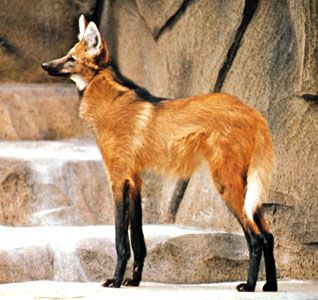
The maned wolf (Chrysocyon brachyurus) is a unique, large-eared member of the dog family (Canidae) native to the remote plains of central South America. Despite its name, it is not a true wolf and does not belong to the genus Canis.12
Physically, the maned wolf is distinguished by its foxlike head, long reddish-brown fur, an erectile mane, and notably long, blackish legs. It typically stands about 75 cm (30 inches) at the shoulder and weighs approximately 23 kg (50 pounds).1
As a solitary and primarily nocturnal animal, it maintains a varied diet consisting of small animals, insects, and plant material. While it may occasionally attack sheep, it generally avoids human contact. Because it is a distinct species, it is often categorized separately from other canids like the red wolf or the Ethiopian wolf.12
Why is the maned wolf not considered a true wolf?
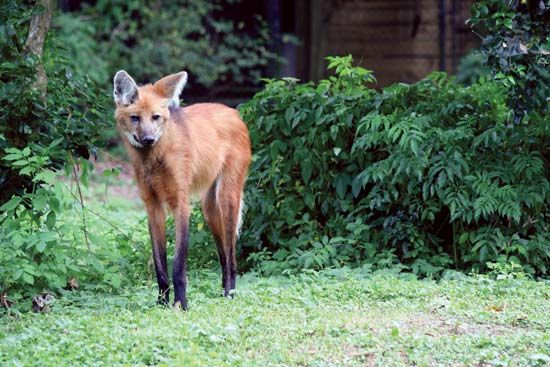
The maned wolf (Chrysocyon brachyurus) is not considered a “true” wolf because it does not belong to the genus Canis, which includes the gray wolf, coyote, and domestic dog. While it is a member of the dog family (Canidae), it is the sole species within its own distinct genus, Chrysocyon.123
Taxonomically, the maned wolf is classified separately from the wolves of the genus Canis. Although it shares the “wolf” name, it is more accurately described as a unique South American canid that possesses characteristics falling somewhere between those of a fox and a wolf. Its evolutionary path and physical traits—such as its long, stilt-like legs and erectile mane—distinguish it from the typical morphology of Canis species.1243
What role does the lobo guará play in its ecosystem?
The lobo guará, commonly known as the maned wolf, plays a role in its ecosystem as an omnivorous, solitary animal native to the grasslands and plains of central South America.1
As a predator and scavenger, it helps maintain the balance of its environment by consuming a varied diet that includes small animals and insects. Additionally, because it consumes plant material, it likely contributes to seed dispersal within its habitat, though specific ecological studies on its role as a seed disperser are not detailed in the provided search results.1
It is important to note that while the lobo guará is often called a wolf, it is not a member of the genus Canis and is distinct from true wolves. It generally avoids human contact, though it may occasionally prey on livestock such as sheep when its natural food sources are scarce.13
How does the maned wolf’s diet differ from other canids?
The maned wolf (Chrysocyon brachyurus) is an omnivore that incorporates a significant amount of plant material into its diet alongside small animals and insects. While many canids, such as the red fox and various South American foxes, are also omnivorous and consume fruits, berries, and other plant matter, the maned wolf’s dietary habits are characteristic of its solitary, nocturnal lifestyle in the remote plains of South America.167
The provided search results do not indicate that the maned wolf’s diet is fundamentally unique compared to other omnivorous canids, as many members of the dog family (Canidae) exhibit similar flexibility in their food preferences. Like the South American foxes, the maned wolf consumes a mix of animal and plant matter, though it is distinct in its specific evolutionary classification as the sole species in its genus.167
Sources
- maned wolf — Encyclopædia Britannica
- wolf - Other wolves — Encyclopædia Britannica
- maned wolf — Merriam-Webster
- dog - Other wild canids — Encyclopædia Britannica
- canine - Paleontology and classification — Encyclopædia Britannica
- omnivore — Encyclopædia Britannica
- South American fox — Encyclopædia Britannica
Published on · 3 min read