Marantaceae
Marantaceae, commonly known as the prayer plant or arrowroot family, is a group of approximately 31 genera and 550 species of rhizomatous perennial herbs…
What is Marantaceae?
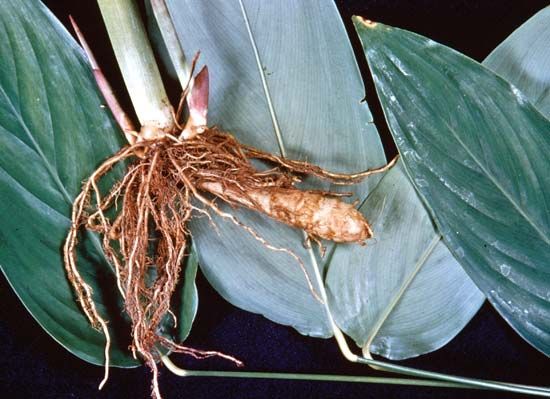
Marantaceae, commonly known as the prayer plant or arrowroot family, is a group of approximately 31 genera and 550 species of rhizomatous perennial herbs within the order Zingiberales. These plants are native to moist or swampy tropical forests across the Americas, Africa, and Asia.1
Physically, they range from slender, reedlike stalks to dense bushes reaching nearly 2 meters in height. A defining characteristic is a pronounced swelling at the junction of the petiole and the leaf blade. Their leaves are typically arranged in two rows, and they produce asymmetrical flowers in mirror-image pairs.12
The family is economically and aesthetically significant:
- Food: The rhizomes of Maranta arundinacea provide the starch known as arrowroot.1
- Ornamentals: Many species, such as the prayer plant, are popular houseplants valued for their patterned foliage.1
- Utility: Species like Calathea and Schumannianthus dichotomus are used for basket weaving, food wrapping, and mat making.1
Why are they called prayer plants?
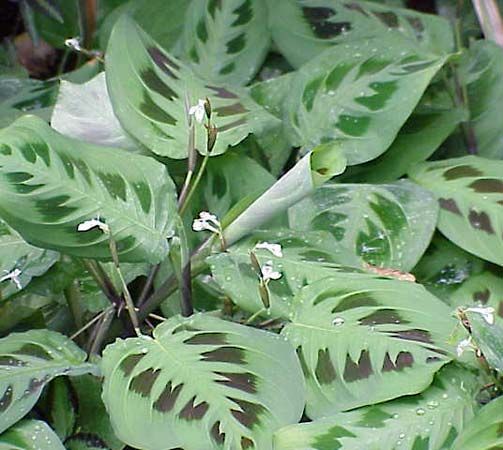
The prayer plant (Maranta leuconeura) earns its common name from its distinct daily movement, where its leaves fold upward in the evening, resembling hands clasped in prayer.345
This behavior is a biological phenomenon known as nyctinasty, a rhythmic, circadian movement triggered by changes in light intensity. During the day, the leaves typically lie flat, but as darkness approaches, they reorient themselves to a vertical, folded position. This movement is facilitated by the pulvinus, a thickened, specialized joint located at the base of the leaf stalk that regulates the plant’s position through changes in cellular turgor pressure.653
How is arrowroot starch extracted from rhizomes?
The extraction of arrowroot starch from the rhizomes of Maranta arundinacea is a straightforward process focused on isolating the starch granules from the plant’s fibrous material.
The production follows these steps:
- Harvesting: The tubers are collected when they are fully gorged with starch, which occurs just before the plant enters its dormant season.7
- Preparation: The roots are thoroughly peeled to remove the outer skin.7
- Grating: The peeled tubers are grated in water to break down the plant tissue and release the starch.7
- Purification: The resulting mixture is subjected to several washings to separate the starch from the pulp.7
- Drying: Finally, the purified mixture is dried to produce a fine, white starch powder.7
This traditional method yields a high-quality, easily digestible starch that is prized for its ability to thicken liquids into a transparent, pleasant-tasting jelly at lower cooking temperatures.7
What are the benefits of growing Marantaceae as houseplants?
Growing members of the Marantaceae family as houseplants offers several aesthetic and biological benefits:
- Striking Foliage: These plants are primarily cultivated for their ornamental value. They feature beautifully patterned, oval leaves that often display intricate color variations, such as contrasting green shades, striking red venation, or silvery markings.31
- Dynamic Movement: A unique benefit of keeping these plants is their fascinating behavior known as nyctinasty. Their leaves fold upward in the evening, mimicking hands clasped in prayer, which provides an engaging, interactive element to indoor gardening.31
- Variety: The family includes a diverse range of popular houseplants beyond the classic prayer plant, such as various species of Calathea, Stromanthe, and Ctenanthe, allowing for a wide selection of foliage shapes and patterns to suit different interior spaces.4
- Adaptability: While native to moist tropical forests, many species have been successfully adapted as houseplants in temperate regions, where they thrive as low-growing, evergreen perennials.34
Sources
- Marantaceae — Encyclopædia Britannica
- Marantaceae — Merriam-Webster
- prayer plant — Encyclopædia Britannica
- prayer plant — Merriam-Webster
- nyctinasty — Merriam-Webster
- 7 Especially Fitting Common Names for Plants | Prayer Plant — Merriam-Webster
- Arrowroot — Encyclopædia Britannica
- Cereal processing - Processing — Encyclopædia Britannica
- Cereal processing - Rice starch — Encyclopædia Britannica
Published on · 3 min read