March Fly
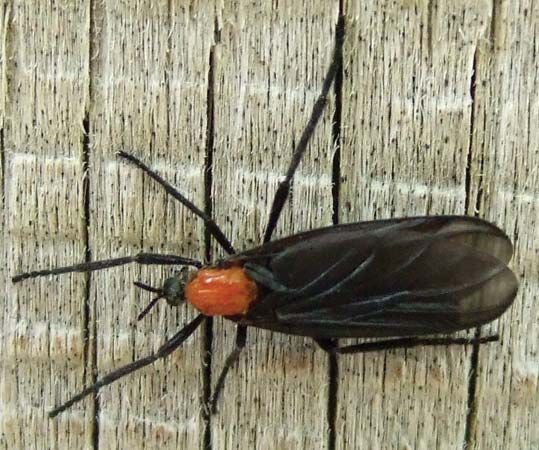
A March fly is any member of the insect family Bibionidae, which belongs to the order Diptera. These stout, compact, and well-armoured flies are commonly…
What is March fly?
A March fly is any member of the insect family Bibionidae, which belongs to the order Diptera. These stout, compact, and well-armoured flies are commonly observed around flowers during the spring and early summer in the Northern Hemisphere.12
Adult March flies are typically dark in color and often feature distinct red or yellow markings. Their larvae are found in soil, where they feed on decaying vegetation and plant roots; occasionally, they may become agricultural pests.12
It is important to note that the common name “march fly” can be confusing, as it is also used in Australia to refer to members of the family Tabanidae—a group that includes horseflies and deerflies. Additionally, the term should not be confused with “marsh fly,” which refers to the family Sciomyzidae, a group of flies whose larvae are known to prey on snails and other mollusks.234
How do the larvae of March flies affect garden plants?
The larvae of March flies (family Bibionidae) primarily reside in the soil, where they consume decaying vegetation and plant roots. While they are generally considered part of the soil ecosystem, they can occasionally become agricultural or horticultural pests when their feeding habits impact the health of garden plants.1
Because these larvae are soil-dwellers, they retain a primitive tracheal system that allows them to distribute oxygen while living underground. Their impact on gardens is typically linked to this root-feeding behavior, which can damage or weaken plants if the larvae are present in significant numbers.61
What are the main differences between March flies and horse flies?
March flies and horse flies are distinct insects belonging to different families within the order Diptera. While the name “March fly” is sometimes used in Australia to refer to horse flies, they are biologically separate groups.1
Key Differences
Feature
March Fly
Horse Fly
Family
Bibionidae
Tabanidae
Adult Diet
Typically nectar; often seen around flowers
Females are bloodsuckers; males feed on nectar and sap
Larval Habitat
Soil; feed on decaying vegetation and roots
Streams, marshes, and wooded areas
Human Impact
Generally harmless, though larvae can be minor plant pests
Females can be serious pests to humans and animals due to painful bites
Disease Risk
Not typically associated with disease transmission
Can carry diseases like
anthrax
and
tularemia
Distinguishing Characteristics
- March Flies: These are stout, dark insects often marked with red or yellow. They are most active in spring and early summer and are primarily known for their soil-dwelling larvae that feed on plant roots and organic matter.79
- Horse Flies: These are strong, fast fliers ranging in size from a housefly to a bumblebee. Females possess bladelike, piercing mouthparts used to feed on blood, which is necessary for egg production. They are known for their metallic or iridescent eyes.810
Why are marsh flies considered helpful for controlling snail populations?
Marsh flies (family Sciomyzidae) are considered helpful for controlling snail populations because their larvae are specialized parasites that prey on slugs, snails, and other mollusks.
These flies typically lay their eggs directly on the host animal. Once the larvae hatch, they feed upon the host, often consuming it entirely. In many cases, the larva will eventually pupate inside the shell of the snail it has consumed. Because of this predatory behavior, marsh flies serve as a natural biological control agent for these mollusks in their native marshy habitats.3
Sources
- March fly — Encyclopædia Britannica
- Diptera - Annotated classification — Encyclopædia Britannica
- marsh fly — Encyclopædia Britannica
- List of insects - flies (order Diptera ) — Encyclopædia Britannica
- biting midge — Encyclopædia Britannica
- Diptera - Larvae — Encyclopædia Britannica
- horse fly — Encyclopædia Britannica
- March fly — Merriam-Webster
- Diptera - Importance — Encyclopædia Britannica
- List of flies — Encyclopædia Britannica
- Diptera - General features — Encyclopædia Britannica
Published on · 3 min read