Margay
The margay (Leopardus wiedii) is a small cat native to the Americas. Its range extends across South America and Central America, reaching as far north as…
In which regions of the world can margays be found?
The margay (Leopardus wiedii) is a small cat native to the Americas. Its range extends across South America and Central America, reaching as far north as Mexico and, on rare occasions, into the extreme southern United States.12
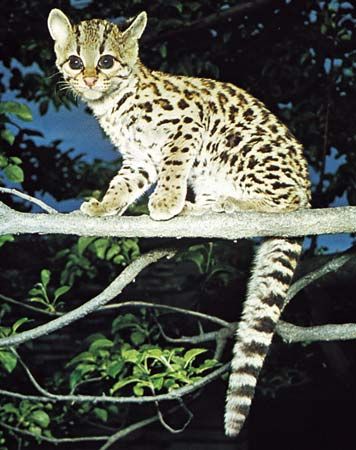
These felines are primarily forest-dwelling animals and are highly adapted for an arboreal lifestyle, possessing specialized claws and feet that allow them to navigate tree trunks and branches with agility. While they resemble the ocelot, they are distinguished by their longer tails and larger eyes.1
How does the margay’s size compare to other small wild cats?
The margay (Leopardus wiedii) is a small cat that is generally smaller than its close relative, the ocelot.13
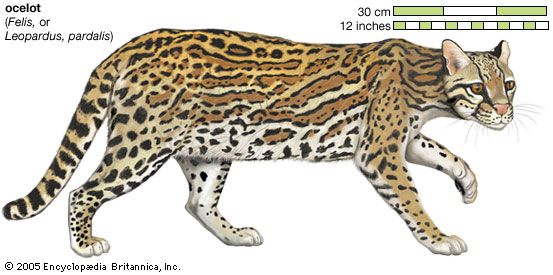
While the margay can reach a maximum length of about 1.1 meters (3.5 feet)—including a tail of approximately 46 cm (18 inches)—and weigh up to 16 kg (35 pounds), it is physically distinct from the ocelot in several ways. The ocelot is larger overall, with a body length of 70–90 cm (28–35 inches) excluding the tail, and it possesses a tail that is notably shorter than its hind leg. In contrast, the margay is highly adapted for an arboreal lifestyle, featuring a longer tail and a fuller face with larger eyes compared to the ocelot. Both species are larger than the average domestic cat, yet they remain small when compared to larger felines such as the jaguar.13
What is the typical diet of a margay, and how does it hunt?
The margay (Leopardus wiedii) is a cat that lives primarily in forest environments. While scientific knowledge regarding its specific habits remains limited, it is understood to be a nocturnal predator.
Its diet consists of small prey, including:
- Birds
- Frogs
- Insects
The margay is largely arboreal, meaning it spends much of its time in trees. It is physically specialized for this lifestyle, possessing unique claws and feet that allow it to move with ease along branches and scamper up tree trunks to hunt or navigate its habitat.1
What are the distinguishing physical characteristics of a margay?
The margay (Leopardus wiedii) possesses several distinct physical characteristics that adapt it for its primarily arboreal lifestyle. Key features include:
- Facial Structure: It has a fuller face compared to the related ocelot, which is emphasized by large, dark eyes and rounded ears.1
- Tail: The margay is characterized by a notably long tail, which is relatively longer in females.1
- Size: Males can reach a maximum length of approximately 1.1 meters (3.5 feet), including a tail of about 46 cm (18 inches), and weigh up to 16 kg (35 pounds). Females are generally smaller.1
- Coat: Its coloration ranges from pale gray to deep brown, featuring dark markings such as spots, stripes, bands, and black-edged blotches.1
- Specialized Anatomy: The margay has specially adapted claws and feet that enable it to navigate tree trunks and branches with ease.1
Sources
- margay — Encyclopædia Britannica
- margay — Merriam-Webster
- ocelot — Encyclopædia Britannica
Published on · 2 min read