Marmoset
Marmosets exhibit unique reproductive and social behaviors within the family Callitrichidae. Their gestation period typically lasts between four and six…
How do marmosets reproduce and care for their young?
Marmosets exhibit unique reproductive and social behaviors within the family Callitrichidae. Their gestation period typically lasts between four and six months, and they most commonly give birth to twins, though single births and triplets also occur.1
“True” marmosets (genus Callithrix) generally breed in monogamous pairs. Their social structure is highly cooperative; older offspring assist the breeding pair by feeding, carrying, and educating the infants. Within these groups, the presence of the breeding pair physiologically suppresses the sexual development of younger members of both sexes until they leave the group.1
In contrast, some tamarins may utilize a polyandrous system where two males share in the rearing of a single female’s infants. For these species, reproductive suppression appears to be behavioral rather than physiological. While most mammals do not form pairs, marmosets are notable exceptions where parental care is shared between the sexes.12

Where are marmosets primarily found in the wild?
Marmosets are small primates native to South America. Their distribution varies by group and species, but they are primarily found within the following regions:
- Brazil: Many species, including the common marmoset, inhabit the scrub forests (caatinga) of northeastern Brazil and various tropical forests along the Atlantic coast. Others are found in the rainforests south of the Amazon River.1
- Amazon Basin: Various species, such as pygmy marmosets and Goeldi’s monkeys, reside in the Amazon River basin, particularly within the upper tributaries and the southwestern regions.1
- Other Regions: Certain species, like the cotton-top tamarin, are found in countries such as Colombia and Panama.1
These tree-dwelling monkeys are highly adapted to their specific forest environments, ranging from dense rainforests to fragmented forest habitats.1
What is the typical diet of marmosets, and how does it impact their role in their ecosystem?
Marmosets are small, omnivorous primates that maintain a diverse diet consisting primarily of insects, fruit, tree sap, and other small animals.1
Their dietary habits are closely linked to their physical adaptations and ecological role:
- Specialized Feeding: “True” marmosets (genus Callithrix) possess specialized teeth—short lower canines and long lower incisors—that allow them to gnaw into tree bark. This creates characteristic notches from which sap flows, providing a consistent food source.1
- Ecological Constraints: As small-bodied primates, marmosets fall under “Kay’s threshold,” an approximate 500-gram limit that influences their dietary choices. Because they are small, they can efficiently meet their energy needs by foraging for high-protein insects and energy-rich sap, whereas larger animals would struggle to capture enough insects to sustain themselves.3
- Ecosystem Impact: By feeding on sap and insects, marmosets interact directly with forest vegetation and insect populations. Their foraging behavior, particularly the creation of sap-flow notches, can influence the health and structure of the trees they inhabit.1
What are some of the different species of marmosets?
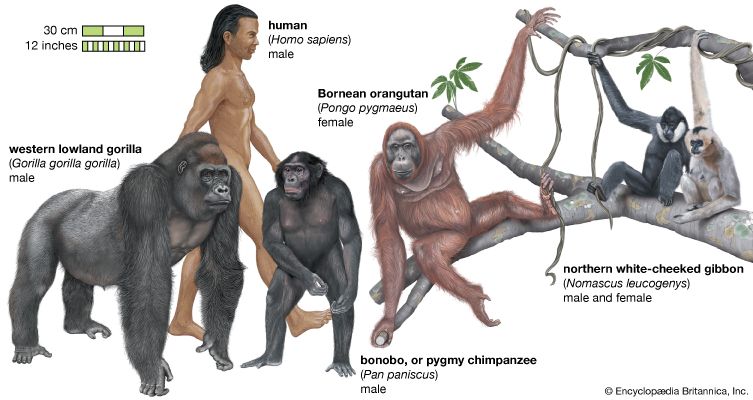
Marmosets belong to the family Callitrichidae and are categorized into three primary groups: “true” marmosets, tamarins, and Goeldi’s monkey.
True Marmosets (Genus Callithrix)
These species are characterized by short lower canine teeth, which they use alongside long lower incisors to gnaw into tree bark for sap.1
- Pygmy Marmosets (C. pygmaea and C. niveiventris): The smallest “true” marmosets, weighing only about 90 grams.1
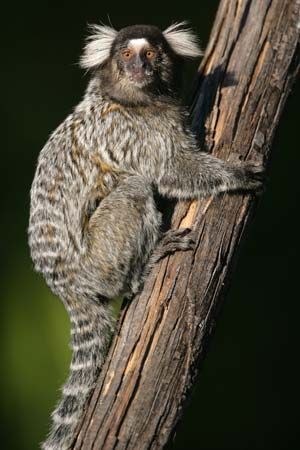
- Common Marmoset (C. jacchus): Known for its marbled brown-and-white fur, white ear tufts, and ringed tail.1
- Atlantic Coast Species: There are five Callithrix species inhabiting Brazil’s Atlantic coast, with over a dozen additional species identified in the rainforests south of the Amazon River.1
Tamarins (Genera Saguinus and Leontopithecus)
Tamarins are distinguished by their relatively long lower canine teeth.1
- Lion Tamarins (Leontopithecus): Known for their thick manes. This group includes the golden lion tamarin and the critically endangered black-faced lion tamarin.1
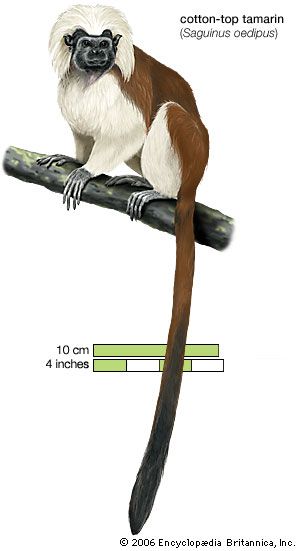
- Genus Saguinus: This group contains at least 12 species, such as the cotton-top tamarin, the emperor tamarin, and the mustached tamarin.1
Goeldi’s Monkey (Callimico goeldi)
Also known as Goeldi’s marmoset, this species is found in the western Amazon River basin. It is distinct from other marmosets due to its black color, the presence of a third set of molars, and its reproductive habits.1
Sources
- marmoset — Encyclopædia Britannica
- Reproductive behaviour - Mammals — Encyclopædia Britannica
- primate - Diet — Encyclopædia Britannica
Published on · 3 min read