Crest-tailed Marsupial Rat
The crest-tailed marsupial rat (Dasyuroides byrnei) is a rare, ratlike mammal belonging to the family Dasyuridae. Native to the desert and grasslands of…
What is crest-tailed marsupial rat?
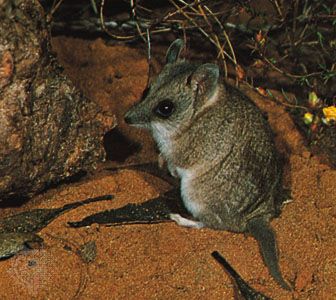
The crest-tailed marsupial rat (Dasyuroides byrnei) is a rare, ratlike mammal belonging to the family Dasyuridae. Native to the desert and grasslands of central Australia, this species is entirely terrestrial and nocturnal, typically living in ground burrows.1
Physically, it averages about 17.5 cm (7 inches) in length with a 13.5-centimetre (5-inch) tail. While its fur is generally a light gray, the distal portion of its tail is distinctively crested with long black hairs on both the upper and lower sides. Like other members of the Dasyuridae family, the crest-tailed marsupial rat is highly carnivorous.1
It is important to distinguish this animal from the crest-tailed marsupial mouse, also known as the mulgara (Dasycercus cristicauda), which is a separate arid-land species.2
What are the main differences between dasyurids and other marsupials?
Dasyurids (family Dasyuridae) are a distinct group of marsupials primarily defined by their carnivorous diet and specific ecological roles, which set them apart from the broader, more herbivorous-leaning marsupial population.45
The main differences between dasyurids and other marsupials include:
- Dietary Specialization: While many marsupials, such as kangaroos and wombats, are strictly or primarily herbivorous, dasyurids are highly carnivorous. They feed chiefly on insects and other small animals, filling ecological niches similar to those occupied by shrews or cats in other parts of the world.45
- Taxonomic Classification: Dasyurids belong to the order Dasyuromorphia, which is distinct from the order Diprotodontia—a group that contains the majority of well-known marsupials like koalas, possums, and macropodids.5
- Behavioral and Physical Traits: Dasyurids exhibit high energy needs due to their active, insectivorous lifestyles. For example, dunnarts must consume their own body weight in food daily to sustain their metabolism. Unlike the larger, often social “mobs” of grazing marsupials, most dasyurids do not exhibit complex social organizations.4
While all marsupials share fundamental traits—such as giving birth to underdeveloped young that continue development in a pouch or attached to teats—dasyurids represent a specialized branch of the infraclass Metatheria that has adapted to thrive as predators in Australasian environments.45
How do nocturnal animals like the crest-tailed marsupial rat adapt to desert environments?
Nocturnal animals like the crest-tailed marsupial rat utilize a combination of behavioral and physiological strategies to survive the harsh conditions of desert environments.
Behavioral Adaptations
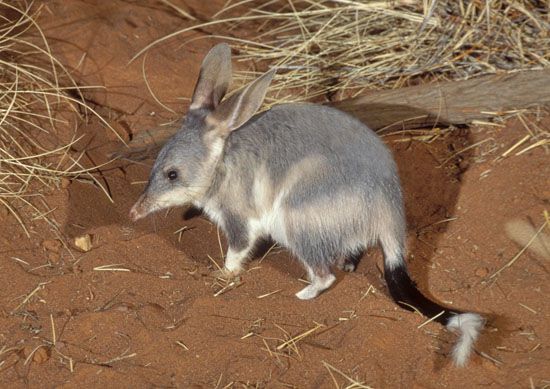
The most significant behavioral adaptation for these animals is their nocturnal and burrowing lifestyle. By remaining in underground burrows during the day, they avoid the extreme heat and low humidity of the desert surface, which helps minimize water loss through evaporation and prevents overheating. Many desert-dwelling marsupials, such as the bilby, construct multiple burrows within their home range to serve as protected hiding spots from both daytime heat and predators.8910
Physiological Mechanisms
To manage water and temperature, these animals rely on several physiological traits:
- Water Conservation: Desert animals typically possess skin that is relatively impervious to water, reducing loss through the integument.8
- Respiratory Efficiency: To minimize water loss during breathing, many desert animals cool their exhaled air. As warm, dry air is inhaled, it cools the nasal passages; when the animal exhales, moisture from the lungs condenses in the nose and is reabsorbed rather than lost to the environment.8
- Metabolic Regulation: In response to extreme heat or food shortages, some endotherms may enter a state of torpor or estivation, which depresses their metabolic rate, heart rate, and body temperature to conserve energy and water.1
What other types of carnivorous marsupials are found in Australia?
In Australia, carnivorous marsupials are primarily classified within the order Dasyuromorphia, which contains approximately 60 species6. These animals occupy various ecological niches, often serving as the functional equivalents of placental carnivores like cats, shrews, or hyenas.4
Key types of carnivorous marsupials found in Australia include:
- Dasyurids (Family Dasyuridae): This diverse family includes many well-known species such as:
- Quolls: Cat-sized predators that are among the most recognizable Australian carnivores.136
- Tasmanian Devil: The largest living carnivorous marsupial, known for its powerful jaws and scavenging habits.64
- Small insectivores: This group includes dunnarts, antechinus, planigales, kowari, and phascogales, which are highly active and have high metabolic rates to support their insect-based diets.1354
- Numbat (Family Myrmecobiidae): A specialized, termite- and ant-eating marsupial that uses a long, sticky tongue to forage.54
- Extinct Species: Australia was once home to the thylacine (or Tasmanian wolf), a large, dog-like carnivorous marsupial that was driven to extinction on the mainland following the introduction of the dingo of the dingo.5
While some other marsupials, such as bandicoots, consume a mixed diet of insects and plant material, the species listed above are the primary groups specialized for a carnivorous lifestyle.54
Sources
- crest-tailed marsupial rat — Encyclopædia Britannica
- rat kangaroo — Encyclopædia Britannica
- marsupial mouse — Encyclopædia Britannica
- dasyurid — Encyclopædia Britannica
- marsupial — Encyclopædia Britannica
- marsupial - Classification — Encyclopædia Britannica
- List of marsupials — Encyclopædia Britannica
- Biosphere - Humidity — Encyclopædia Britannica
- Do Camels Store Water in Their Humps? — Encyclopædia Britannica
- bilby — Encyclopædia Britannica
- climatic adaptation — Encyclopædia Britannica
- Biosphere - Temperature — Encyclopædia Britannica
- Tasmanian devil — Encyclopædia Britannica
- Diprotodon — Encyclopædia Britannica
Published on · 3 min read