Mauna Kea
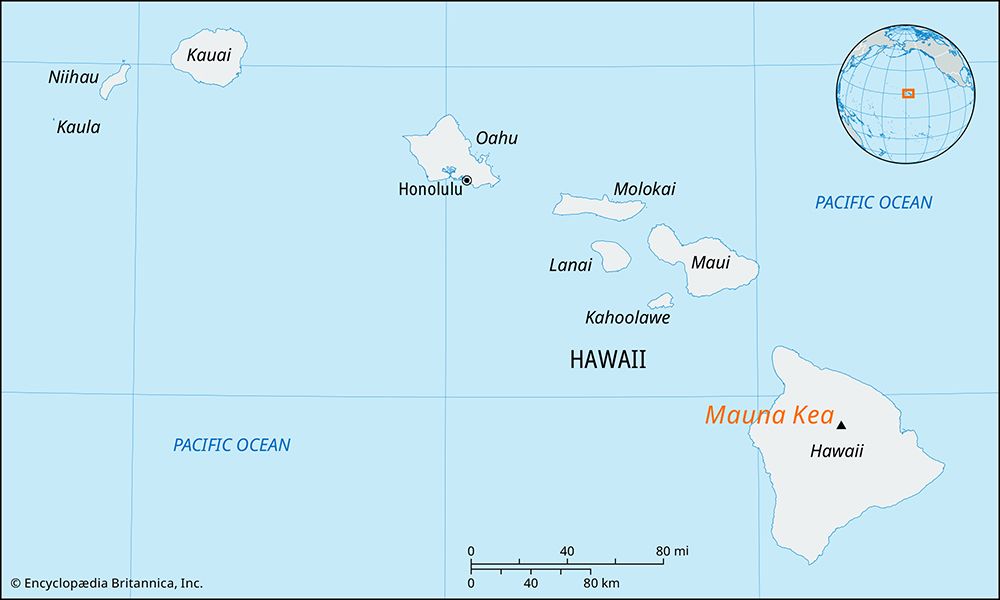
Mauna Kea is a dormant volcano located in the north-central part of the island of Hawaii, in the state of Hawaii, U.S. Standing at 13,796 feet (4,205 meters)…
What is Mauna Kea and where is it located in Hawaii?
Mauna Kea is a dormant volcano located in the north-central part of the island of Hawaii, in the state of Hawaii, U.S. Standing at 13,796 feet (4,205 meters) above sea level, it is the highest point in the state.12
The name Mauna Kea translates to “White Mountain,” a reference to the fact that the peak is often snowcapped. The mountain is home to the Mauna Kea Observatory, which is recognized as one of the most important astronomical observatories in the world due to its high elevation, clear air, and stable weather conditions. Historically, the site was also significant to ancient Hawaiians, who quarried basalt from high-altitude caves to create tools.13
What is the geological history of Mauna Kea and how was it formed?
Mauna Kea is a dormant shield volcano located on the island of Hawaii. Its formation is part of the broader geological evolution of the Hawaiian Islands, which are created as the Pacific Plate moves over a stationary mantle plume of molten rock.13
As a shield volcano, Mauna Kea was built over a long period by numerous effusive eruptions of fluid basalt, resulting in a broad, dome-shaped structure. It is older than its neighbor, Mauna Loa, which is reflected in its more pronounced geological dissection—the process by which erosion creates ravines and valleys on the volcano’s flanks.143
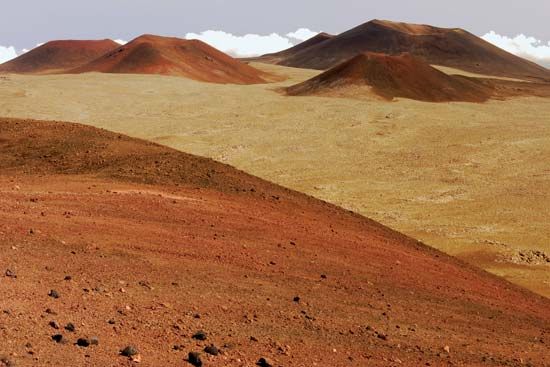
The mountain’s surface has been shaped by various environmental factors over time. During the Ice Age, a glacier covered the peak, and the volcano features numerous cinder cones across its 30-mile-wide dome. While it last erupted approximately 4,500 years ago, its history is also marked by the deposition of ash, which has influenced the development of drainage patterns on its slopes.13
What types of research are conducted at the observatories on Mauna Kea?
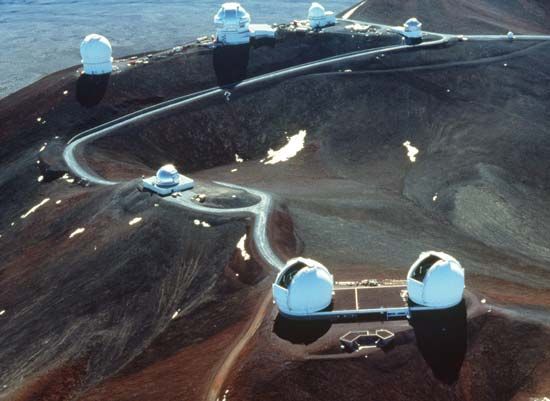
The observatories on Mauna Kea are world-renowned for their ability to conduct advanced astronomical research, facilitated by the site’s high elevation and exceptionally clear, dry air. Because the summit sits above 40 percent of the Earth’s atmosphere, it is uniquely suited for observations that would otherwise be obscured by water vapor.2
Research conducted at these facilities includes:
- Infrared and Submillimetre Astronomy: Mauna Kea hosts one of the world’s most significant collections of telescopes designed for infrared, submillimetre, and millimetre wavelengths, which are essential for studying distant stellar objects.2
- Optical Observations: Large optical telescopes, such as the Keck telescopes, the Subaru, and Gemini North, perform deep-space imaging and spectroscopy.2
- Planetary and Galactic Studies: Research includes tracking planetary transits, such as the first observation of a planet eclipsing its star, and studying the orbits of stars around the center of the Milky Way Galaxy, which provided evidence for a massive black hole.6
- Solar System Exploration: Telescopes are used to discover and characterize objects within our solar system, including dwarf planets and their moons.6
Why is Mauna Kea considered a dormant volcano, and when was its last eruption?
Mauna Kea is classified as a dormant volcano because, while it has not erupted in approximately 4,500 years, it remains an active volcano with the potential to erupt again in the future.17
In geological terms, volcanoes are categorized based on their recent activity. An “active” volcano is defined as one that has erupted within the last 10,000 years. Within this category, a “dormant” volcano is one that is currently quiet but retains the potential for future eruptions, distinguishing it from an “extinct” volcano, which has not erupted in over 10,000 years and is considered unlikely to erupt again.7
Mauna Kea’s last eruption occurred about 4,500 years ago. Despite this long period of inactivity, it is not considered extinct, and it remains a subject of monitoring due to its potential for future volcanic activity.17
Sources
- Mauna Kea — Encyclopædia Britannica
- Mauna Kea Observatory — Encyclopædia Britannica
- Mauna Kea — Merriam-Webster
- volcano - Shield volcanoes — Encyclopædia Britannica
- valley - Valley evolution in Hawaii — Encyclopædia Britannica
- Keck Observatory — Encyclopædia Britannica
- Are Volcanoes Dangerous When They’re Not Erupting? — Encyclopædia Britannica
Published on · 3 min read