Makālu
Makālu is one of the world’s highest mountains, standing at an elevation of 27,766 feet (8,463 meters) in the Himalayas along the border between Nepal and…
What is Makālu?
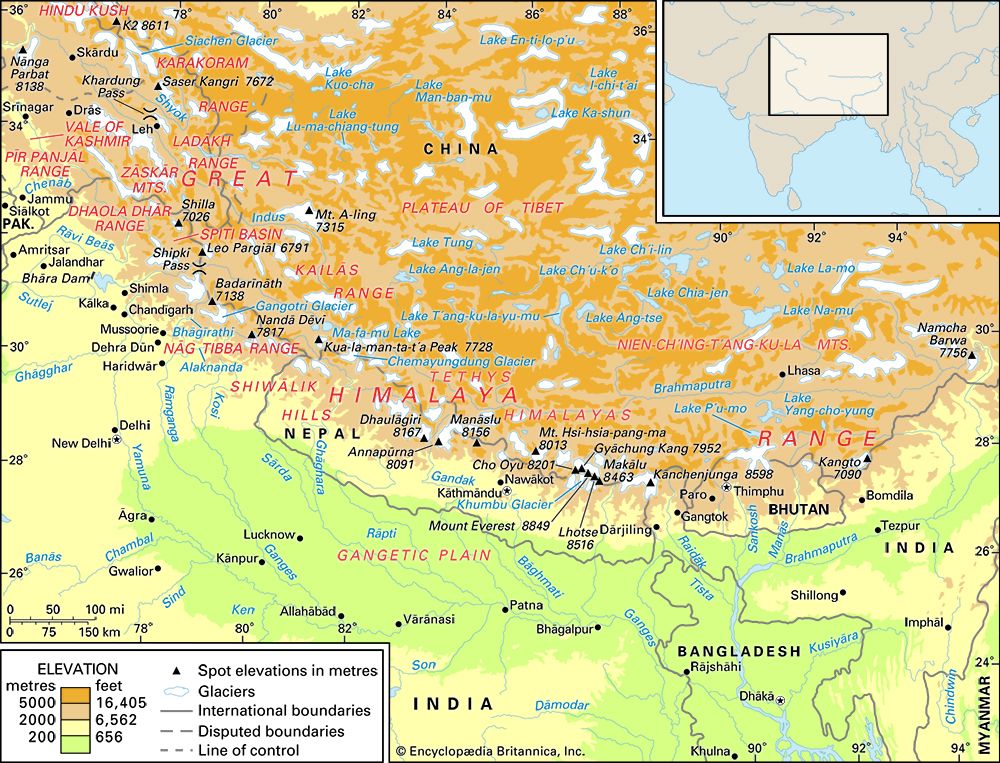
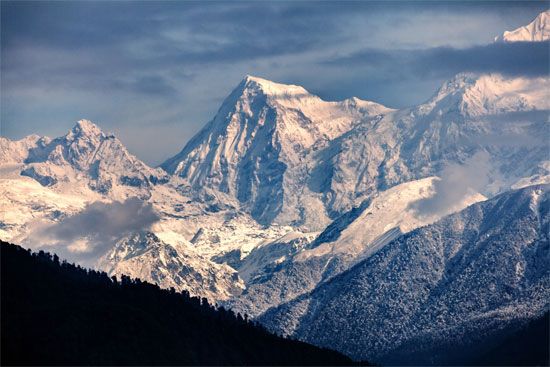
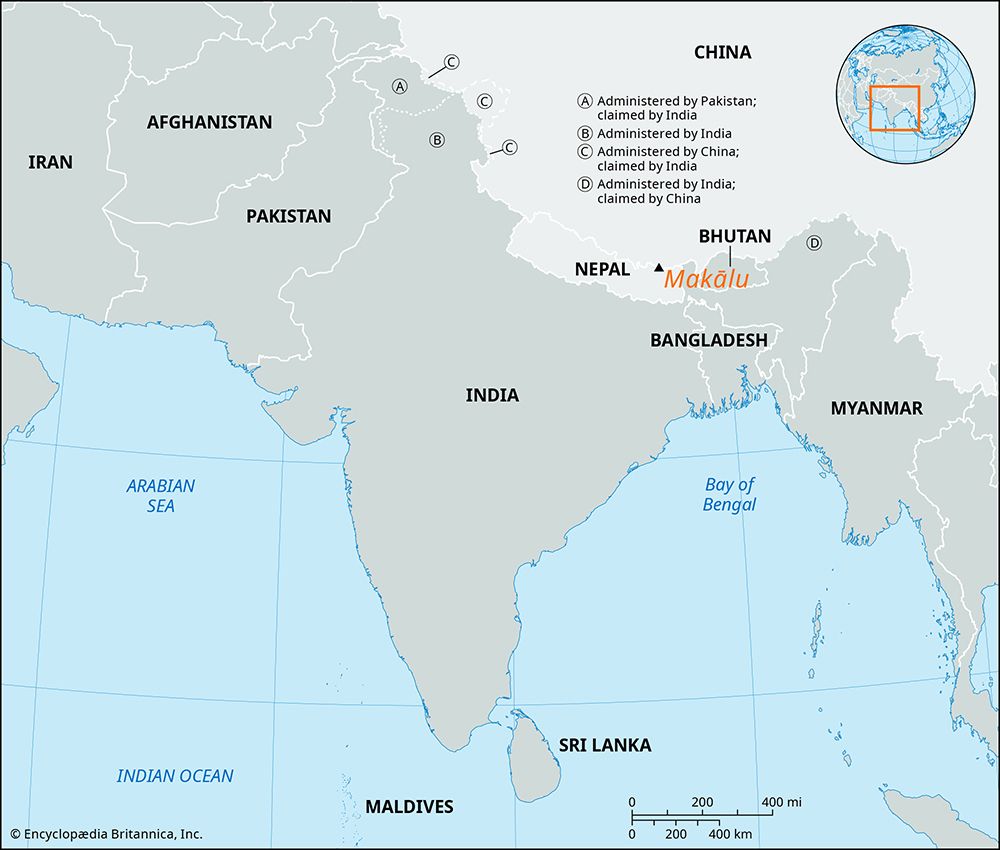
Makālu is one of the world’s highest mountains, standing at an elevation of 27,766 feet (8,463 meters) in the Himalayas along the border between Nepal and Tibet (China). Located 14 miles (23 km) east-southeast of Mount Everest, it is recognized as the fifth-highest mountain in the world.12
While the mountain was observed by climbers during expeditions to Mount Everest, serious attempts to ascend its steep, glacier-covered slopes did not commence until 1954. The first successful summit was achieved on May 15, 1955, by Jean Couzy and Lionel Terray, members of a French expedition, with seven additional climbers reaching the peak within the following two days.1
How does Mount Makalu compare to Mount Everest in difficulty?
Comparing the difficulty of Mount Makalu and Mount Everest involves understanding the unique challenges of high-altitude mountaineering. While both are located in the Himalayas and reach extreme elevations, they present different technical and environmental hurdles.
- Mount Everest: Known for its extreme isolation and the physiological toll of the “death zone” (above 25,000 feet), Everest presents significant risks related to hypoxia, unpredictable weather, and avalanches. Its difficulty is compounded by the logistical challenge of reaching its remote base camps and the necessity of managing supplemental oxygen usage at high altitudes.1
- Mount Makalu: Standing at 27,766 feet (8,463 meters), Makalu is characterized by its steep, glacier-covered sides. Although it is a neighbor to Everest, its specific topography requires technical climbing skills to navigate its challenging slopes.34
While Everest is often cited as the ultimate human challenge due to its height and environmental severity, other peaks in the region, such as Kanchenjunga, are frequently noted as being among the world’s most difficult mountaineering challenges.4
What are the other mountains that make up the world’s highest peaks?
When discussing the world’s highest peaks, mountaineers often focus on the “Seven Summits”—the highest mountains on each of the seven continents. However, classification can vary based on geographical perspectives, such as whether Europe and Asia are considered separate or as the single continent of Eurasia, or whether Australia is defined in isolation or as part of Oceania.5
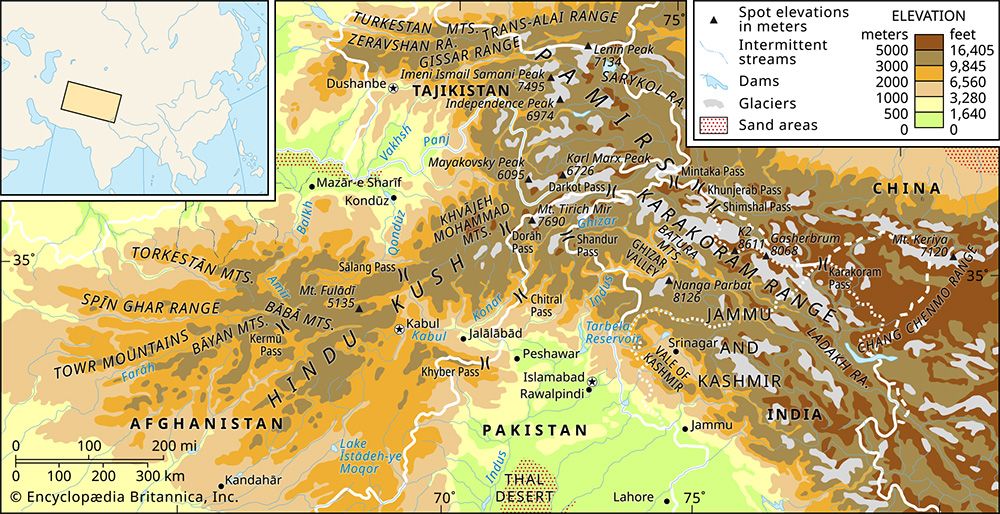
Beyond these continental high points, the world’s most elevated mountains are concentrated in Asia, particularly within the Himalayas and the Karakoram Range. Notable peaks include:
- Mount Everest: The world’s highest mountain at 29,035 feet (8,850 meters).6
- K2: Located in the Karakoram range, reaching 28,251 feet (8,611 meters).6
- Kanchenjunga: Situated in the Himalayas, standing at 28,169 feet (8,586 meters).6
- Lhotse I: Also in the Himalayas, with an elevation of 27,940 feet (8,516 meters).6
While Everest holds the record for the highest elevation above sea level, other mountains claim “tallest” status based on different metrics. For example, Mauna Kea is the tallest when measured from base to peak, and Chimborazo is the farthest point from the Earth’s center.7
What kind of climate and wildlife are found in the Himalayas?
The Himalayas function as a major climatic divide, significantly influencing weather patterns across the Indian subcontinent and Central Asia. By obstructing cold northern air and forcing moisture-laden monsoon winds to rise and condense, the range creates heavy precipitation on its southern slopes while leaving regions like Tibet in an arid rain shadow.1112
Climatic conditions vary drastically by elevation and exposure. The foothills experience tropical climates, while the highest peaks endure extreme, Arctic-like conditions. Temperatures drop sharply with altitude; for instance, while lower elevations may be pleasantly warm, areas near Mount Everest can see temperatures fall well below zero.1211
The region’s wildlife is equally diverse, often categorized by geography and elevation:
- Foothills and Forests: The humid Tarai region and lower forests host Indian elephants, Indian rhinoceroses, Asiatic black bears, clouded leopards, and various primates like langurs.131415
- High Elevations: Remote, high-altitude areas are home to snow leopards, brown bears, lesser pandas, and Tibetan yaks.1315
- Above the Tree Line: In the highest reaches, life is dominated by insects, spiders, and mites, which are the only animals capable of surviving at extreme altitudes.1315
Sources
- Makālu — Encyclopædia Britannica
- Makalu — Merriam-Webster
- Mount Everest - The human challenge — Encyclopædia Britannica
- mountaineering - History — Encyclopædia Britannica
- The World’s Highest Mountains by Continent — Encyclopædia Britannica
- Manāslu I — Encyclopædia Britannica
- Himalayas - Study and exploration — Encyclopædia Britannica
- Is Mount Everest Really the Tallest Mountain in the World? — Encyclopædia Britannica
- Himalayas: Top Questions — Encyclopædia Britannica
- mountain - Selected world mountains — Encyclopædia Britannica
- Exploring 7 of Earth’s Great Mountain Ranges - Himalayas — Encyclopædia Britannica
- Himalayas - Climate of the Himalayas — Encyclopædia Britannica
- India - Mammals — Encyclopædia Britannica
- Asia - The influence of topography — Encyclopædia Britannica
- Himalayas - Plant life — Encyclopædia Britannica
- Himalayas - Animal life — Encyclopædia Britannica
- human respiratory system - High altitudes — Encyclopædia Britannica
Published on · 3 min read