Mauritius Hemp
It is a common misconception that Mauritius hemp (Furcraea foetida) is a type of true hemp; in reality, it is a member of the asparagus family (Asparagaceae)…
What are the environmental benefits of using Mauritius hemp?
It is a common misconception that Mauritius hemp (Furcraea foetida) is a type of true hemp; in reality, it is a member of the asparagus family (Asparagaceae) and is classified as a leaf fibre plant.1
Regarding your query, the provided information does not contain data concerning the environmental benefits of cultivating or using Mauritius hemp. The available records focus on the plant’s botanical characteristics, its history of cultivation, and the industrial processes used to extract its fibres for products like bagging and cordage.12
What role does Mauritius hemp play in sustainable textile production?
Mauritius hemp (Furcraea foetida) is a leaf fibre plant belonging to the asparagus family. While it is not a true hemp, it is categorized alongside other natural fibres that play a role in sustainable material production.1
As a natural leaf fibre, Mauritius hemp is biodegradable. This characteristic makes it a more ecologically sustainable alternative to synthetic materials like polyester or nylon, which are derived from fossil fuels.2
In terms of utility, the fibre is primarily used for industrial applications such as bagging, cordage, and coarse fabrics. It is noted for being softer and finer than other leaf fibres like sisal and henequen, and it possesses a good affinity for dyes. Although it is a sustainable, plant-based resource, its use in textiles is often limited by the labor-intensive nature of harvesting and the processing requirements of decortication.12
Are there any challenges in the production or processing of Mauritius hemp?
The production and processing of Mauritius hemp (Furcraea foetida) involve several notable challenges that limit its widespread industrial use:
- Labor-Intensive Requirements: Like other leaf fibres, Mauritius hemp is highly labor-intensive to harvest. The leaves must be collected, and the fibre must be separated from the surrounding leaf tissue through decortication—a scraping or peeling process—before being cleaned and dried.13
- Processing Limitations: While machine decortication is commonly used, the process is sometimes preceded by several days of retting, adding complexity to the production cycle. Furthermore, many potentially useful natural fibres remain unexploited due to the limitations of existing cultivation and processing methods, which struggle to compete with the efficiency of synthetic alternatives.13
- Environmental Vulnerability: Although the fibre is fairly resistant to deterioration in fresh water, it is subject to damage when exposed to salt water, which restricts its suitability for certain maritime or outdoor applications.1
- Physical Properties: While the fibre is valued for being softer and finer than sisal or henequen, it is not as strong, which may limit its utility in heavy-duty cordage.1
What is Mauritius hemp and where does it originate from?
Mauritius hemp (Furcraea foetida) is a plant belonging to the asparagus family (Asparagaceae) and is a member of the leaf fibre group. Despite its name, it is not a true hemp.1
The plant is native to Brazil, where commercial fibre production began around 1875. It was later introduced to Mauritius in the late 18th century, and by the late 19th century, cultivation had expanded to East Africa, Sri Lanka, and St. Helena.1
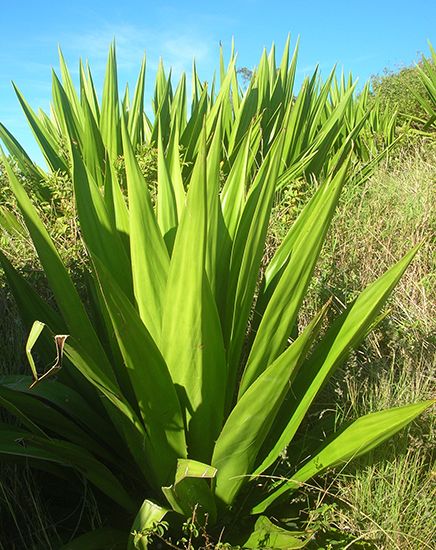
The plant is characterized by a dense rosette of long, lance-shaped leaves that can reach up to 2.1 metres (7 feet) in length. It is primarily cultivated for its creamy white fibres, which are used to manufacture bagging, coarse fabrics, and cordage. While it is softer and finer than other leaf fibres like sisal and henequen, it is generally not as strong.1
Sources
- Mauritius hemp — Encyclopædia Britannica
- Mauritius hemp — Merriam-Webster
- leaf fiber — Encyclopædia Britannica
Published on · 3 min read