Lark
Larks belong to the songbird family Alaudidae, which comprises approximately 90 species. They are primarily ground-dwelling birds found throughout the Old…
What are the defining characteristics of larks as a bird species?
Larks belong to the songbird family Alaudidae, which comprises approximately 90 species. They are primarily ground-dwelling birds found throughout the Old World, with the horned lark being the only species native to the New World.12
Key characteristics include:
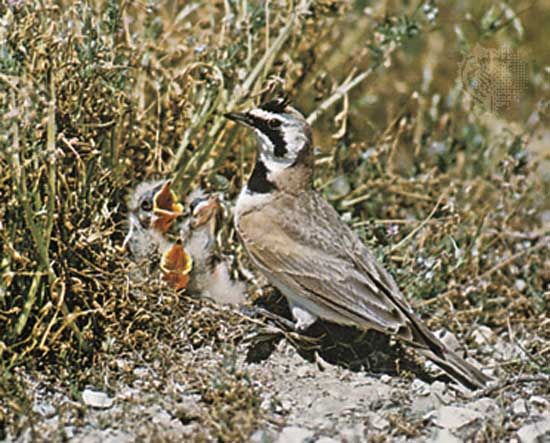
- Physical Appearance: Larks typically measure between 13 and 23 cm (5 to 9 inches) in length. Their plumage is generally plain or streaked in colors that camouflage well with the soil. Their bills are variable, ranging from small and conical to long and downward-curving, and they possess a notably long, sometimes straight, hind claw.1
- Behavior: These birds are often found in flocks, foraging for seeds and insects on the ground.1
- Vocalization: All species are known for high, thin, melodious voices. During courtship, males often sing while in flight or audibly clap their wings. The skylark is particularly famous for its rich, sustained song delivered while airborne.13
Where are larks typically found, and what types of habitats do they prefer?
Larks are primarily found throughout the continental Old World, with the horned lark being the only species native to the New World. While the skylark has been introduced to regions such as Australia, New Zealand, and parts of North America, their natural distribution is centered in the Eastern Hemisphere.1
Regarding their habitat preferences, larks are generally ground-dwelling birds that occupy a variety of open environments. Their specific habitat depends on the species:1
- Desert Environments: Certain species, such as the desert lark, are specifically adapted to the arid deserts of Asia and Africa.6
- Bushy and Wooded Areas: Other species, known as bush larks, frequent areas with more vegetation, such as bushy or wooded landscapes.7
Because they forage for seeds and insects on the ground, their plumage has evolved to match the color of the soil, providing essential camouflage in these diverse terrains.1
What are some of the different species of larks, and how do they differ?
The family Alaudidae includes approximately 90 species of larks. While they share common traits such as terrestrial habits and elongated hind claws, they exhibit significant diversity in their physical features and behaviors.18
- Horned Lark: Notable as the only lark species native to the New World, it is distinct from its Old World relatives.1
- Skylark: A common Old World species, it is widely recognized for its rich, sustained song, which the male typically delivers while in flight.19
- Variations in Morphology: Species differ significantly in their bill structure, which ranges from small and narrowly conical to long and downward-curving, reflecting adaptations to different foraging needs.1
It is important to note that the name “lark” is sometimes applied to birds in other families due to habitat similarities, such as the meadowlark, songlark, and pipit, which are not members of the Alaudidae family.1
How do larks’ migratory patterns differ from other bird species, if they migrate at all?
Larks are migratory birds, but their patterns differ from many other species due to their high sensitivity to environmental conditions. Unlike birds that migrate with remarkable regularity regardless of weather, larks rely on surrounding conditions—specifically temperature and barometric pressure—to initiate their spring and autumn migrations.1
Key aspects of their migratory behavior include:
- Weather Dependency: Because their flight patterns are dictated by immediate environmental factors, larks lack the rigid, clock-like arrival and departure schedules seen in less weather-dependent species like swifts or swallows.1
- Flight Speed: During migration, skylarks have been observed traveling at speeds of 35 to 45 kilometres (22 to 28 miles) per hour.11
- Physiological Preparation: Like other migratory birds, larks undergo internal physiological changes, such as the accumulation of body fat, to prepare for the energy demands of their journey.1
While many birds are highly migratory, others exhibit “partial migration,” where only some populations of a species migrate while others remain sedentary. Larks generally follow the broader trend of passerine migration, though their specific reliance on weather makes them a distinct example of environmentally triggered movement.121
Sources
- Lark — Encyclopædia Britannica
- Songbird — Encyclopædia Britannica
- lark — Merriam-Webster
- Skylark — Encyclopædia Britannica
- larks — Merriam-Webster
- desert lark — Merriam-Webster
- bush lark — Merriam-Webster
- Alaudidae — Merriam-Webster
- skylark — Merriam-Webster
- Woodlark — Merriam-Webster
- Migration - Modes of migration — Encyclopædia Britannica
- Migration - Physiological stimulus of migration — Encyclopædia Britannica
- Migration - Birds — Encyclopædia Britannica
- Migration - In Europe — Encyclopædia Britannica
Published on · 3 min read