Medieval Warm Period
The Medieval Warm Period (MWP), occurring roughly from 900 to 1300 CE, is hypothesized to have brought relatively mild, reliable weather to parts of the…
How did the Medieval Warm Period affect agriculture and human settlements?
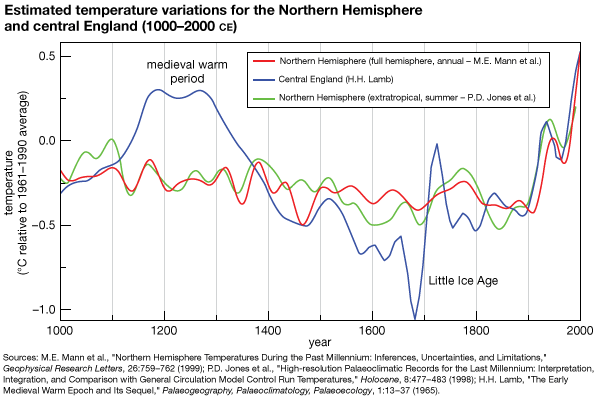
The Medieval Warm Period (MWP), occurring roughly from 900 to 1300 CE, is hypothesized to have brought relatively mild, reliable weather to parts of the Northern Hemisphere, particularly the North Atlantic region and northern Europe.12
Impact on Agriculture
The period’s pleasant conditions and extended growing seasons are often associated with increased agricultural productivity and crop diversity. In northern Europe, warmer temperatures allowed for the cultivation of wheat and the maintenance of vineyards at higher latitudes and elevations than are possible today. Similarly, in the southwestern United States, increased precipitation during this time supported the expansion of vegetation and agriculture.123
Impact on Human Settlements
The favorable climate facilitated significant human expansion and exploration:
- Norse Expansion: Milder climates and reduced sea ice enabled the Vikings to establish settlements in Iceland and southern Greenland, and to venture as far as the coasts of Labrador and Newfoundland Newfoundland.132
- Settlement Patterns: In the Arctic, Inuit populations settled in areas like Ellesmere Island around 900 CE.3
- Regional Variation: While some areas prospered, the MWP was not globally uniform. Some regions, such as the American West and the Asian steppe, experienced severe, multi-decade droughts that challenged local populations.12
How did the end of the Medieval Warm Period lead to the Little Ice Age?
The transition from the Medieval Warm Period (roughly 900–1300 CE) to the Little Ice Age (roughly 1300–1850 CE) was not a direct causal chain where one event triggered the other. Instead, climatologists view these as distinct, overlapping climatic intervals driven by shifts in global environmental factors.71
The end of the warm period and the onset of cooler conditions were likely influenced by several concurrent phenomena:
- Reduced Solar Output: Records indicate a decline in solar activity starting around 1250 CE, reaching a significant low by 1500 CE. Periods of low sunspot activity, such as the Spörer Minimum and Maunder Minimum, coincided with some of the coldest years of the Little Ice Age.76
- Atmospheric Circulation: Many scientists point to a reversal or shift in the North Atlantic Oscillation. A shift to a “negative” phase can funnel cold Arctic air over northern Europe, contributing to the severe winters and wet summers that characterized the era.7
- Volcanic Activity: Explosive volcanism propelled ash and gases into the stratosphere, reflecting solar radiation and cooling the Earth’s surface for years at a time.7
While the Medieval Warm Period was marked by agricultural prosperity, the subsequent cooling led to crop failures, famine, and the abandonment of settlements, such as the Norse colonies in Greenland.76
How did the climate during the Medieval Warm Period compare to today’s temperatures?
Comparing the climate of the Medieval Warm Period (MWP) to modern temperatures is complex, as the MWP was not a globally uniform event. While some regions, such as the North Atlantic and parts of Europe, experienced relatively warm conditions between 900 and 1300 CE, there is little evidence that these temperatures prevailed on a global scale.1
Regional vs. Global Comparisons
- Regional Variability: Evidence for the MWP is most pronounced in the North Atlantic, northern Europe, and parts of North America, where historical records and climate proxies suggest extended growing seasons and warmer summers. However, other regions, such as the Mediterranean and parts of the Southern Hemisphere, show little to no difference in temperature compared to the present day.1
- Scientific Consensus: Calculating a global average temperature for the MWP remains inconclusive. While some early estimates suggested the period was 1–2 °C (1.8–3.6 °F) warmer than early 20th-century conditions in Europe, these figures do not represent a global average.1
- Modern Context: In contrast, modern global warming is characterized by a rapid, widespread increase in atmospheric carbon dioxide levels, which have reached concentrations higher than at any point in at least 800,000 years.8
Ultimately, while the MWP serves as a point of comparison in climate debates, scientists emphasize that the variability of that era was likely driven by natural patterns, whereas current trends are significantly influenced by human activity.18
How does the Medieval Warm Period relate to current discussions about climate change?
The Medieval Warm Period (MWP), a climatic interval roughly between 900 and 1300 CE, is frequently invoked in modern debates regarding climate change. Its role in these discussions is primarily characterized by two opposing perspectives:
- Arguments by Skeptics: Some global warming skeptics cite the MWP as evidence that historical climate fluctuations were natural and that warmer temperatures can be beneficial, particularly for agricultural productivity in northern regions. They often argue that if the Earth was as warm or warmer than today during the Middle Ages, current warming trends may not be as unprecedented or exclusively human-driven as scientific consensus suggests.1
- Scientific Perspective: In contrast, many climate scientists maintain that the MWP provides little evidence to diminish the urgency of modern climate concerns. They emphasize that the MWP was likely a regional phenomenon—most pronounced in the North Atlantic and parts of the Northern Hemisphere—rather than a global one. Furthermore, they note that the variability of that era is well-explained by natural factors like solar radiation and volcanic activity, whereas current warming is driven by rapid, human-induced increases in greenhouse gases.19
Ultimately, researchers argue that comparing the MWP to the present is difficult due to the lack of global data for the medieval period and the distinct, rapid nature of modern anthropogenic climate change.110
Sources
- Medieval warm period — Encyclopædia Britannica
- Holocene Epoch - The Viking-Norman Period — Encyclopædia Britannica
- Climate change - Centennial-scale variation — Encyclopædia Britannica
- Origins of agriculture - New lands and crops — Encyclopædia Britannica
- Origins of agriculture - Agricultural advances — Encyclopædia Britannica
- Holocene Epoch - “ Medieval ” Cool Period — Encyclopædia Britannica
- Little Ice Age — Encyclopædia Britannica
- Global warming - Carbon dioxide — Encyclopædia Britannica
- Is Climate Change Real? — Encyclopædia Britannica
- Global warming - Climatic variation since the last glaciation — Encyclopædia Britannica
Published on · 4 min read
