Meliaceae
The Meliaceae family, commonly known as the mahogany family, consists of approximately 51 genera and 575 species of trees and occasionally shrubs native to…

What are the main characteristics of plants in the Meliaceae family?
The Meliaceae family, commonly known as the mahogany family, consists of approximately 51 genera and 575 species of trees and occasionally shrubs native to tropical and subtropical regions.1
Key characteristics include:
- Leaves: Most members possess large, pinnately compound leaves with leaflets arranged in a feather-like pattern. The genus Chisocheton is notable for exhibiting indeterminate or continuous leaf growth.12
- Flowers: These are typically arranged in branched clusters, such as panicles. A defining feature of the family is that the stamens are often fused into a tube.12
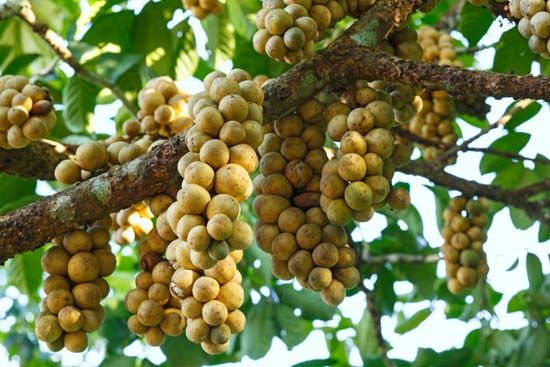
- Fruit and Seeds: The fruit is generally a leathery capsule or a fleshy, colored structure. The seeds are frequently winged to facilitate wind dispersal.12
- Economic Importance: The family is highly valued for its timber, including various types of mahogany, which are prized for being lustrous, easy to work, and resistant to warping. Additionally, some species provide medicinal oils, resins, and edible fruits.13
What types of leaves and flowers are typically found in Meliaceae plants?
Plants in the Meliaceae family, commonly known as the mahogany family, exhibit distinct morphological features regarding their foliage and reproductive structures.
Leaves
Most members of the Meliaceae family possess large, pinnately compound leaves, where the leaflets are arranged along a central axis in a feather-like pattern. While these leaves are generally arranged alternately along the stem, the Asian genus Chisocheton is notable for having leaves that exhibit indeterminate or continuous growth.13
Flowers
The flowers of Meliaceae plants are typically small and arranged in branched clusters, such as panicles. A defining characteristic of the family is that the stamens are often fused into a tube, a condition known as being monadelphous. These flowers are often fragrant and may be bisexual or unisexual, with some species displaying a tendency toward dioecism, where male and female flowers are borne on separate plants.1345

What is the taxonomic classification of the Meliaceae family within the plant kingdom?
The Meliaceae family, commonly known as the mahogany family, is classified within the order Sapindales.
Within modern botanical classification, such as the Angiosperm Phylogeny Group system, the order Sapindales is placed in the Rosid II group, alongside orders like Malvales and Brassicales. While some older sources may have historically associated the family with the order Geraniales, current scientific consensus based on DNA sequence data and morphological analysis places Meliaceae firmly within Sapindales, where it is grouped closely with the families Rutaceae and Simaroubaceae due to shared characteristics like the presence of a nectary disk between the anthers and carpels.157
How many genera and species are estimated to be in the Meliaceae family?
The Meliaceae family, commonly known as the mahogany family, is estimated to comprise 52 genera and 621 species. These plants are primarily trees and shrubs, though the family also includes a small number of perennial herbs.1
Sources
- Meliaceae — Encyclopædia Britannica
- Sapindales - Meliaceae — Encyclopædia Britannica
- Sapindales - Characteristic morphological features — Encyclopædia Britannica
- angiosperm - The androecium — Encyclopædia Britannica
- Meliaceae — Merriam-Webster
- stamen — Encyclopædia Britannica
- Sapindales - Evolution — Encyclopædia Britannica
- Sapindales — Encyclopædia Britannica
- Sapindales - Distribution and abundance — Encyclopædia Britannica
Published on · 2 min read