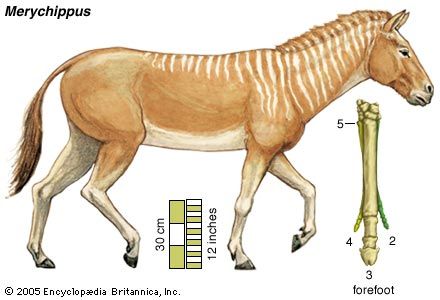
Merychippus
Merychippus is an extinct genus of early horse identified through fossilized remains found in deposits dating to the Middle and Late Miocene Epoch…
What fossil evidence has been found of Merychippus, and where were these fossils discovered?
Merychippus is an extinct genus of early horse identified through fossilized remains found in deposits dating to the Middle and Late Miocene Epoch, approximately 16.4 to 5.3 million years ago.1
Fossil evidence reveals significant evolutionary developments in the skeleton of Merychippus:
- Dentition: The teeth evolved to be higher with the appearance of dental cement, facilitating a grazing lifestyle similar to that of modern horses.1
- Size and Skull: The animal grew to the size of a modern pony, and its skull became more elongated.1
- Limbs and Toes: The limbs became better adapted for running. While some forms retained three toes, more progressive species exhibited smaller side toes, with the central toe becoming significantly larger and supporting most of the animal’s weight.1
- Hooves: A well-developed hoof was present on the central toe.1
While the provided records confirm these fossils were found in Middle and Late Miocene deposits, they do not specify particular geographic locations of discovery.1
How do paleontologists determine the age and relationships of Merychippus fossils?
Paleontologists determine the age and evolutionary relationships of Merychippus primarily through stratigraphic analysis and comparative anatomy.
The age of these fossils is established by their presence in geological deposits dating to the Middle and Late Miocene Epoch, which spanned from approximately 16.4 to 5.3 million years ago.1
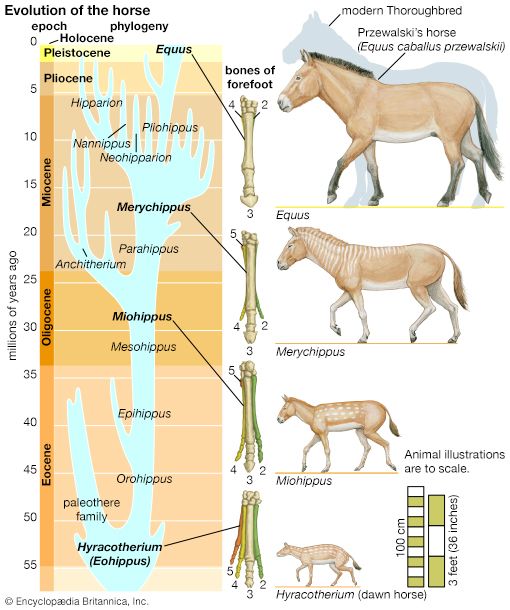
To understand the evolutionary relationships of Merychippus, researchers examine morphological transitions in the fossil record. By comparing skeletal features with those of earlier ancestors, such as the genus Parahippus, scientists can trace the development of specific traits. Key indicators of these relationships include:
- Dental Evolution: The emergence of high-crowned teeth and dental cement, which mirror the patterns found in modern horses.1
- Skeletal Morphology: The transition toward a more elongated skull and body proportions similar to a modern pony.1
- Locomotor Adaptations: The shift in limb structure, where the central toe became larger to support the animal’s weight, eventually leading to the development of a well-defined hoof.1
What were the key physical characteristics of Merychippus?
Merychippus was a significant ancestor in the evolution of the horse, exhibiting several key physical characteristics that marked its transition toward a modern equine form:
- Size: It was relatively large, standing approximately 10 hands (about 101.6 cm or 40 inches) high, making it comparable in size to a modern pony.12
- Dentition: It possessed high-crowned teeth with dental cement, a specialized adaptation for a grazing diet that allowed it to grind coarse grasses effectively.12
- Skull: The skull was elongated, closely resembling the shape of a modern horse.12
- Limbs: The lower leg bones were fused, an adaptation that supported swift running. While it remained three-toed, the central toe was significantly larger and bore most of the animal’s weight, often featuring a well-developed hoof.12
- Foot Structure: In many species, the footpad was lost, and the two side toes were reduced in size, with strong ligaments connecting the central hoof to the lower leg to create a spring-like mechanism for movement.12
What other genera of horses were contemporary with Merychippus?
During the Middle and Late Miocene Epoch, Merychippus existed alongside several other groups within the horse family, Equidae. While Merychippus represented a progressive line leading toward modern equines, other contemporary lineages maintained different evolutionary strategies.
Key contemporary groups included:
- Anchitheres: These were a diverse group of three-toed, browsing horses that descended from Miohippus. Unlike the grazing-adapted Merychippus, these horses continued to rely on a browsing diet and successfully expanded from North America into Eurasia via the Bering land bridge.1
- Late Miocene Descendants: Toward the end of the Miocene, Merychippus itself gave rise to various evolutionary branches. Many of these, such as the genera Hipparion, Neohipparion, and Nannippus, retained the ancestral three-toed foot structure.1
- Early One-Toed Lineages: A distinct branch emerging from the Merychippus lineage eventually led to Pliohippus, which is recognized as the direct predecessor to the modern genus Equus.1
Sources
- Merychippus — Encyclopædia Britannica
- horse - Evolution of the horse — Encyclopædia Britannica
- Merychippus — Merriam-Webster
Published on · 3 min read