Mesohippus
Mesohippus is a genus of extinct horses that lived during the early and middle Oligocene Epoch, approximately 33.9 to 23 million years ago. Commonly…
What is Mesohippus?
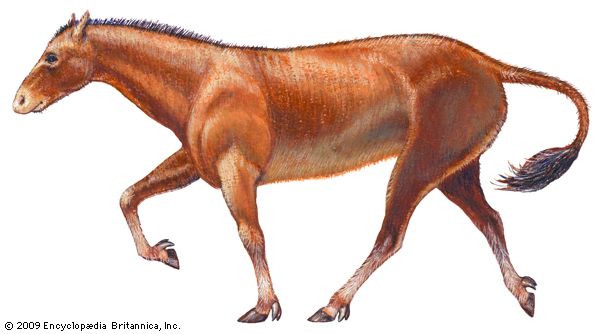
Mesohippus is a genus of extinct horses that lived during the early and middle Oligocene Epoch, approximately 33.9 to 23 million years ago. Commonly discovered as fossils in the Badlands of South Dakota, this animal was roughly the size of a modern collie dog.1
Key characteristics of Mesohippus include:
- Physical Appearance: It was the first of the three-toed horses and possessed a distinctly horselike appearance.1
- Diet: As a browser, its teeth were not adapted for the grazing habits seen in later, more advanced equine species.1
- Evolutionary Role: While it is often cited as a predecessor to the larger genus Miohippus, some scientific perspectives suggest it may not have been on the direct ancestral line leading to modern horses.123
How did the diet of horses change from browsing to grazing?
The transition from a browsing to a grazing diet in the evolution of the horse was a significant adaptation driven by the spread of grasslands across North America during the Miocene Epoch.4
Early ancestors like Eohippus and Mesohippus were browsers, possessing teeth adapted for softer, succulent vegetation. The shift toward grazing began in earnest with Parahippus, which developed specialized dental structures to process the coarser, abrasive nature of grass.4
Key evolutionary changes included:
- Tooth Structure: The cheek teeth developed larger, stronger crests to facilitate the side-to-side grinding motion required for grass.4
- High-Crowned Teeth: To compensate for the rapid wear caused by grazing, horses developed extremely long crowns. As the exposed surface wore down, more of the tooth grew out from beneath the gumline, ensuring a functional grinding surface throughout the animal’s life.4
- Completion: This transition was essentially finalized in Merychippus, which exhibited the high-crowned dentition and skull structure characteristic of modern equines.4
What are the main differences between Mesohippus and Miohippus?
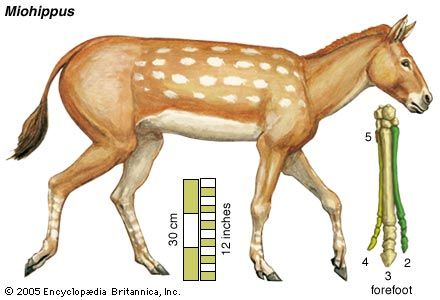
Mesohippus and Miohippus represent successive stages in the evolution of the horse, with Miohippus evolving from its predecessor. While both were three-toed, they differ primarily in size and dental development.
The main differences between the two genera are:
- Size: Mesohippus was relatively small, roughly the size of a modern collie dog, whereas Miohippus was a larger form.31
- Dentition: Miohippus possessed more-derived (specialized) teeth compared to the more primitive, browsing-adapted teeth of Mesohippus.31
- Chronology: Mesohippus lived during the early and middle Oligocene Epoch (33.9–23 million years ago), while Miohippus originated in the Late Eocene Epoch and remained common through the late Oligocene.31
While Mesohippus is considered the first of the three-toed horses, Miohippus represents a transition toward the more advanced, faster-running equines that would eventually coexist with one-toed relatives in the Miocene Epoch.31
We could dive deeper into how these skeletal changes contributed to the increased speed and efficiency of later horse species.
Why did early horses evolve to have fewer toes?
The evolution of the horse toward fewer toes was a functional adaptation for swift running and increased efficiency on open plains. As the Equidae lineage transitioned from forest-dwelling browsers to grassland grazers, their limbs underwent significant changes to prioritize speed and endurance.54
The primary evolutionary driver was the development of the “mesaxonic” condition, where the axis of the limb passes through the third or middle toe. This digit became increasingly dominant, thicker, and longer, eventually bearing the majority of the animal’s weight. As this central toe became more specialized, the lateral digits underwent reduction:5
- Structural Rigidity: The reduction in digits allowed for a more vertical, stable limb position, which, combined with the fusion of lower leg bones like the radius and tibia, created a rigid, efficient mechanism for fore-and-aft movement.54
- Energy Efficiency: By concentrating weight on a single, hoofed digit, horses minimized the energy required for locomotion, allowing them to cover vast distances across grasslands.56
- Spring Mechanism: In advanced forms like Merychippus and eventually Equus, strong ligaments attached the central hoof to the lower leg, acting as a spring that propelled the limb forward after impact.54
Sources
- Mesohippus — Encyclopædia Britannica
- Mesohippus — Merriam-Webster
- Miohippus — Encyclopædia Britannica
- horse - Evolution of the horse — Encyclopædia Britannica
- perissodactyl - Limbs — Encyclopædia Britannica
- hoof — Encyclopædia Britannica
- foot — Encyclopædia Britannica
Published on · 3 min read