Miohippus
Miohippus is an extinct genus of horses that originated in North America during the late Oligocene Epoch (approximately 28.4 to 23 million years ago).…
What is Miohippus?
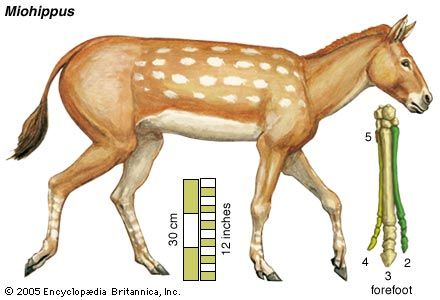
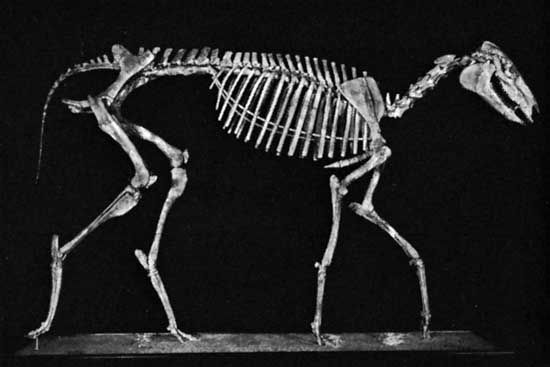
Miohippus is an extinct genus of horses that originated in North America during the late Oligocene Epoch (approximately 28.4 to 23 million years ago). Evolving from the earlier genus Mesohippus, Miohippus was larger and possessed more-derived dentition.123
Like its predecessor, Miohippus was a three-toed browser, but its physical adaptations allowed it to run faster than earlier, five-toed ancestors. The genus persisted into the Miocene Epoch (23 to 5.3 million years ago), where its descendants split into various evolutionary branches. One branch, the anchitheres, included several successful three-toed genera that spread into Eurasia, while another branch led to the development of grazing horses and eventually the modern genus Equus.143
How did the transition from forest to grassland affect horse evolution?
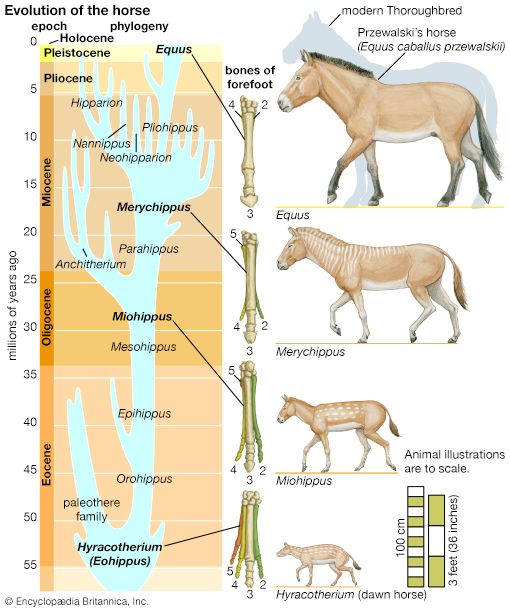
The transition from forest to grassland during the late Cenozoic was a primary driver of horse evolution, necessitating significant anatomical and physiological adaptations to survive in more open environments.
As global cooling in the late Eocene and subsequent climate shifts in the Miocene converted thick forests into expansive grasslands, ancestral horses faced new ecological pressures. These changes led to several key evolutionary developments:
- Dental Adaptations: Early horses were browsers that fed on succulent leaves using low-crowned teeth. As they shifted to grazing on coarse, gritty grasses, they developed high-crowned teeth with complex crests and ridges. These teeth were designed to withstand the abrasive nature of grass and the side-to-side grinding motion required for digestion.546
- Locomotion and Limb Structure: To navigate open plains and escape increasingly efficient predators, horses evolved longer, more slender legs. The fusion of lower leg bones and the reduction of toes—culminating in the single-hoofed foot of the modern genus Equus—provided a spring mechanism that enhanced speed and energy efficiency.54
- Digestive Changes: While not preserved in the fossil record, the shift to a diet of cellulose-rich grass necessitated corresponding adaptations in the digestive tract to process the coarser vegetation.54
What are the main differences between Mesohippus and Miohippus?
The transition from Mesohippus to Miohippus represents a significant progression in the evolutionary history of horses. While Mesohippus was a small, collie-sized browser of the Oligocene Epoch, Miohippus emerged as a larger, more advanced successor during the late Oligocene.15
The primary differences between the two genera include:
- Size: Miohippus was physically larger than the earlier Mesohippus.15
- Dentition: Miohippus possessed more-derived, specialized teeth compared to the unspecialized, browsing-focused teeth of Mesohippus.15
- Locomotion: While Mesohippus was the first of the three-toed horses, Miohippus further refined these adaptations, allowing it to run significantly faster than its predecessors.15
Mesohippus is famously associated with the Badlands of South Dakota, whereas Miohippus persisted into the Miocene Epoch, eventually coexisting with more advanced, one-toed relatives.15
Why did horses eventually evolve to have only one toe?
The evolution of the horse toward a single-toed foot was a gradual process driven by the need for increased speed and efficiency in open, grassland environments. As ancestral horses transitioned from browsing in forests to grazing on the plains, their locomotion requirements shifted significantly.4
Key factors in this development included:
- Weight Distribution: Over millions of years, the weight of the animal shifted to the central digit. In early ancestors like Mesohippus, the foot was three-toed, but by the time of Merychippus in the Miocene, the central toe had become the primary weight-bearing structure.4
- Locomotion and Speed: The reduction of side toes and the fusion of lower leg bones created a more stable and efficient limb for running. This structure, combined with strong ligaments, acted as a spring mechanism that enhanced the horse’s ability to travel quickly across hard, open ground and escape predators.410
- Specialization: While many three-toed lineages existed, the branch leading to the modern genus Equus eventually favored the single-hoofed foot. This specialized adaptation represents the most highly developed form of a hoofed digit among mammals, providing both endurance and speed.410
Sources
- Miohippus — Encyclopædia Britannica
- Miohippus — Merriam-Webster
- perissodactyl - Horses — Encyclopædia Britannica
- horse - Evolution of the horse — Encyclopædia Britannica
- Mesohippus — Encyclopædia Britannica
- horse - Anatomical adaptations — Encyclopædia Britannica
- Tertiary Period - The rise of mammals — Encyclopædia Britannica
- Quaternary - Fauna and flora — Encyclopædia Britannica
- Columbian Exchange - Animals — Encyclopædia Britannica
- hoof — Encyclopædia Britannica
Published on · 3 min read