Pliohippus
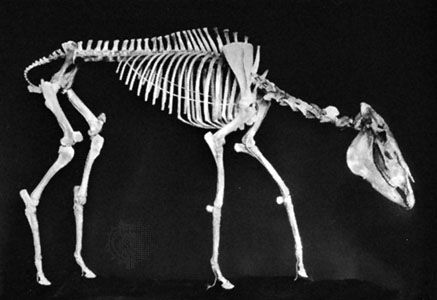
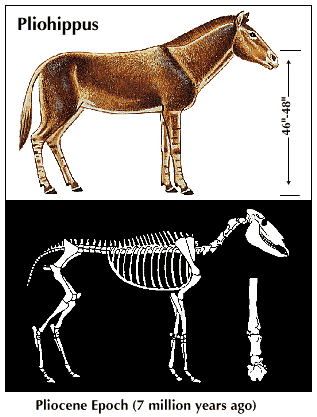
Pliohippus is an extinct genus of horses that lived in North America during the Pliocene Epoch, approximately 5.3 to 2.6 million years ago. It is recognized…
What is Pliohippus?
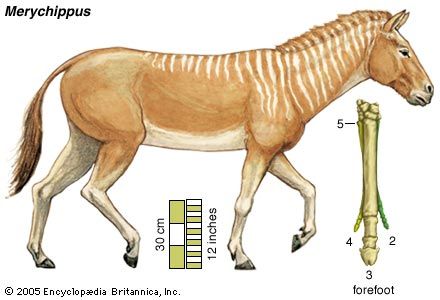
Pliohippus is an extinct genus of horses that lived in North America during the Pliocene Epoch, approximately 5.3 to 2.6 million years ago. It is recognized as the earliest one-toed horse, having evolved from the three-toed Merychippus of the preceding Miocene Epoch.123
Key characteristics of Pliohippus include:
- Physical Adaptations: Its limbs were specialized for running in open country, and it possessed strongly hypsodont (high-crowned) molar teeth with complex folding, which allowed it to graze on abrasive grasses.142
- Evolutionary Significance: Pliohippus is considered the direct predecessor of the genus Equus, which includes all modern horses, asses, and zebras.23
Because of its specialized teeth and limb structure, researchers believe Pliohippus primarily inhabited open plains, where it relied on grazing rather than browsing for food.1
How did the transition from three-toed to one-toed feet help horses survive?
The transition from three-toed to one-toed feet was a critical evolutionary adaptation that enhanced the ability of horses to survive in open-country environments. This shift was part of a broader trend toward limbs that were increasingly rigid and specialized for efficient, high-speed movement in a forward direction.15
Key benefits of this transition included:
- Increased Efficiency and Speed: As horses moved from forest environments to open plains, the reduction of lateral digits allowed the limbs to become more slender and specialized for fore-and-aft movement. By concentrating the body’s weight on a single, enlarged central digit, horses gained a more stable and efficient structure for running.15
- Structural Rigidity: The evolution of the one-toed foot involved the fusion of lower leg bones (such as the radius and ulna) and the development of a specialized spring mechanism. Strong ligaments attached the hoofed central toe to the ankle and lower leg bones, providing a mechanism that helped propel the animal forward after impact with the ground.45
- Weight Distribution: In earlier three-toed forms like Merychippus, the central toe already bore most of the weight, but the transition to the one-toed Pliohippus and eventually Equus finalized this specialization, optimizing the limb for the demands of life on the grasslands.345
What is the significance of hypsodont teeth in grazing animals?
Hypsodont teeth are a critical evolutionary adaptation for grazing animals, providing the durability necessary to consume abrasive vegetation. Unlike primitive, low-crowned brachydont teeth, which are typical of browsers, hypsodont teeth feature high crowns that extend well above the gum line. This structure allows the teeth to withstand the significant wear caused by the silica-rich grasses found in open-country environments.6
The significance of this adaptation is further enhanced by two key features:
- Complex Surface Structure: The grinding surfaces of these teeth often evolve into a convoluted, selenodont arrangement, which creates an efficient, self-sharpening surface for grinding tough plant material.6
- Cement Reinforcement: The hollows between the ridges (lophs) of hypsodont teeth are filled with secondary cement. This deposit acts as a strengthening agent, significantly increasing the tooth’s resistance to abrasion and ensuring it remains functional throughout the animal’s life.6
This specialization is a hallmark of highly efficient grazers, such as the Equidae family, including the extinct Pliohippus and modern horses.62
How did the environment change from the Eocene to the Pliocene epoch?
The transition from the Eocene Epoch (roughly 56 to 33.9 million years ago) to the Pliocene Epoch (5.3 to 2.6 million years ago) was marked by a profound and steady shift toward a cooler, drier global climate.78
Climatic Cooling and Tectonic Drivers
The Eocene was characterized by extreme warmth, including the Paleocene-Eocene Thermal Maximum and the Eocene Optimum, during which tropical flora and fauna existed at high latitudes. Following this, a long-term cooling trend began, driven largely by tectonic movements. The opening of the Drake Passage isolated Antarctica, fostering the development of a permanent ice sheet. By the Pliocene, this cooling trend accelerated, leading to the expansion of northern hemisphere glaciers around 3.2 million years ago, a process influenced by the uplift of major mountain ranges like the Andes and the Tibetan Plateau.8
Environmental and Ecological Shifts
- Vegetation: The cooling and drying trends converted vast areas of Eocene rainforest into more open forests and grasslands. By the Pliocene, these open biomes, including savannas, became widespread.910
- Faunal Evolution: These environmental changes forced significant evolutionary turnover. Primitive herbivores disappeared, replaced by modern groups such as horses, camels, and antelopes. In the Pliocene, the reestablishment of the land bridge between North and South America allowed for significant faunal migration.97
- Hominin Development: The shifting, mosaic habitats of the Pliocene are believed to have stimulated new lifeways for early hominins, including the development of bipedalism.10
Sources
- Pliohippus — Encyclopædia Britannica
- Pliohippus — Merriam-Webster
- perissodactyl - Horses — Encyclopædia Britannica
- horse - Evolution of the horse — Encyclopædia Britannica
- perissodactyl - Limbs — Encyclopædia Britannica
- perissodactyl - Teeth — Encyclopædia Britannica
- Pliocene Epoch — Encyclopædia Britannica
- Climate change - Cenozoic climates — Encyclopædia Britannica
- Tertiary Period - The rise of mammals — Encyclopædia Britannica
- human evolution - Hominin habitats — Encyclopædia Britannica
Published on · 4 min read