Mesa
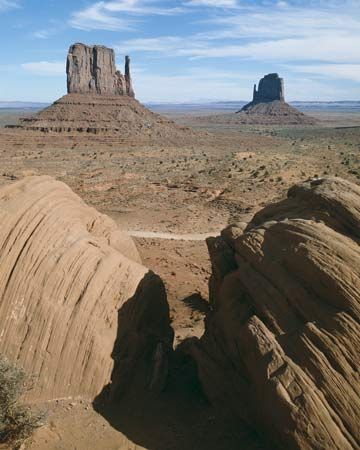
A mesa (Spanish for "table") is a flat-topped tableland characterized by one or more steep sides. These landforms are common in the Colorado Plateau region…
What is mesa?
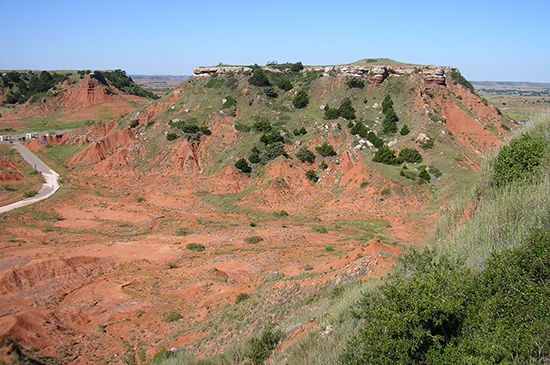
A mesa (Spanish for “table”) is a flat-topped tableland characterized by one or more steep sides. These landforms are common in the Colorado Plateau region of the United States and are created through the process of erosion.1
During denudation, layers of harder rock act as protective caps for the underlying land. As surrounding areas—such as stream valleys—are worn away by active erosion, these resistant sections remain as elevated, flat-topped features. While a mesa is a broad, elevated landform, a butte is similar in structure but smaller in size. Both are distinct types of plateau formations.12
How does erosion create a mesa?
A mesa is created through the geological process of erosion, specifically during a phase of landscape evolution known as denudation.
The formation occurs within a plateau when layers of harder, more resistant rock act as protective caps for the underlying land. As surrounding areas—such as stream valleys—undergo active erosion and downcutting, the softer material is stripped away. Because the resistant cap rock is more durable, it remains as an elevated, flat-topped landform, while the surrounding terrain is lowered. This process leaves behind the distinct table-like structure known as a mesa, or, if the feature is smaller, a butte.1
This landscape evolution is a result of the balance between the resistance of rock types and the erosive forces acting upon them, a concept central to understanding the topography of regions like the Colorado Plateau.15
What is the difference between a mesa and a butte?
The primary difference between a mesa and a butte is their relative size and scale. Both are flat-topped landforms with steep sides created by erosion in arid regions, such as the Colorado Plateau, where layers of hard rock protect the underlying material from being worn away.17
- Mesa: Derived from the Spanish word for “table,” a mesa is a broad, isolated, flat-topped elevation. It is generally more extensive than a butte but less extensive than a plateau.12
- Butte: A butte is similar in structure to a mesa but is smaller in size. It is often described as a flat-topped hill surrounded by a steep escarpment, sometimes referred to as a “fortress hill.”17
Essentially, while both landforms share a common geological origin involving the stripping of softer rock around a resistant cap, the distinction lies in their surface area and overall dimensions.12
Where are mesas most commonly found?
Mesas are most commonly found in arid regions characterized by plateau landscapes. They are particularly prevalent in the Colorado Plateau region of the western United States, where the combination of horizontal rock layers and active erosion facilitates their formation.14
These landforms are iconic features of desert environments, such as those found in Arizona, where the differential weathering of hard cap rock and softer underlying material creates their signature flat-topped appearance.123
Sources
- mesa — Encyclopædia Britannica
- mesa — Merriam-Webster
- butte — Encyclopædia Britannica
- mesas — Merriam-Webster
- Colorado Plateau — Encyclopædia Britannica
- Earth sciences - Concepts of landform evolution — Encyclopædia Britannica
- butte — Merriam-Webster
- mesa — Merriam-Webster
Published on · 2 min read