Deccan
The Deccan Plateau is a vast, topographically diverse region that forms the southern peninsula of India. While often associated specifically with the land…
What is the geographical location and extent of the Deccan Plateau in India?
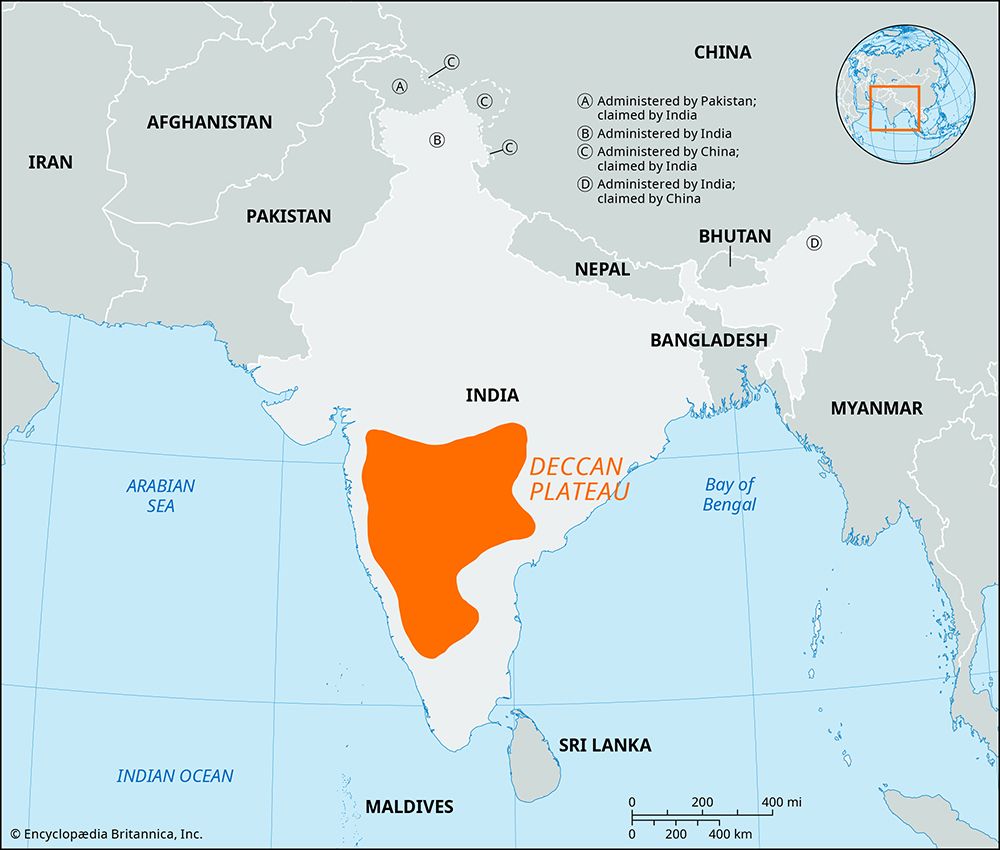
The Deccan Plateau is a vast, topographically diverse region that forms the southern peninsula of India. While often associated specifically with the land south of the Narmada River, the region extends northward beyond the Vindhya Range, which is traditionally considered the symbolic boundary between northern India and the Deccan.12
Geographically, the plateau is defined by the following boundaries:
- North: The Satpura Range serves as its northern extremity, though the region encompasses areas reaching toward the Aravalli Range1.13
- East and West: It is flanked by the Ghats—the Western Ghats and Eastern Ghats—which are escarpments that converge at the plateau’s southern tip.13
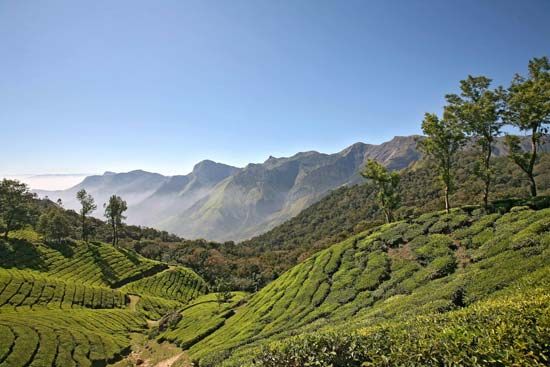
The plateau features an average elevation of approximately 2,000 feet (600 meters) and exhibits a general eastward slope, causing its major rivers—including the Godavari, Krishna, and Kaveri—to flow toward the Bay of Bengal.13
How has the Deccan Plateau influenced the development of different kingdoms and empires in Indian history?
The Deccan Plateau has served as a pivotal stage in Indian history, acting as both a coveted prize for northern empires and a cradle for powerful regional dynasties. Its mineral wealth and strategic position made it a frequent target for expansionist powers, including the Mauryan and Gupta dynasties, who sought to control its resources.2
Rise of Regional Powers
The plateau fostered the development of distinct regional kingdoms that defined the southern landscape for centuries. The Satavahana dynasty was the first to build a major empire in the region, leveraging Indo-Roman trade and establishing a historical period characterized by significant material prosperity and cultural patronage. Following them, families such as the Chalukya, Rashtrakuta, Hoysala, and Yadava dynasties established successive kingdoms, though they were often locked in conflict with neighboring states.32
Conflict and Synthesis
The region’s history was marked by a constant tension between northern incursions and southern resistance:
- Delhi Sultanate & Bahmanis: The Delhi sultanate conducted looting raids before eventually gaining control, leading to the establishment of the independent Bahmani dynasty in 1347.2
- Vijayanagara Empire: Serving as a vital barrier against northern Muslim sultanates, the Vijayanagara empire fostered a resurgence of Hindu administration and culture. Its military innovations, such as the adoption of cavalry and specialized archers, were essential in narrowing the strategic gap between northern and southern powers.56
- Mughal Era: The decline of the Mughal Empire in the 18th century triggered a power vacuum, resulting in intense rivalries between the Marathas, the nizam of Hyderabad, and the Arcot nawab, which ultimately facilitated British absorption of the region.2
What role did the Deccan Plateau play during India’s struggle for independence?
During India’s struggle for independence, the Deccan Plateau served as a significant site of both political transition and nationalist sentiment. Its role was defined by the complex status of its princely states and the historical legacy of its regional powers.
The Integration of Hyderabad
The most prominent event involving the Deccan during the transition to independence was the status of the princely state of Hyderabad. When the Indian subcontinent was partitioned in 1947, the nizam of Hyderabad initially sought to maintain independent status rather than join the new Indian union. Following a period of tension and a signed standstill agreement, India invaded the state on September 13, 1948. Within four days, the state acceded to India, marking a critical step in the consolidation of the nation.910
Nationalist Symbolism
The Deccan also played a symbolic role in the broader independence movement. Indian nationalists frequently invoked the history of the Maratha empire, particularly the legacy of Shivaji, to foster a sense of national identity. By framing the Marathas as heroes of resistance against foreign tyranny, nationalists utilized the region’s history to bolster the cause of Hindu nationalism and anti-colonial sentiment.2
How was the Deccan Plateau formed, and what are its main geological features?
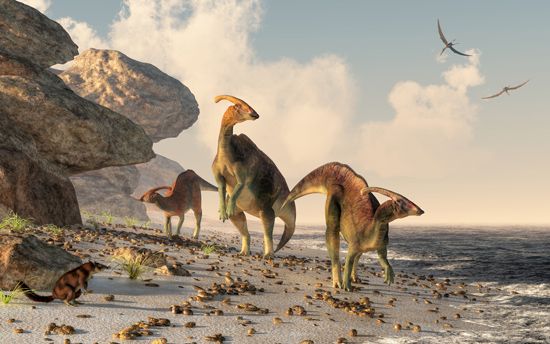
The Deccan Plateau is a geologically stable region that was once part of the ancient supercontinent of Gondwana Gondwana. Its formation is primarily attributed to massive volcanic activity that occurred 60–65 million years ago, when the Indian landmass passed over a hot spot in the Earth’s mantle—the same hot spot that currently underlies the island of Réunion. This event produced the extensive basaltic lava flows known as the Deccan Traps.412
The plateau’s geological features include:
- Composition: The main peninsular block is composed of ancient gneiss, granite, and schists, overlaid in the northwest by more recent basaltic lava.4
- Topography: It is a high, triangular tableland with an average elevation of about 2,000 feet (600 meters), generally sloping toward the east.134
- Boundaries: The plateau is flanked by the Western Ghats and Eastern Ghats, with the Satpura Range marking its northern extremity.13
- Landforms: The region features rolling terrain, eroded hill ranges, and characteristic mesa-like formations.144
Sources
- India - Inland regions — Encyclopædia Britannica
- Deccan — Encyclopædia Britannica
- India - History of India — Encyclopædia Britannica
- India - The Deccan of India — Encyclopædia Britannica
- Satavahana dynasty — Encyclopædia Britannica
- Vijayanagara — Encyclopædia Britannica
- India - Wars and rivalries — Encyclopædia Britannica
- Delhi sultanate: Top Questions — Encyclopædia Britannica
- Hyderabad — Encyclopædia Britannica
- Maratha empire — Encyclopædia Britannica
- Bombay Presidency Association: Top Questions — Encyclopædia Britannica
- British raj - The early Congress movement — Encyclopædia Britannica
- plateau - Geographic distribution — Encyclopædia Britannica
- India - Relief — Encyclopædia Britannica
Published on · 4 min read