Metauro River
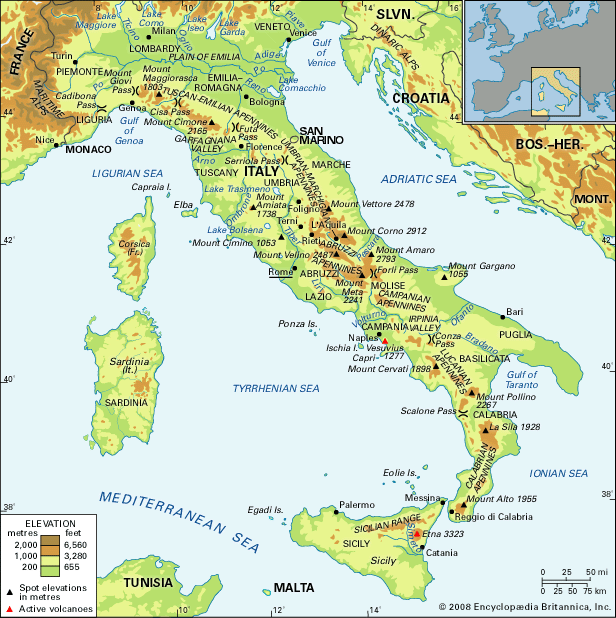
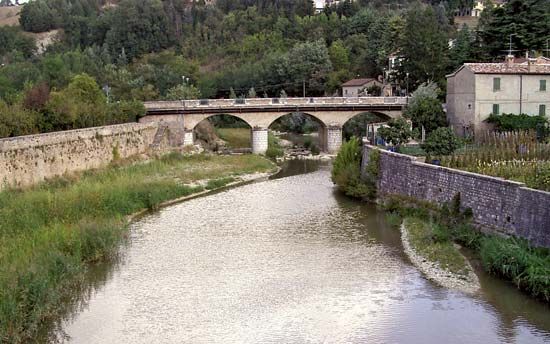
The Metauro River is a 68-to-70-mile-long river located in the Marche region of central Italy. It rises in the Etruscan Apennines and flows east-northeast…
What is Metauro River?
The Metauro River is a 68-to-70-mile-long river located in the Marche region of central Italy1. It rises in the Etruscan Apennines and flows east-northeast, emptying into the Adriatic Sea just south of Fano.12
Historically known as the Metaurus, the river’s lower valley was the site of a significant Roman victory in 207 BCE during the Second Punic War. In this decisive battle, Roman consuls Marcus Livius Salinator and Claudius Nero defeated the Carthaginian forces led by Hasdrubal, the brother of Hannibal. This engagement served as a major turning point in the conflict between Rome and Carthage.2
What was the outcome of the Second Punic War?
The Second Punic War (218–201 BCE) concluded in a complete triumph for Rome, establishing it as the dominant power in the Mediterranean.3
The war effectively ended following the Battle of Zama in 202 BCE, where the Roman general Scipio Africanus defeated Hannibal. Faced with the loss of their final army, the Carthaginians were forced to accept peace terms dictated by Rome, which included:34
- Territorial Cessions: Carthage was compelled to cede Spain and its remaining Mediterranean islands to Rome.34
- Military Restrictions: The Carthaginians were required to surrender their warships and forfeit their independence regarding foreign policy and military affairs.34
- Financial Indemnity: Carthage was obligated to pay an indemnity of 10,000 talents over 50 years.34
This victory marked a turning point in ancient history, as Rome transitioned from a regional power to a Mediterranean empire. While the war devastated parts of the Italian peninsula, the resilience of the Roman confederacy ultimately overcame Hannibal’s strategic efforts.435
Who was Hannibal and why was he important?
Hannibal (247–c. 183 BCE) was a renowned Carthaginian general and one of the most significant military leaders of antiquity. He is primarily remembered for commanding Carthaginian forces against the Roman Republic during the Second Punic War (218–201 BCE).89
Hannibal’s importance stems from his tactical brilliance and his role as Rome’s most formidable adversary. Key aspects of his legacy include:
- Military Innovation: He is famous for his strategic mastery, most notably the Battle of Cannae, which remains a textbook example of a “double envelopment” maneuver. Despite being outnumbered, he inflicted a catastrophic defeat on the Roman army.10
- Enduring Hostility: Sworn to eternal opposition against Rome by his father, Hamilcar Barca, Hannibal spent decades challenging Roman hegemony across the Mediterranean.9
- Psychological Impact: His successes were so profound that he became a bogeyman to Roman society, deeply influencing the Roman psyche and military development.10
- Leadership: He successfully commanded a diverse, multi-ethnic mercenary army for years without significant internal discord, demonstrating exceptional leadership and resourcefulness.11
Though ultimately defeated at the Battle of Zama, Hannibal’s campaigns fundamentally shaped the trajectory of the Roman Republic.1210
What are the Apennine Mountains?
The Apennine Range is a series of mountain ranges that serves as the physical backbone of the Italian peninsula. Stretching approximately 870 miles (1,400 kilometers), the range forms a great arc from the Cadibona Pass in the northwest to the Egadi Islands west of Sicily.13
Geologically, the Apennines are part of the younger Alpine system and consist largely of marine sedimentary rocks, such as shales, sandstones, and limestones, deposited during the Mesozoic Era. The range is tectonically active, characterized by seismic activity and a history of volcanic development that includes both extinct and active volcanoes like Mount Vesuvius and Mount Etna.1415
The landscape is rugged, with elevations reaching their highest point at Mount Corno (9,554 feet). The climate is generally continental with Mediterranean influences, supporting diverse flora that ranges from northern woodlands of oak and chestnut to southern Mediterranean evergreens. Today, the range hosts significant biodiversity, including species like the brown bear and wolf, which are protected in various natural reserves.1315161718
Sources
- Metauro River — Encyclopædia Britannica
- Metauro — Merriam-Webster
- Punic Wars - The war in Africa — Encyclopædia Britannica
- Battle of Zama — Encyclopædia Britannica
- ancient Rome - Roman expansion in the western Mediterranean — Encyclopædia Britannica
- Punic Wars - Campaigns in Sicily and Spain — Encyclopædia Britannica
- Rome - City of world power — Encyclopædia Britannica
- Hannibal — Encyclopædia Britannica
- Hannibal - The wars in Spain and Africa — Encyclopædia Britannica
- Hannibal - Early life — Encyclopædia Britannica
- Hannibal - The war in Italy — Encyclopædia Britannica
- Hannibal - Personality — Encyclopædia Britannica
- Apennine Range — Encyclopædia Britannica
- Apennine Range - Geology — Encyclopædia Britannica
- Apennine Range - Physiography — Encyclopædia Britannica
- Italy — Encyclopædia Britannica
- Apennine Range - Climate of the Apennine Range — Encyclopædia Britannica
- Apennine Range - Plant and animal life — Encyclopædia Britannica
Published on · 3 min read