Mediterranean Sea
The Mediterranean Sea has served as a vital "inland sea" for human civilization, facilitating trade and communication due to its temperate climate and…
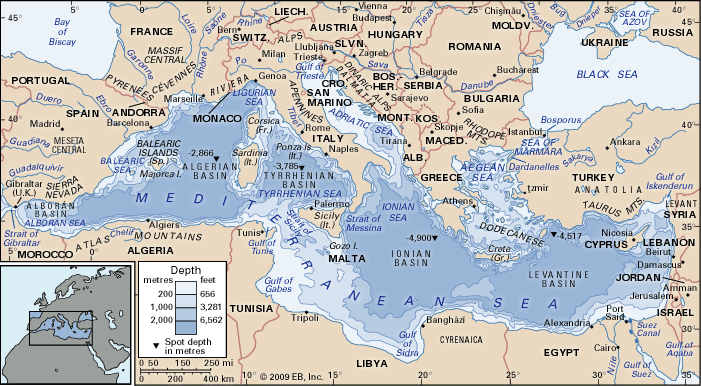
How has the Mediterranean Sea influenced trade and transportation throughout history?
The Mediterranean Sea has served as a vital “inland sea” for human civilization, facilitating trade and communication due to its temperate climate and navigable straits. Historically, it acted as an incubator for Western civilization, with maritime relations binding eastern and western Mediterranean cultures during the Bronze Age.123
During the Middle Ages, Italian commercial states and cities like Constantinople and Barcelona became key intermediaries between the Orient and Europe. This era also saw significant advancements in shipping, as Mediterranean vessels like the buss and carrack influenced European shipbuilding through the exchange of technical designs.14
The sea’s prominence declined after the 15th century due to the rise of the Ottoman Empire and the discovery of safer oceanic routes to Asia around the Cape of Good Hope. However, the 1869 opening of the Suez Canal and the advent of steamships revitalized the region, transforming it into one of the world’s busiest sea-lanes. Today, the Mediterranean remains a critical hub for global trade, energy transport, and a massive tourism industry.1
How do oceanographers study the Mediterranean Sea’s currents and water circulation patterns?
Oceanographers study the Mediterranean Sea’s complex circulation patterns through a combination of historical expeditions, systematic hydrographic surveys, and modern oceanographic modeling.
Historical and Systematic Research
Early scientific interest in the sea’s flow began with 17th-century observations of countercurrents, but modern systematic study did not emerge until the 20th century. Key milestones include:
- Early Expeditions: The Danish Thor expedition (1908–1910) conducted foundational research on pelagic life and its relationship to hydrographic conditions.5
- Mid-Century Surveys: Extensive investigations in the 1940s and 1950s, notably by the vessel Calypso, provided critical data on vertical circulation and deep-water formation.5
- Multinational Cooperation: Since the 1960s, organizations such as the Intergovernmental Oceanographic Commission and NATO have sponsored collaborative efforts to map the sea’s currents and air-sea interactions.5
Key Hydrodynamic Processes
Research focuses on the Mediterranean’s unique “breathing” mechanism, where it inhales surface water from the Atlantic Ocean and exhales denser, saline water at depth through the Strait of Gibraltar. Scientists study these density currents to understand how they influence the North Atlantic, including the formation of “Meddies”—subsurface eddies that transport heat and salt.67
These studies are vital for understanding climatic change, as the Mediterranean serves as a model for global thermohaline circulation processesine circulation](https://www.britannica.com/science/thermohaline-circulation) processes.56
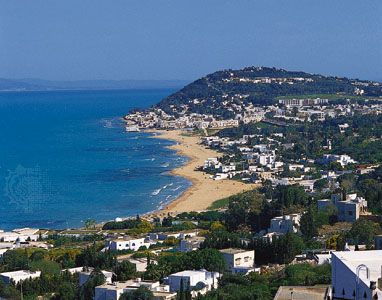
How has tourism affected the Mediterranean coastal regions in recent decades?
In recent decades, tourism has become a cornerstone of the economy for countries bordering the Mediterranean Sea, generating a significant portion of global tourism income annually. The region’s combination of sunshine, beaches, and historical monuments attracts tens of millions of visitors each year, providing essential employment and foreign exchange for coastal nations.110
However, this rapid growth has also placed significant pressure on the environment. Since the mid-20th century, the surge in tourism, alongside increasing industrialization and rising shoreline populations, has led to severe water pollution in many coastal areas. Because the Mediterranean has relatively weak tidal and current movements, pollutants often remain concentrated near their discharge points.11
In response to these environmental challenges, regional nations have collaborated through the United Nations Environment Programme to implement the Mediterranean Action Plan (Med Plan). While this initiative has been successful in raising awareness and establishing legal frameworks—such as the Barcelona Convention—improvements in overall environmental quality remain limited.11
What is the historical significance of the Mediterranean Sea in ancient civilizations?
The Mediterranean Sea is often described as the “incubator of Western civilization” due to its central role in connecting early societies through trade, communication, and cultural exchange. Its geography—characterized by navigable waters, temperate weather, and accessible straits—facilitated the movement of people and goods across three continents.11213
Economic and Technological Hub
The sea served as a vital artery for the exchange of essential resources, including metals like tin, silver, and copper, as well as agricultural products such as grain and olive oil. This economic necessity drove significant technological advancements:5
- Maritime Innovation: The development of the sailing ship allowed for long-distance travel, enabling civilizations like the Egyptians and Phoenicians to navigate the entire Mediterranean and beyond.3
- Naval Power: The sea became a theater for competition, leading to an “arms race” in naval technology, such as the development of the trireme and the introduction of heavy missile weapons like catapults on warships.4
- Trade Networks: The integration of city-states into larger empires, such as those during the Hellenistic age, removed trade barriers and expanded routes as far as India and China.5
By fostering these connections, the Mediterranean allowed for the transmission of knowledge, art, and religion, fundamentally shaping the development of the ancient world.14315
Sources
- Mediterranean Sea - Transportation and tourism — Encyclopædia Britannica
- ship - Early oceanic navigation — Encyclopædia Britannica
- Mediterranean Sea — Encyclopædia Britannica
- Western architecture - Bronze Age cultures — Encyclopædia Britannica
- Mediterranean Sea - Study and exploration — Encyclopædia Britannica
- Strait of Gibraltar — Encyclopædia Britannica
- Mediterranean Sea - Hydrology — Encyclopædia Britannica
- density current - Mediterranean overflow current — Encyclopædia Britannica
- thermohaline circulation — Encyclopædia Britannica
- Mediterranean Sea - Impact of human activity — Encyclopædia Britannica
- Europe - Tourism of Europe — Encyclopædia Britannica
- warship - Later developments — Encyclopædia Britannica
- Hellenistic age - Economic developments — Encyclopædia Britannica
- history of technology - Copper and bronze — Encyclopædia Britannica
- ancient Middle East - Evolution of Middle Eastern civilizations — Encyclopædia Britannica
- Achaemenid Empire: Top Questions — Encyclopædia Britannica
Published on · 4 min read