Miacis
Miacis was a diverse genus of extinct carnivores that lived from the late Paleocene to the late Eocene Epoch. Its physical characteristics included the…
What were the physical characteristics of Miacis?
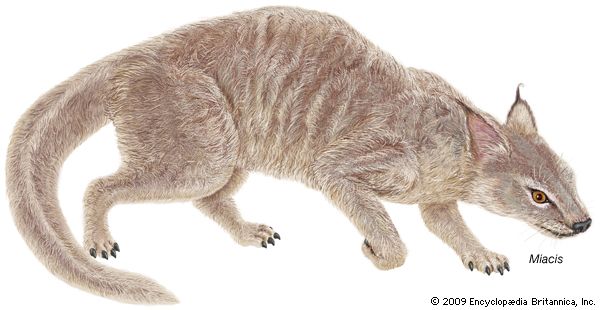
Miacis was a diverse genus of extinct carnivores that lived from the late Paleocene to the late Eocene Epoch. Its physical characteristics included the following:
- Size: These animals were relatively small, with body masses ranging from approximately 1 to 7 kg (2.2 to 15.4 pounds).1
- Locomotion: They were likely at least partly arboreal, possessing the ability to reverse their hind feet to climb trees, similar to squirrels1.
- Limb Structure: Their hind limbs were longer than their forelimbs.1
- Skeletal Features: The pelvis was notably doglike in its form and structure, and some specialized traits were present in the vertebrae.1
- General Appearance: As forest dwellers, different species varied in appearance; some resembled civets, while others were similar to kinkajous.1
Are there any specific species of Miacis that are particularly well-known or important?
While Miacis is a significant genus of extinct carnivores that served as the ancestral type for the family Miacidae, the provided information does not identify specific species within the genus as being particularly well-known or individually important.
Instead, the genus is recognized collectively as a representative group of early carnivores that were the ancestors of modern caniforms. While individual species are noted for their morphological diversity—with some resembling civets and others similar to kinkajous—they are generally studied for their shared evolutionary role as forest-dwelling, arboreal precursors to modern dogs, bears, raccoons, and weasels.12
How do paleontologists study and classify Miacis fossils?
Paleontologists study and classify Miacis fossils primarily by analyzing structural characteristics, as these features are essential for defining the Carnivora order and its subdivisions.
Because soft tissue is rarely preserved in the fossil record, researchers rely heavily on skeletal morphology. Key areas of focus include:
- Dentition: The overall tooth pattern and the specific shape of individual teeth are considered especially important for determining the evolutionary relationships of fossil forms.1
- Skull and Skeleton: Paleontologists examine the skull (particularly jaw articulation) and postcranial elements, such as the pelvis and vertebrae, to identify specialized traits.21
- Limb Structure: Analysis of foot structure—including the number of toes, claw type, and bone fusion—helps researchers understand the animal’s locomotion and evolutionary position.21
By comparing these morphological data points, scientists classify Miacis as a representative of the Miacidae family, which serves as an ancestral group for modern caniforms.24
How is Miacis related to modern carnivorous mammals?
Miacis is a significant genus of extinct carnivores that serves as an ancestral type for the family Miacidae. Paleontologists identify this genus as a foundational group from which modern caniforms evolved.12
The relationship between Miacis and modern mammals is characterized by the following:
- Ancestral Lineage: Miacis is considered the ancestor of the canids—including dogs, wolves, foxes, coyotes, and jackals—as well as the broader group that includes bears, raccoons, and weasels.16
- Evolutionary Transition: While Miacis did not leave direct descendants, doglike canids evolved from it. By approximately 30 to 40 million years ago, the genus had evolved into early forms such as Cynodictis, which eventually gave rise to the lineages of modern canids.6
- Morphological Links: The pelvis of Miacis was notably doglike in structure, and its dental patterns provide the basis for how scientists classify these early carnivores in relation to their modern descendants.16
Sources
- Miacis — Encyclopædia Britannica
- Miacidae — Merriam-Webster
- Miacis — Merriam-Webster
- carnivore - Distinguishing taxonomic features — Encyclopædia Britannica
- bivalve - Critical appraisal — Encyclopædia Britannica
- mammal - Food habits — Encyclopædia Britannica
- dog - Ancestry — Encyclopædia Britannica
Published on · 2 min read