Milford Sound
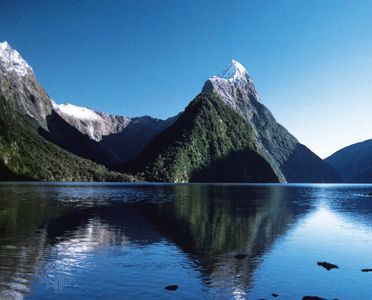
Milford Sound is a fjord located on the southwestern coast of the South Island in New Zealand. It is an inlet of the Tasman Sea formed by the flooding of a…
What is Milford Sound and where is it located in New Zealand?
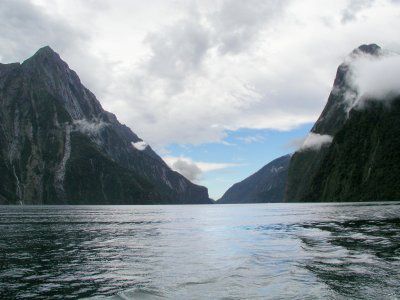
Milford Sound is a fjord located on the southwestern coast of the South Island in New Zealand. It is an inlet of the Tasman Sea formed by the flooding of a glacial valley.1
As the northernmost fjord within Fiordland National Park, the area is characterized by dramatic, steep valley walls that plunge into deep waters, overlooked by peaks such as Mitre Peak and Pembroke Peak. The site is a popular destination for its natural beauty and serves as the terminus for the famous Milford walking track. While the region is largely rugged and wild, the town of Milford Sound remains one of the few permanently inhabited locations in the area.1
How was Milford Sound formed geologically?
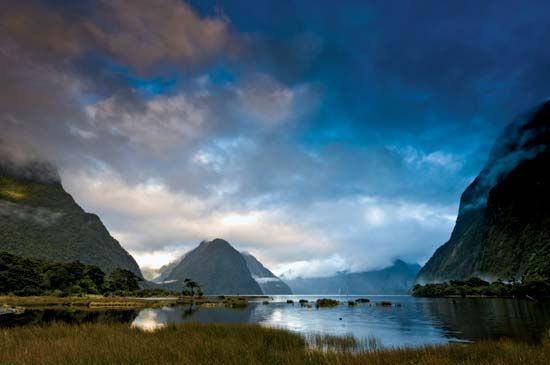
Milford Sound was formed through the process of glacial erosion followed by marine inundation. During the last ice ages, massive, heavy glaciers carved deep U-shaped valleys into the landscape of New Zealand’s South Island.13
These glaciers were so immense that they were able to erode the valley floors far below sea level before the ice eventually floated or melted away. Once the glaciers retreated, the rising waters of the Tasman Sea flooded these deep, steep-walled valleys, creating the fjord known today as Milford Sound valleys, creating the fjord known today as Milford Sound.31
The resulting landscape features dramatic, vertical valley walls that plunge hundreds of feet into the water, with the fjord reaching depths of up to 1,680 feet (512 meters) near its head. Because of this glacial origin, the fjord is characterized by its deep, narrow channel and steep sides, which are typical of such submerged glacial valleys.132
How deep is Milford Sound and what unique marine life can be found in its waters?
Milford Sound reaches a maximum depth of 1,680 feet (512 meters) near the head of the fjord.1
The waters of the fjord and the surrounding coastal areas support a variety of marine life, including dolphins, seals, and penguins. While the provided information highlights these species as inhabitants of the region’s fjords, it does not specify unique or endemic marine species exclusive to Milford Sound itself.2
How does Milford Sound compare to other fjords in New Zealand and around the world?
Milford Sound shares the fundamental geological characteristics of fjords worldwide, as all are products of marine inundation following intense glacial erosion. Like other fjords, it features a characteristic U-shaped valley with steep, vertical walls that plunge deep beneath the water’s surface.15
Comparison of Features
- Geological Origin: Like the famous fjords of Norway, Chile, and Canada, Milford Sound was carved by massive glaciers that eroded the valley floor far below sea level.32
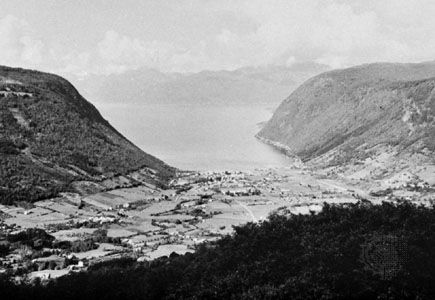
- Depth and Morphology: While Milford Sound reaches a significant depth of 1,680 feet (512 meters), it is shallower than some of the world’s most prominent fjords. For instance, Sogn Fjord in Norway reaches depths of 4,290 feet (1,308 meters), and the Canal Messier in Chile reaches 4,167 feet (1,270 meters).15
- Thresholds: A common feature of global fjords is a shallow rock threshold or “sill” at the mouth, formed by glacial deposits. This sill often restricts water exchange, leading to unique conditions within the fjord basin.352
Milford Sound is distinguished as the northernmost fjord within New Zealand’s Fiordland National Park, a region renowned for its rugged, high-relief landscape.16
Sources
- Milford Sound — Encyclopædia Britannica
- Fiordland National Park — Encyclopædia Britannica
- fjord — Encyclopædia Britannica
- Mount Aspiring National Park — Encyclopædia Britannica
- estuary - Fjords — Encyclopædia Britannica
- glacial landform - Erosional landforms of continental glaciers — Encyclopædia Britannica
Published on · 3 min read