Penguin
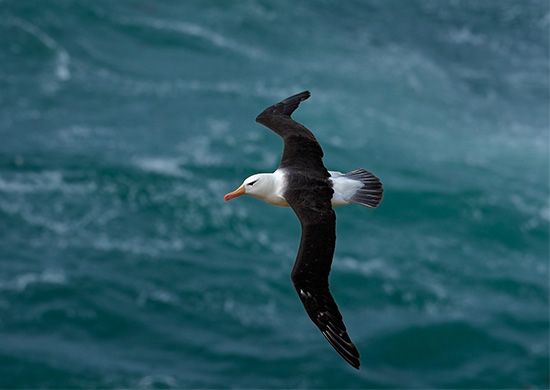
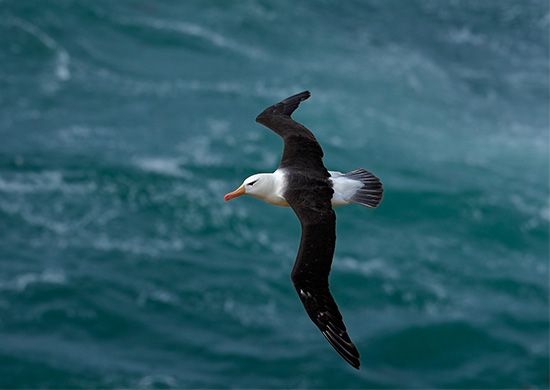
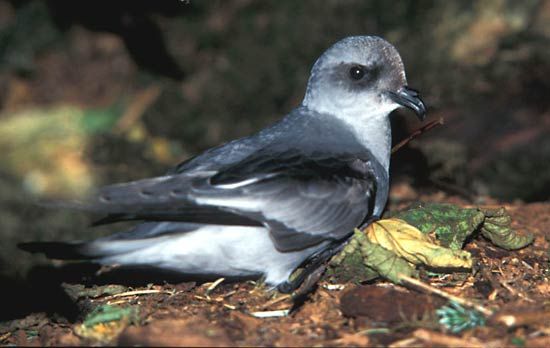
Penguins share a common evolutionary origin with the order Procellariiformes, which includes albatrosses, shearwaters, and petrels. Fossil evidence indicates…
What is the evolutionary history of penguins?
Penguins share a common evolutionary origin with the order Procellariiformes, which includes albatrosses, shearwaters, and petrels. Fossil evidence indicates that penguin ancestors evolved in the Southern Hemisphere approximately 60 million years ago, with well-defined fossils appearing by about 50 million years ago.12
Early in their history, penguins evolved a large body size. During the Eocene Epoch, giant species such as Icadyptes and Anthropornis stood up to 1.8 metres (6 feet) tall. The smaller size of modern penguins is a geologically recent development that began about 8 million years ago.1
Throughout their evolution, penguins have become highly specialized for a flightless, aquatic existence. Key adaptations include the transformation of forelimbs into paddle-like flippers and a body morphology optimized for efficient swimming and diving. Their confinement to the Southern Hemisphere is largely due to these specialized environmental adaptations and their flightless nature, which prevented them from crossing tropical barriers to reach the Northern Hemisphere.32
How do penguins communicate with each other?
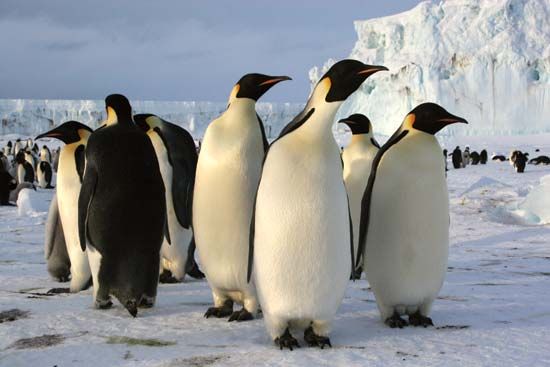
Penguins utilize a variety of visual and vocal displays to communicate, particularly during the breeding season when they must locate mates and identify their chicks within large, noisy colonies.4
Vocal Communication
Vocalizations are essential for individual recognition, especially in species that do not build nests, such as the emperor penguin and king penguin. These birds possess a specialized vocal organ called the syrinx, which allows them to produce two different frequencies simultaneously. This creates a unique “two-voiced” call with a beating amplitude pattern that enables mates and parents to identify each other amidst the background noise of a crowded colony.54
Across different species, vocalizations are diverse and include trumpeting, croaking, cackling, and cooing. For instance, members of the genus Spheniscus are often called “jackass penguins” due to the braying sounds they produce.4
Visual and Behavioral Displays
Beyond vocal calls, penguins employ various physical displays to facilitate pairing and social interaction. These behaviors are often more elaborate in experienced, older birds. When parents return from foraging to a nursery group, or crèche, they use both voice and appearance to distinguish their specific chick from others.4
What adaptations do penguins have for swimming and surviving in cold environments?
Penguins possess remarkable physiological and behavioral adaptations that allow them to thrive in aquatic environments and survive extreme cold.
Adaptations for Swimming
Penguins are highly specialized for an aquatic existence, with their forelimbs transformed into rigid, paddle-like flippers used for propulsion. Their bodies are streamlined to minimize friction and turbulence, allowing them to reach speeds of up to 40 km (25 miles) per hour. While swimming, they use a figure-eight stroke pattern, and their webbed feet act as rudders for steering. Additionally, they possess salt glands above their eyes, which allow them to ingest seawater by excreting excess salt.43
Adaptations for Cold Environments
To survive freezing temperatures, penguins rely on several insulation strategies:
- Plumage and Fat: Their short, stiff feathers are densely packed, trapping a layer of air against the skin that provides excellent insulation. They also maintain a thick layer of fat.74
- Countercurrent Heat Exchange: To prevent heat loss through their feet, penguins use a specialized system of thermal conduction where closely aligned arteries and veins transfer heat from outgoing blood to returning blood.74
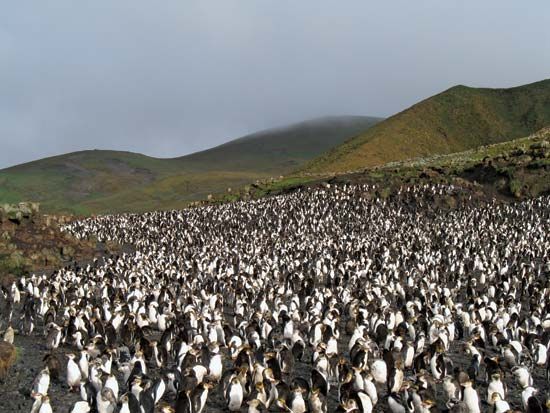
- Behavioral Huddling: Penguins gather in large, tightly packed groups to share body heat and shield themselves from harsh winds.7
How do different penguin species vary in size and appearance?
Penguin species exhibit significant variation in size and appearance, ranging from the diminutive blue penguin to the towering emperor penguin.9
Size Variation
Penguins range drastically in physical stature:
- Smallest: The blue, or fairy, penguin (Eudyptula minor) is the smallest species, standing about 25–35 cm (10–14 inches) tall and weighing approximately 1–1.5 kg (2–3.3 pounds).910
- Largest: The emperor penguin (Aptenodytes forsteri) is the largest, reaching heights of up to 1.3 meters (4.3 feet) and weighing between 25 and 45 kg (55–100 pounds).9118
Appearance and Coloration
While most penguins share a classic black-and-white “tuxedo” pattern—black on the back and white on the underside—there are distinct ornamental differences among species:9
- Head and Neck Markings: Emperor and king penguins are notable for vibrant orange and yellow patches on their heads, necks, and breasts.911
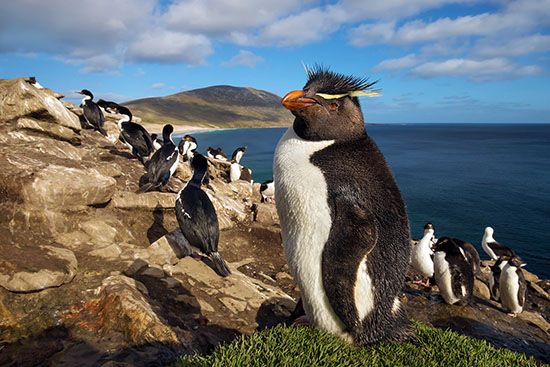
- Crests: Species in the genus Eudyptes, such as the macaroni and rockhopper penguins, are characterized by distinctive yellow brow tufts.92
- Other Features: Some species possess red beaks or feet, while others have yellow irises. The blue penguin is uniquely distinguished by its pale blue to dark gray plumage on its head and back.910
Sources
- penguin - Fossil record — Encyclopædia Britannica
- Why are there no penguins at the North Pole? — Encyclopædia Britannica
- penguin - Form and function — Encyclopædia Britannica
- How do penguins stay warm? — Encyclopædia Britannica
- How Do Penguins Tell Each Other Apart? — Encyclopædia Britannica
- penguin - Reproduction — Encyclopædia Britannica
- Locomotion - Tetrapodal vertebrates — Encyclopædia Britannica
- Emperor penguin: Top Questions — Encyclopædia Britannica
- penguin - General features — Encyclopædia Britannica
- penguin - Classification — Encyclopædia Britannica
- Blue penguin — Encyclopædia Britannica
- Emperor penguin — Encyclopædia Britannica
Published on · 4 min read