Mink
Mink are small, slender-bodied, semiaquatic carnivorous mammals belonging to the weasel family. They typically measure 30–50 cm (12–20 inches) in length…
What are the physical characteristics of minks?
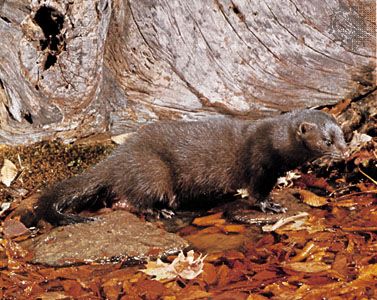
Mink are small, slender-bodied, semiaquatic carnivorous mammals belonging to the weasel family. They typically measure 30–50 cm (12–20 inches) in length, excluding a 13–23-cm (5–9-inch) tail, and weigh 2 kg (4.5 pounds) or less, with females being smaller than males.1
Their physical characteristics include:
- Body Structure: Short legs, a long thick neck, and a broad head featuring short, rounded ears.1
- Feet: They possess partially webbed feet, which assist them in being strong and agile swimmers.21
- Coat: They have a soft, thick pelage consisting of dense underfur overlaid with dark, glossy guard hairs. While typically a deep, rich brown, they may have white markings on the throat, chest, or underparts.21
- Tail: They have a relatively short, bushy tail.2
In captivity, selective breeding has allowed for a wider range of coat colors, including white, sapphire, and black, and ranch-raised mink can grow significantly larger than their wild counterparts due to improved nutrition.1
Where are minks typically found in the wild?
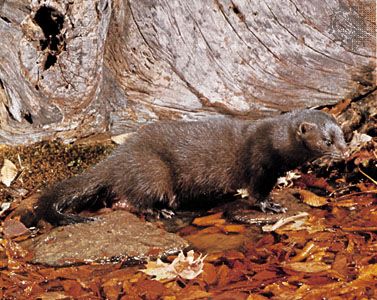
Mink are native to the Northern Hemisphere and are characterized by their semiaquatic nature, living in close proximity to water. They typically inhabit shorelines and banks, where they explore holes, crevices, and deepwater pools to hunt for prey.2
The distribution of these animals varies by species:
- American Mink: Originally native to most of North America, excluding arid regions of the Southwest. Due to the fur industry and subsequent escapes or releases from farms, they have established populations across Europe and South America, where they are often considered an invasive species.2
- European Mink: Once found from northern Spain to the Ural Mountains in Russia, their range has been severely reduced. They are now limited to fragmented areas, including parts of northern Spain, southwestern France, the Danube River delta, and western Russia.2
What are the different species of minks and how do they differ?
There are two distinct species of mink, both belonging to the weasel family (Mustelidae): the American mink (Neovison vison or Neogale vison) and the European mink (Mustela lutreola).21
While they share similar physical traits—such as a slender body, short legs, partially webbed feet, and a dense, water-repellent coat—they differ significantly in their status and ecological impact:
- American Mink: Native to North America, this species is highly adaptable and aggressive. Due to the global fur industry, it has been introduced to Europe and South America, where it is considered an invasive species that threatens local wildlife. It is classified as a species of least concern by the IUCN.2
- European Mink: This species is less aggressive and less adaptable. It is currently classified as a critically endangered species because it has been displaced by the American mink throughout its native range, which has shrunk from a vast area across Europe and Russia to a few fragmented populations.2
How long do minks typically live in the wild versus in captivity?
Sorry, the Britannica knowledge base does not contain information regarding the typical lifespan of minks in the wild or in captivity.
Sources
- mink — Merriam-Webster
- mink — Encyclopædia Britannica
Published on · 2 min read