Grison
A grison is a weasel-like carnivore belonging to the genus Galictis (sometimes referred to as Grison) within the family Mustelidae. Found throughout most of…
What is grison?
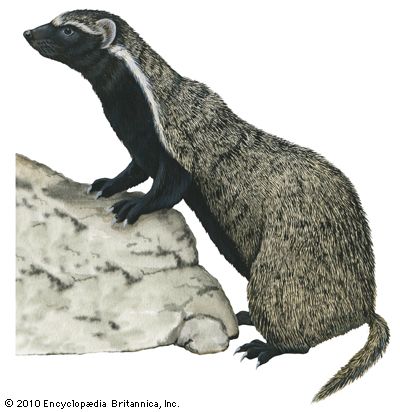
A grison is a weasel-like carnivore belonging to the genus Galictis (sometimes referred to as Grison) within the family Mustelidae. Found throughout most of Central and South America, these animals are characterized by their slender bodies, short legs, and small, broad ears.12
Physically, grisons typically measure 40–50 cm (16–22 inches) in length, excluding their 15–20 cm (6–8 inch) tail, and weigh between 1 and 3 kg (2–6.5 pounds). They are easily identified by their distinct coloration: a grayish or brown back contrasted with black limbs, faces, and underparts, and a signature white stripe that runs across the forehead and along the sides of the neck.1
Grisons are generally diurnal and gregarious animals that are adept at swimming, climbing, and burrowing. While they are sometimes tamed when young, they are known to be destructive to poultry. They primarily feed on fruit and small animals, typically producing litters of two to four young.13
What other animals belong to the Mustelidae family?
The family Mustelidae comprises approximately 62 species of fur-bearing carnivores found globally, with the exception of Australia, Antarctica, and most oceanic islands. While skunks were historically classified within this group, genetic analysis has placed them into their own family, Mephitidae.24
Mustelids are categorized into eight subfamilies, including a diverse array of animals:
- Otters (Lutrinae): Includes sea otters, river otters, and clawless otters.24
- Weasels and Minks (Mustelinae): Includes various weasels, minks, ferrets, and ermines.24
- Badgers: Represented across several subfamilies, including the American badger (Taxidea), Eurasian badgers (Meles), hog badgers (Arctonyx), and ferret-badgers (Melogale).24
- Guloninae: Includes the wolverine, martens, fishers, and the tayra.com/animal/fisher-mammal), and the tayra.24
- Ictonychinae: Includes grisons, zorilles, the Patagonian weasel, and the African striped weasel.24
- Mellivorinae: Consists solely of the honey badger (ratel).24
How do grisons hunt and what is their typical diet?
Grisons are opportunistic carnivores that exhibit a varied diet consisting of both animal prey and plant matter. Their typical diet includes a range of small animals and fruit.1
Regarding their hunting habits, grisons are diurnal, meaning they are primarily active during the day. They are highly versatile predators that utilize their physical agility to hunt in diverse environments; they are adept at climbing, swimming, and burrowing, which allows them to pursue prey across different terrains. While they are capable of being tamed when young, they are noted for being destructive to poultry, often raiding domestic coops when the opportunity arises.13
What are the main differences between a grison and a ferret?
While both the grison and the ferret are members of the Mustelidae family, they belong to distinct biological genera and exhibit notable differences in their physical characteristics and natural history.
Taxonomic and Physical Differences
- Genus: The grison belongs to the genus Galictis, whereas the ferret is classified under the genus Mustela.12
- Appearance: Grisons are characterized by a distinct color pattern: they have grayish or brown backs with black limbs, faces, and underparts, accented by a white stripe that runs across the forehead and down the sides of the neck. They possess small, broad ears and a relatively stocky build compared to the typically more slender, elongated body shape associated with many Mustela species.1
- Size: Grisons generally measure 40–50 cm (16–22 inches) in length, excluding their 15–20 cm (6–8 inch) tail, and weigh between 1 and 3 kg (2–6.5 pounds).1
Behavioral Distinctions
Grisons are primarily diurnal (active during the day) and are known for being gregarious, often living in small groups. They are highly versatile, demonstrating adept skills in climbing, swimming, and burrowing. While they can be tamed if captured young, they are also known to be opportunistic predators that may raid poultry coops.1
Sources
- grison — Encyclopædia Britannica
- List of mustelids — Encyclopædia Britannica
- grison — Merriam-Webster
- weasel — Encyclopædia Britannica
- mustelid — Encyclopædia Britannica
Published on · 3 min read