Mizo Hills
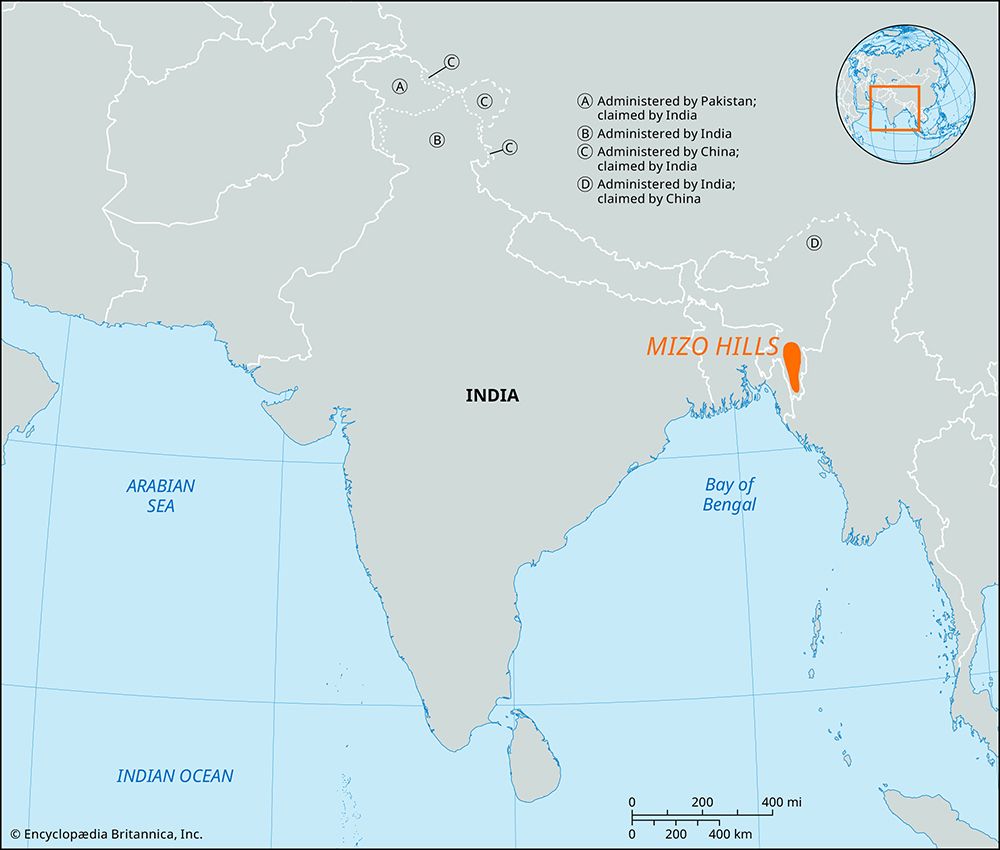
The Mizo Hills are a mountain range located in the southeastern part of the Mizoram state in northeastern India. Forming part of the north Arakan Yoma…
What is Mizo Hills?
The Mizo Hills are a mountain range located in the southeastern part of the Mizoram state in northeastern India. Forming part of the north Arakan Yoma system, these mountains consist of a series of compact, parallel ridges composed of sandstone, limestone, and shale.12
The ridges reach elevations of approximately 7,000 feet (2,100–2,125 meters) and are separated by narrow river valleys. The slopes are characterized by thick evergreen forests that provide valuable timber and bamboo. In the intermontane valleys, local populations practice terrace cultivation and shifting agriculture, the latter of which is locally known as jhum.12
Historically, the region was known as the Lushai Hills District of Assam before being renamed the Mizo Hills District in 1954. It eventually became part of the state of Mizoram, which achieved full statehood in 1987.2
What is the significance of the jhum method of agriculture?
The jhum method, a form of shifting agriculture, is a traditional cultivation system significant for its adaptation to tropical environments where continuous farming would otherwise exhaust the soil. In this process, plots of land are cleared—often through slash-and-burn techniques—cultivated for a limited period, and then left fallow to allow for the natural regeneration of vegetation and soil nutrients.32
The significance of jhum includes:
- Ecological Adaptation: It serves as a practical response to tropical soil conditions, preventing the permanent degradation that can occur with intensive, sedentary farming in the absence of fertilizers or advanced conservation techniques.3
- Sustainability and Biodiversity: While historically criticized by colonial and modern policymakers as environmentally damaging, some contemporary research suggests that traditional jhum practices may be more ecologically sustainable than settled agriculture, as they allow for forest regeneration and the maintenance of greater biodiversity.4
- Cultural Integration: In regions like Mizoram, jhum is deeply embedded in the social and cultural fabric. Significant festivals, such as chapchar kut, are centered on the agricultural cycle of these fields.2
However, increased population pressure has forced a reduction in the traditional fallow cycles, which has led to decreased farm productivity in some areas.2
How did Christian missionaries influence the culture of the Mizo people?
Christian missionaries began working in the Mizo Hills in the late 19th century, and their influence profoundly reshaped Mizo society in several key areas:
- Religious Transformation: The most significant impact was the widespread conversion of the population to Christianity, predominantly Protestantism. Most of these conversions occurred during the 1920s and 1930s, and today, the great majority of the Mizo people are Christian.
- Education: Missionaries were the primary drivers behind the early development and promotion of institutionalized education in the region. They established the first schools around the turn of the 20th century, laying the foundation for what would eventually become one of the highest literacy rates among all Indian states.
- Cultural Integration: The influence of the church extended into cultural life, where music and dance—integral parts of Mizo identity—became closely associated with Christian holidays.
While these changes were transformative, the Mizo people have maintained other cultural traditions, such as festivals centered on the agricultural cycle, alongside their Christian practices.
What are some of the unique festivals celebrated in Mizoram?
Festivals in Mizoram are deeply rooted in the state’s agricultural cycle, reflecting the traditional lifestyle of its people. While many modern festivities are associated with Christian holidays, several unique traditional celebrations remain central to Mizo cultural life:7
- Mim Kut: Held in August or September, this festival occurs after the first harvest of the year. It serves as a time for thanksgiving and is also dedicated to honoring deceased relatives.7
- Pawl Kut: This is a significant harvest festival that typically takes place in December or January.7
- Chapchar Kut: Celebrated by shifting agriculturalists, this festival marks the beginning of the agricultural year. It occurs in March, after the forest has been cleared but before the burning of the new fields begins.7
These celebrations highlight the enduring connection between the Mizo people and their land, preserving traditions that have persisted alongside the widespread adoption of Christianity in the region.7
Sources
- Mizo Hills — Encyclopædia Britannica
- Mizoram — Encyclopædia Britannica
- Shifting agriculture — Encyclopædia Britannica
- Arunachal Pradesh - Agriculture and forestry — Encyclopædia Britannica
- forest societies in India - Disruption during colonial rule — Encyclopædia Britannica
- Mizo — Encyclopædia Britannica
- Meitei — Encyclopædia Britannica
Published on · 3 min read