Mount Kazbek
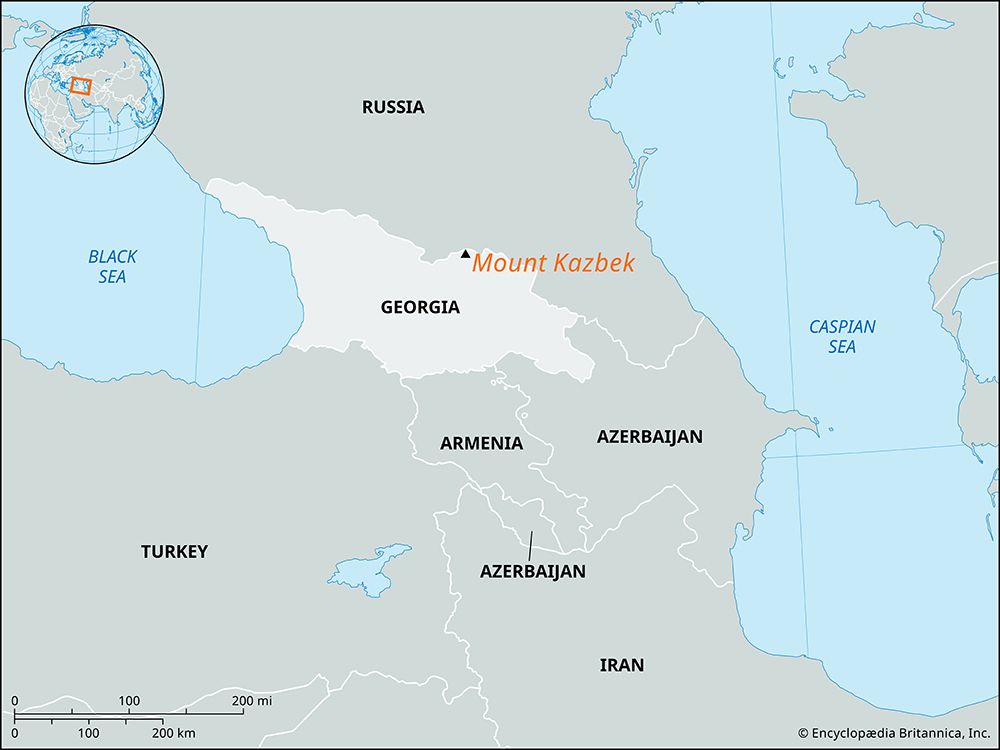
Mount Kazbek is a prominent mountain located in the central Caucasus Mountains on the border between Georgia and Russia. While sources vary slightly on its…
What is Mount Kazbek?
Mount Kazbek is a prominent mountain located in the central Caucasus Mountains on the border between Georgia and Russia. While sources vary slightly on its precise height, it is recognized as one of Georgia’s highest peaks, reaching an elevation of approximately 16,512 to 16,558 feet (5,033 to 5,047 meters).12
Geologically, it is an extinct volcano characterized by a double conical shape and significant lava deposits. The mountain is capped by extensive icefields that serve as the source for the headstreams of the Terek River, while its lower elevations are defined by alpine meadows. Beyond its physical geography, the peak holds cultural significance, having been famously celebrated in the literary works of poets such as Aleksandr Pushkin and Mikhail Lermontov.1
What are the Caucasus Mountains?
The Caucasus Mountains are a major mountain system and region situated on the isthmus between the Black Sea to the west and the Caspian Sea to the east. This region, which serves as a convergence point between Europe and Asia, is occupied by Russia, Georgia, Azerbaijan, and Armenia.3
The system consists of two primary ranges:
- The Greater Caucasus: The northern backbone of the system, extending approximately 750 miles (1,200 km). It includes Mount Elbrus, the highest peak in the system at 18,510 feet (5,642 meters).34
- The Lesser Caucasus: Located to the south, this range extends toward the Armenian Highland and into Turkey.34
Historically, the region has functioned as a vital migration gateway and a cultural “ethnic museum,” characterized by immense linguistic and cultural diversity. It is also deeply rooted in mythology, serving as the legendary site of Prometheus’s suffering and the Argonauts’ search for the Golden Fleece.35
What myths are associated with Mount Kazbek?
While Mount Kazbek is a site of significant cultural and literary inspiration, the provided search results do not contain information regarding specific myths associated with the mountain itself.
It is important to note that while the broader Caucasus Mountains are famously linked to the Greek myth of Prometheus—who was said to be chained to a mountain in the region—the specific attribution of this or other myths to Mount Kazbek is not addressed in the available data.
How do glaciers affect the Terek River?
The Terek River originates directly from the glaciers of Mount Kazbek in the main Caucasus range. These glaciers serve as a primary source for the river’s water supply as it begins its journey northward.10
The influence of glacial and snow melt is a defining characteristic of the river’s hydrological cycle. In the spring, as temperatures rise and ice and snow begin to melt, the Terek River—along with other rivers of the Greater Caucasus—enters a significant flood cycle. This period of high water levels can persist for up to six months, driven by the seasonal melting of the mountain’s frozen water reserves.1112
Sources
- Mount Kazbek — Encyclopædia Britannica
- Kazbek — Merriam-Webster
- Caucasus — Encyclopædia Britannica
- Caucasus - Geology of Caucasus — Encyclopædia Britannica
- Caucasus Mountains — Merriam-Webster
- Caucasus - Physiography — Encyclopædia Britannica
- history of Transcaucasia - Early history — Encyclopædia Britannica
- Caucasus - Climate — Encyclopædia Britannica
- Transcaucasia - Climate — Encyclopædia Britannica
- Terek River — Encyclopædia Britannica
- Caucasus - Drainage — Encyclopædia Britannica
- Transcaucasia - Drainage — Encyclopædia Britannica
Published on · 2 min read