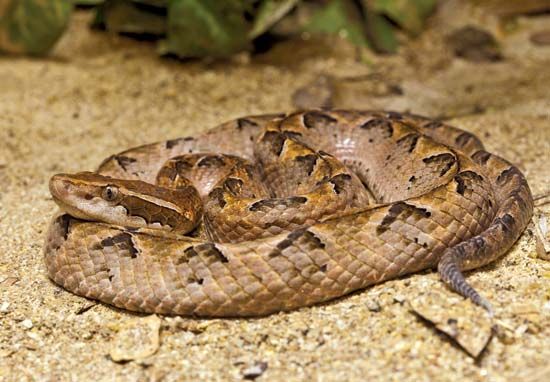
Moccasin
Moccasins, which belong to the genus Agkistrodon, are venomous pit vipers found in the New World. Their distribution and preferred habitats depend on the…
Where are moccasin snakes typically found, and what habitats do they prefer?
Moccasins, which belong to the genus Agkistrodon, are venomous pit vipers found in the New World. Their distribution and preferred habitats depend on the specific species:1
- Water Moccasin (Agkistrodon piscivorus): These semiaquatic snakes are found in the southeastern United States. Their range extends from central Texas north to southeastern Missouri, southern Illinois, and the western fringes of the Ohio River valley, as well as across the coastal plains of Georgia, South Carolina, North Carolina, and southeastern Virginia. They prefer moist environments, including wetlands, marshy lowlands, moist forests, and intertidal habitats. They generally remain close to water sources.21
- Mexican Moccasin (Agkistrodon bilineatus): Also known as the cantil, this species is found in lowland regions ranging from the Rio Grande to Nicaragua.1
Both species are considered dangerous and should be avoided. While the water moccasin is a common species of least concern, localized populations can be affected by habitat loss.12
How venomous are moccasin snakes, and what are the effects of their bite?
Moccasin snakes, which include the water moccasin (Agkistrodon piscivorus) and the Mexican moccasin (A. bilineatus), are considered dangerous snakes capable of delivering a potentially lethal bite. While they are involved in hundreds of snakebites annually in the United States, human fatalities from these encounters are rare.14
The venom of the water moccasin is a hemotoxin, a type of poison that specifically targets the blood and circulatory system. The primary effects of this venom include:42
- Inhibition of clotting: The venom interferes with the blood’s ability to coagulate, which can lead to dangerous internal or external bleeding.42
- Tissue destruction: The venom contains enzymes that break down tissues at the site of the bite, which can result in severe local damage.42
The severity of any snakebite depends on several factors, including the amount of venom injected, the location of the bite, and the speed at which the victim receives antivenin therapy. If you or someone else is bitten, it is critical to seek professional medical attention immediately rather than attempting home remedies like cutting or suctioning the wound.5
What is the difference between water moccasins and copperheads?
Water moccasins and copperheads are both venomous pit vipers belonging to the genus Agkistrodon and the subfamily Crotalinae, making them close relatives. While they share similar anatomical features—such as the characteristic sensory pit between the eye and nostril—they differ significantly in their primary habitats and behaviors.126
Key Differences
- Habitat: The water moccasin (Agkistrodon piscivorus), also known as the cottonmouth, is a semiaquatic snake that prefers moist environments such as wetlands, marshy lowlands, and the edges of water sources. In contrast, the copperhead is often associated with more terrestrial or highland environments.12
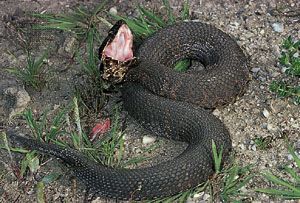
- Behavior and Appearance: The water moccasin is famously called the “cottonmouth” because it displays the bright white interior of its mouth when threatened. It is a large-bodied snake that can be completely black or brown with dark crossbands. Copperheads are generally distinguished by their unique coloration, which typically features a copper-colored head and hourglass-shaped crossbands on their bodies.12
- Taxonomy: While both are members of the same genus, they are distinct species adapted to different ecological niches.12
What is the origin of the name ‘moccasin’ for these snakes?
The term “moccasin,” when applied to these snakes, is derived from the Virginia Algonquian word mockasin.7
While the word originally referred to a type of soft leather shoe or boot—a term documented as early as 1612—it was later applied to the water moccasin (Agkistrodon piscivorus), with the first known use in this context appearing around 1821. The name is also used to describe other snakes, such as those in the genus Gloydius, that share a physical resemblance to the water moccasin.76
Sources
- moccasin — Encyclopædia Britannica
- water moccasin — Encyclopædia Britannica
- water moccasins — Merriam-Webster
- snakebite — Encyclopædia Britannica
- Venom — Encyclopædia Britannica
- water moccasin — Merriam-Webster
- moccasin — Merriam-Webster
Published on · 3 min read