Scarlet Snake
The scarlet snake (Cemophora coccinea) is a small, nocturnal, and burrowing member of the Colubridae family found in the United States from New Jersey to…
What is scarlet snake?
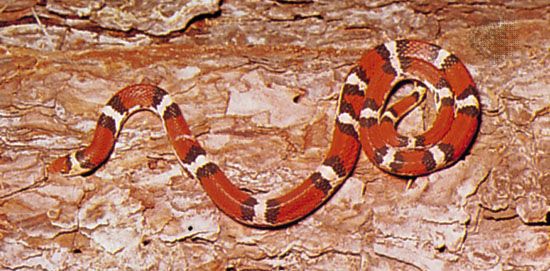
The scarlet snake (Cemophora coccinea) is a small, nocturnal, and burrowing member of the Colubridae family found in the United States from New Jersey to Texas. It is a harmless species that primarily feeds on insects and small vertebrates, with a particular preference for lizard and snake eggs.1
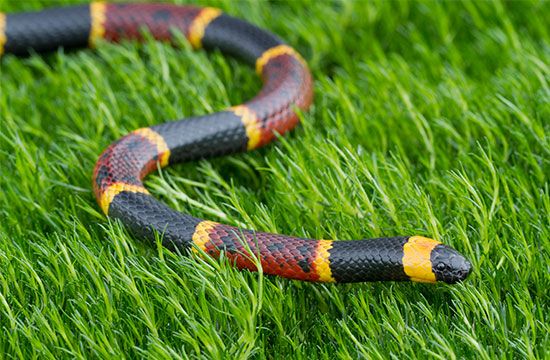
Because of its vibrant red, black, white, and yellow rings, the scarlet snake is often called a “false coral snake” and is considered a mimic of the venomous coral snake. It also bears a resemblance to the scarlet king snake, a separate species that is sometimes also referred to as a scarlet snake. While these snakes share similar habitats, they can be distinguished from the venomous coral snake by their color patterns; for instance, in the scarlet king snake, black bands separate the red and yellow colors, whereas in coral snakes, the red and yellow bands touch.123
How can you tell a scarlet snake from a venomous coral snake?
Distinguishing a harmless scarlet snake or scarlet king snake from a venomous coral snake is critical for safety in the United States. While these snakes share similar habitats and vibrant red, black, and yellow or white ringed patterns, they can be identified by the arrangement of their colors.
Herpetologists often use specific mnemonics to help identify them, such as “Red on yellow, kill a fellow; red on black, venom lack”. The most reliable physical indicator is the placement of the bands:1
- Coral Snakes: The red and yellow bands touch each other.14
- Scarlet Snakes and Scarlet King Snakes: The red and yellow bands are separated by black bands.4
It is important to note that while these rhymes are useful for identifying species within the United States, they should not be relied upon in other parts of the world where different venomous species may exhibit similar patterns. When in doubt, it is always safest to maintain a respectful distance from any snake.1
What is the purpose of mimicry in snakes?
In snakes, the primary purpose of mimicry is defense. Many harmless or mildly venomous species have evolved to resemble dangerous, aposematic (warning-colored) species to deter predators.67
This phenomenon is often categorized as Batesian mimicry, where a harmless “mimic” gains protection by resembling a noxious or dangerous “model”. Because predators learn to avoid the distinct, bright patterns of venomous snakes—such as the red, black, and yellow rings of the coral snake—they often avoid the harmless mimics that share those same colors, such as the scarlet snake or milk snake.8967
Interestingly, some researchers suggest that highly venomous snakes themselves may act as mimics of mildly venomous species. Since a predator that dies from a fatal bite cannot learn to avoid the snake, it is hypothesized that mildly venomous, brightly banded snakes serve as the “teachers” that train predators to avoid that specific color pattern, thereby protecting both the mildly venomous and the fatally venomous species.6
What are some other examples of non-venomous snakes that mimic venomous ones?
Many non-venomous and mildly venomous snakes have evolved to mimic the bright, ringed color patterns of the highly venomous coral snake. This defensive strategy, known as Batesian mimicry, allows harmless species to benefit from the avoidance behaviors that predators have developed toward the dangerous “model” species.106
Examples of snakes that exhibit these mimicry patterns include:
- Milk snakes: These common, harmless snakes (Lampropeltis triangulum) often feature bands of red, black, and yellow or white, closely resembling the appearance of coral snakes.9
- Scarlet snakes: Another harmless species that utilizes similar warning coloration to deter potential predators.10
- Scarlet king snakes: These are well-known mimics that share the tricolored ringed pattern of the coral snake.4
- “False coral snakes”: In South America, there are several genera of non-poisonous and mildly poisonous snakes that possess color patterns nearly identical to the local coral snake species (Micrurus).11
Nearly one-third of all American snake species exhibit some form of coral snake pattern, serving as a testament to the effectiveness of this evolutionary defense.4
Sources
- scarlet snake — Encyclopædia Britannica
- scarlet snake — Merriam-Webster
- scarlet king snake — Merriam-Webster
- coral snake — Encyclopædia Britannica
- coral snake — Merriam-Webster
- snake - Coloration — Encyclopædia Britannica
- reptile - Display of colour — Encyclopædia Britannica
- Batesian mimicry — Encyclopædia Britannica
- mimicry - Batesian mimicry — Encyclopædia Britannica
- mimicry - Other forms — Encyclopædia Britannica
- milk snake — Merriam-Webster
- vipers — Merriam-Webster
- black-tailed rattlesnake — Encyclopædia Britannica
Published on · 3 min read