Sea Snake
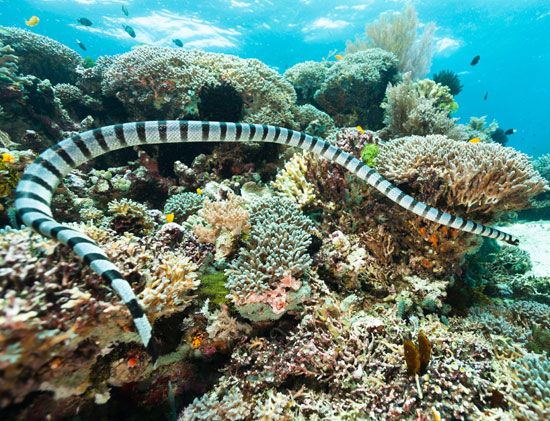
Sea snakes are highly specialized elapids adapted for marine environments. They are categorized into two groups: true sea snakes (subfamily Hydrophiinae) and…
What are the main characteristics that distinguish sea snakes from other snakes?
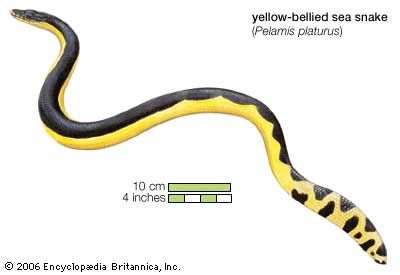
Sea snakes are highly specialized elapids adapted for marine environments. They are categorized into two groups: true sea snakes (subfamily Hydrophiinae) and sea kraits (subfamily Laticaudinae).1
Key Adaptations
True sea snakes exhibit significant physiological differences from terrestrial snakes to thrive underwater:
- Body Shape: They possess flattened bodies and short, oarlike tails for propulsion.1
- Respiration: They have elongated lungs that span their body length and can remain submerged for hours by utilizing cutaneous respiration, absorbing oxygen and expelling carbon dioxide through their skin.1
- Sensory and Physical Traits: They feature valvular nostrils on top of the snout and non-overlapping, juxtaposed scales. Advanced species lack belly scales, rendering them helpless on land.1
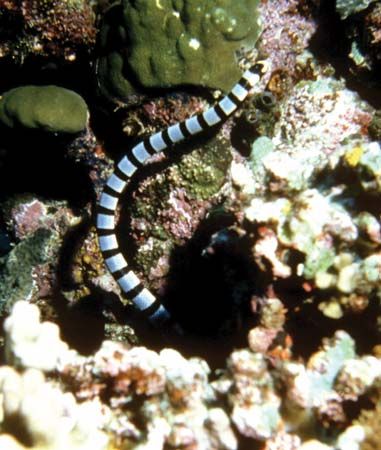
In contrast, sea kraits are less specialized; they retain cylindrical bodies and enlarged belly scales, allowing them to crawl and climb on land to lay their eggs. While both groups possess highly potent venom, they are generally not aggressive toward humans.1
What do sea snakes eat, and how do they hunt their prey?
Sea snakes are highly specialized predators that have evolved distinct dietary habits and hunting strategies to thrive in marine environments.
Diet
Most sea snakes feed primarily on various types of fishes, including eels. Their dietary preferences can be quite specific:
- Generalists: Many species consume fish of various sizes and shapes found along the ocean floor, in mangroves, or among coral reefs.
- Specialists: Certain groups, such as the genera Aipysurus and Emydocephalus, feed exclusively on fish eggs. Others, like those in the genus Hydrophis, specialize in hunting burrowing eels.
- Sea Kraits: These snakes are nocturnal hunters that feed primarily on eels at depths of less than 15 metres.
Hunting Strategies
Sea snakes utilize a combination of physical adaptations and sensory tools to capture prey:
- Morphological Adaptations: Some species, such as those in the genus Microcephalophis, possess a tiny head and a long, slender neck. This allows them to insert their heads deeply into narrow crevices or holes to extract hidden prey.
- Venom: As members of the Elapidae family, sea snakes possess potent venom delivered through short, fixed fangs. This venom is used to rapidly immobilize prey.
- Sensory Detection: Like other snakes, they rely on the Jacobson’s organ in the roof of the mouth. By using their double-tipped tongue to collect chemical cues from the water, they can trail and identify their prey effectively.
How many species of sea snakes are known to exist?
There are more than 60 known species of sea snakes, which are highly venomous marine members of the cobra family (Elapidae).1
These snakes are divided into two independently evolved groups:
- True sea snakes (subfamily Hydrophiinae): This group consists of 55 species.1
- Sea kraits (genus Laticauda): This group consists of 6 species.1
What role do sea snakes play in marine ecosystems?
Sea snakes play a significant role in marine ecosystems primarily as specialized predators that help regulate populations of fishes and eels within their habitats. By hunting in diverse environments—ranging from coral reefs and mangroves to the open ocean floor—they occupy specific ecological niches that influence the distribution and behavior of their prey.1
Their ecological impact is defined by several key factors:
- Trophic Regulation: As highly venomous predators, they exert pressure on prey populations, including species that burrow into the seafloor or hide in narrow crevices.12
- Habitat Utilization: Because they hunt across various substrates, such as hard coral bottoms or soft mud and sand, they are integrated into the health and balance of these complex marine environments.1
- Specialization: Certain species, such as those that feed exclusively on fish eggs, demonstrate a unique level of specialization that further diversifies their role in the food web.1
Sources
- sea snake — Encyclopædia Britannica
- snake - Specializations for securing food — Encyclopædia Britannica
- water snake — Encyclopædia Britannica
- Hydrophidae — Merriam-Webster
- elapid — Encyclopædia Britannica
Published on · 3 min read