Rhesus Monkey
The rhesus monkey (Macaca mulatta) is a prominent member of the macaque genus, which belongs to the family Cercopithecidae (Old World monkeys). While they…
What are the key differences between rhesus monkeys and other primate species?
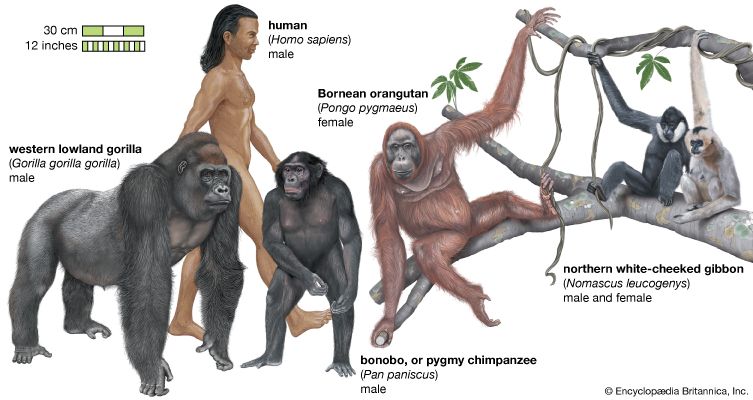
The rhesus monkey (Macaca mulatta) is a prominent member of the macaque genus, which belongs to the family Cercopithecidae (Old World monkeys). While they share many characteristics with other primates, several features distinguish them and their close relatives:12
- Physical Traits: Unlike New World monkeys, rhesus monkeys and other Old World species possess narrow noses with downward-facing nostrils and hard, bare “sitting pads” (ischial callosities) on their buttocks. They lack the prehensile tails found in some New World species; in fact, macaques are nearly tailless.3
- Adaptability: Rhesus monkeys are exceptionally hardy and can thrive in diverse climates and habitats, ranging from forests to areas of human habitation. While most primates are tropical, some rhesus populations have historically extended into temperate northern latitudes.14
- Social Structure: They live in multi-male, multi-female troops. A key behavioral distinction is that males typically leave their birth troop at maturity, while females remain, creating stable, matrilineal social groups.15
- Research Significance: Rhesus monkeys are highly intelligent and have been vital in medical and psychological research, including the identification of the Rh factor in human blood.12
What are the physical characteristics of rhesus monkeys?
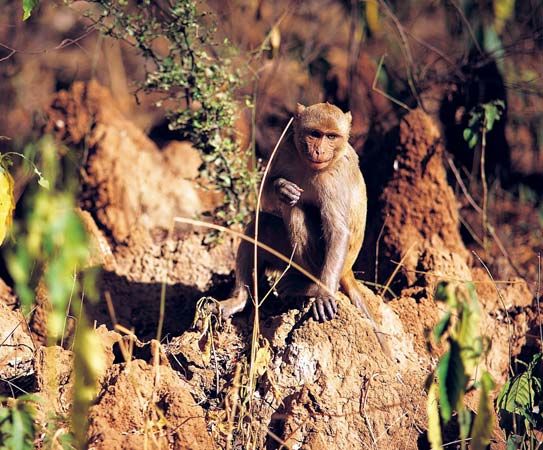
The rhesus monkey (Macaca mulatta) is a robust primate belonging to the family Cercopithecidae. Its physical characteristics include:
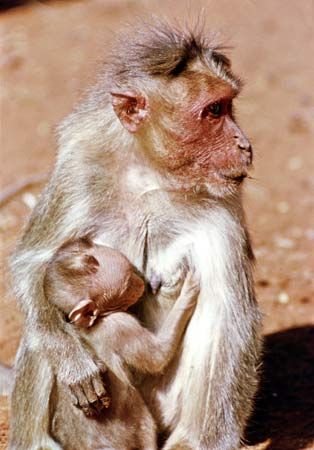
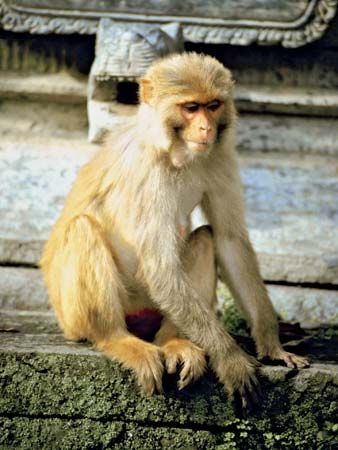
- Size and Build: These monkeys measure approximately 47–64 cm (19–25 inches) in length, excluding their furry 20–30-cm tail. There is sexual dimorphism in weight, with females averaging about 8.5 kg (19 pounds) and males averaging 11 kg.1
- Coloration: They are generally sand-colored or pale brown, with distinct orange coloration on their rump and legs.16
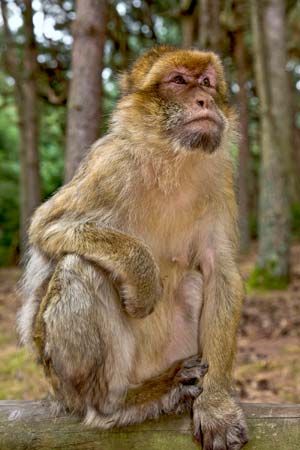
- Muzzle and Facial Features: Like other macaques, they possess a doglike but rounded muzzle with nostrils located on the upper surface.2
- General Anatomy: As Old World monkeys, they are characterized by arms and legs of similar length and the presence of large cheek pouches used for carrying food.2
Where are rhesus monkeys typically found in the wild?
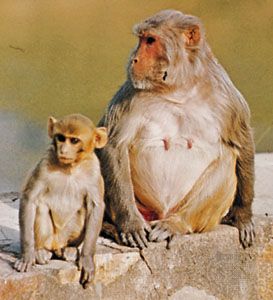
Rhesus monkeys (Macaca mulatta) are native to a variety of forest habitats across northern India, Nepal, eastern and southern China, and northern Southeast Asia.1
These primates are highly adaptable and thrive in diverse climates, ranging from natural forest environments to areas of human habitation. In India, they are frequently found near temples, where they are held sacred and often coexist closely with human populations. While most nonhuman primates are restricted to tropical latitudes, rhesus monkeys have historically demonstrated a broader range, with some populations extending as far north as the latitude of Beijing, China.13
What is the diet of rhesus monkeys, and how does it vary in different habitats?
The rhesus monkey (Macaca mulatta) is an omnivorous primate with a flexible diet that adapts to its environment.
In their natural forest habitats, their diet consists primarily of:
- Fruits
- Seeds
- Roots
- Herbs
- Insects1
When rhesus monkeys live in areas of human habitation, their dietary habits shift significantly. They become opportunistic feeders, frequently consuming agricultural crops and scavenging through human garbage for food scraps. This adaptability is a hallmark of the species, allowing them to thrive in diverse settings ranging from remote forests to densely populated areas near temples.1
As primates, they exhibit a generalist approach to nutrition, which is supported by their digestive physiology. While they have preferences for certain food items, they are not restricted to a single food source, which has contributed to their success in various ecological niches.7
Sources
- rhesus monkey — Encyclopædia Britannica
- macaque — Encyclopædia Britannica
- primate - Distribution and abundance — Encyclopædia Britannica
- monkey - Old World monkeys versus New World monkeys — Encyclopædia Britannica
- monkey — Encyclopædia Britannica
- rhesus monkey — Merriam-Webster
- primate - Diet — Encyclopædia Britannica
Published on · 3 min read