Moreton Bay Pine
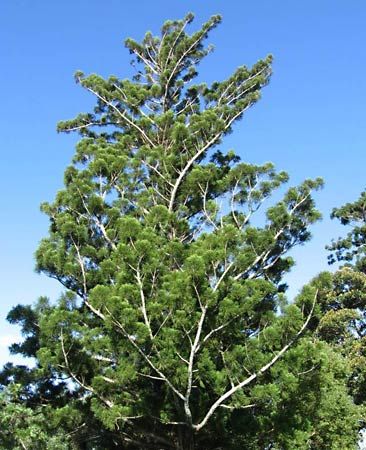
The Moreton Bay pine (Araucaria cunninghamii), also known as the hoop pine, is a large evergreen conifer belonging to the family Araucariaceae. Despite its…
What is Moreton Bay pine?
The Moreton Bay pine (Araucaria cunninghamii), also known as the hoop pine, is a large evergreen conifer belonging to the family Araucariaceae. Despite its common name, it is not a true pine.12
Native to the coastal rainforests of eastern Australia—ranging from northern New South Wales to Queensland—and the Arfak Mountains of New Guinea, the tree can reach heights of approximately 60 metres (200 feet). It features rough, splitting bark and horizontal branches with dense, dagger-shaped or triangular leaves.1
The species is dioecious, meaning male and female cones grow on separate individuals. Its wood is highly valued for use in veneer, plywood, and particleboard. Additionally, it is frequently cultivated as an outdoor ornamental plant.132
Why is the Moreton Bay pine not considered a true pine?
The Moreton Bay pine (Araucaria cunninghamii) is not considered a true pine because it does not belong to the family Pinaceae, which contains the genus Pinus (true pines).143
Instead, the Moreton Bay pine is a member of the family Araucariaceae. While both families are conifers, they are distinguished by significant botanical differences in their reproductive structures:
- Cone Structure: In the family Pinaceae, seed-bearing cones typically have scales that carry two winged seeds, with the scales and bracts often fused. In contrast, members of the Araucariaceae family, such as the Moreton Bay pine, produce massive seed cones where each scale bears only a single large seed, and the scales are completely fused to the much larger bracts.53
- Classification: True pines belong to the genus Pinus within the order Pinales. The Moreton Bay pine belongs to the genus Araucaria, which is a distinct group of pinelike plants that evolved separately within the same broader order.465
What are some other famous species in the Araucaria genus?
The genus Araucaria includes several notable species valued for their distinct growth habits and utility as timber or ornamental plants. Some of the most famous include:
- Monkey puzzle tree (Araucaria araucana): Native to the cordilleras of Chile and Argentina, this tree is widely cultivated for its unique, conspicuous growth habit. It can reach heights of 50 metres and produces large, durable wood.37
- Norfolk Island pine (Araucaria heterophylla): Known for its symmetrically tiered branches, this species is popular as a houseplant in its sapling stage and as an outdoor ornamental in Mediterranean climates. Its wood is also used in construction and shipbuilding.38
- Bunya pine (Araucaria bidwillii): Native to Queensland, Australia, this tree is famous for its massive female cones, which can weigh up to 18 kg. Its large seeds were traditionally a food source for Australian Aboriginal peoples, and it features a unique germination strategy that may protect it from wildfires.39
- Paraná pine (Araucaria angustifolia): Often utilized as an outdoor ornamental, this species is another prominent member of the genus.3
How do conifers like the Moreton Bay pine reproduce?
The Moreton Bay pine (Araucaria cunninghamii) and other conifers in the Araucariaceae family reproduce through a specialized process involving wind-pollinated cones.13
Reproductive Characteristics
- Dioecious Nature: These plants are typically dioecious, meaning male and female cones are produced on separate individual trees.110
- Pollination: Like all conifers, they rely on the wind for pollination. However, unlike many other conifers, the pollen grains of the Araucariaceae do not land directly on an ovule. Instead, they land on the scales of the female cone and must reach the micropyle by burrowing into the cone scales.3
- Seed Development: Female cones are globose and take approximately 18 months to mature. Once mature, the cones disintegrate to release their edible seeds.110
- Gametophyte Phase: The male and female gametophytes develop within the parent sporophyte. The Araucariaceae are notable for having some of the most complex male gametophytes among seed plants, characterized by a high number of prothallial cells.11
Sources
- Moreton Bay pine — Encyclopædia Britannica
- hoop pine — Merriam-Webster
- Araucaria — Encyclopædia Britannica
- pine — Encyclopædia Britannica
- conifer - Annotated classification — Encyclopædia Britannica
- Pinaceae — Encyclopædia Britannica
- Norfolk Island pine — Encyclopædia Britannica
- monkey puzzle — Merriam-Webster
- bunya pine — Encyclopædia Britannica
- conifer - Gametophyte phase — Encyclopædia Britannica
- conifer - Pollination — Encyclopædia Britannica
- seed dispersal - Self-dispersal — Encyclopædia Britannica
Published on · 3 min read