Lebachia
Lebachia is a genus of extinct, cone-bearing plants that lived during the Late Carboniferous and Early Permian epochs, approximately 318 million to 271…
What is Lebachia?
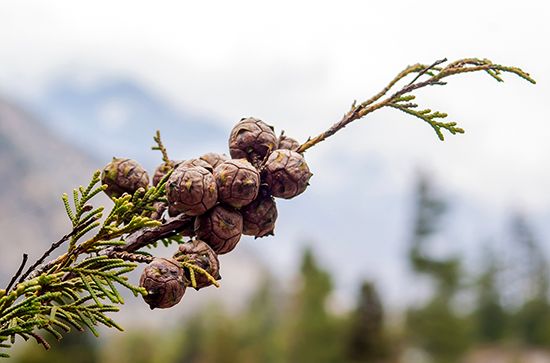
Lebachia is a genus of extinct, cone-bearing plants that lived during the Late Carboniferous and Early Permian epochs, approximately 318 million to 271 million years ago. These plants are considered among the direct ancestors of most modern conifers, excluding yews.1
Physically, Lebachia featured pinnately arranged side branches, giving it a growth habit reminiscent of the contemporary Norfolk Island pine. The genus is distinguished from other fossil conifers primarily by the presence of hairs on its leaves. It produced both pollen-bearing and seed-bearing cones at the tips of its side branches. While classified within the order Coniferales (or sometimes Voltziales), its specific size remains a subject of scientific uncertainty.12
What are the main differences between ancient and modern conifers?
The evolution of conifers from their ancient ancestors to modern species involves significant changes in reproductive structures, leaf morphology, and overall complexity.
Reproductive Structures
Ancient conifers, such as those in the order Cordaitales and the family Lebachiaceae, possessed relatively simple, loose reproductive axes. Over time, these evolved into the complex, compact seed cones characteristic of modern conifers. In modern species, the ovuliferous scale—the woody part of the cone—is a highly modified structure derived from lateral buds that became fused with bracts, a process that became more pronounced from the late Paleozoic through the Mesozoic Era.1
Leaf Morphology
While modern conifers are defined by diverse leaf forms—ranging from minute scales to needles and broad blades—ancient ancestors exhibited different patterns. For example, the extinct Cordaites bore large, strap-shaped leaves up to one meter long. Modern conifers have evolved specialized adaptations to minimize water loss, such as thick, waxy coatings and sunken stomates, which allow them to thrive in varied environments.34
Evolutionary Trends
- Complexity: Modern conifers are distinguished by the combination of simple pollen cones and complex, compound seed cones.5
- Diversity: Modern families, such as Cupressaceae and Pinaceae, emerged during the Mesozoic Era, eventually becoming the dominant vegetation before the rise of angiosperms.1
- Wood Structure: While ancient conifers already possessed dense, compact wood similar to modern types, the evolutionary refinement of tracheids and vascular rays has supported the development of some of the tallest and most massive organisms on Earth, such as coast redwoods.16
How do scientists use fossils to trace plant evolution?
Scientists use fossils to trace plant evolution by analyzing both large physical remains and microscopic evidence preserved in sedimentary rocks. This fossil record reveals patterns of increasing biological diversity, complexity, and structural adaptation over hundreds of millions of years.9
Key Methods of Analysis
- Palynology: Scientists study pollen and spores, which are highly resistant to decay. Because they are produced in vast quantities and dispersed widely, these microfossils allow researchers to reconstruct regional forest composition and track how plant groups shifted in response to climatic change over time.1011
- Morphological Study: Paleobotanists examine the external form and cellular features of fossilized plant parts—such as leaves, stems, and seeds—to understand evolutionary changes in plant structure and life history. When fragments are found separately, scientists often construct “form groups” to classify them until they can be associated with a single organism.912
- Microscopic Analysis: Techniques such as electron microscopy and the study of phytoliths (microscopic silica bodies) help identify specific plant types, even when only small remnants are available in archaeological or geological sediments.1013
By integrating these findings, researchers can delineate phylogenetic relationships between extinct and extant plants, helping to build a branching, evolutionary history of the plant kingdom.1012
What was the climate like during the Carboniferous and Permian periods?
The climates of the Carboniferous Period and Permian Period were defined by significant shifts in geography and atmospheric conditions.
The Carboniferous Period
During the Carboniferous, climate was largely dictated by latitudinal position. Tropical conditions dominated equatorial regions, while midlatitudes were generally dry and higher latitudes were cooler and moist. A defining feature was the extensive glaciation across the supercontinent of Gondwana, which sat at high southern latitudes. As the period progressed into the Pennsylvanian, sea-level changes shifted equatorial environments from carbonate shelves to coal-forming basins, while mountain-building events introduced rain-shadow effects that influenced regional moisture.15
The Permian Period
The Permian began with persistent glaciation in southern landmasses, but the assembly of the supercontinent Pangea triggered a transition toward global warming and increased aridity. High mountain ranges disrupted atmospheric flow, diverting warm marine air and creating widespread deserts in tropical and subtropical zones. By the Late Permian, conditions became hot and dry, culminating in massive volcanism from the Siberian traps, which likely altered the atmosphere and contributed to a severe mass extinction.1617
Sources
- Lebachia — Encyclopædia Britannica
- Lebachia — Merriam-Webster
- gymnosperm - Appearance of gymnosperm divisions — Encyclopædia Britannica
- conifer - Distinguishing taxonomic features — Encyclopædia Britannica
- conifer - Leaves — Encyclopædia Britannica
- gymnosperm - Pinophyta — Encyclopædia Britannica
- Cordaitales — Encyclopædia Britannica
- lower vascular plant - Leaves — Encyclopædia Britannica
- palynology — Encyclopædia Britannica
- plant - Evolution and paleobotany — Encyclopædia Britannica
- Origins of agriculture - Research techniques — Encyclopædia Britannica
- Holocene Epoch - Floral change — Encyclopædia Britannica
- taxonomy - Making a classification — Encyclopædia Britannica
- Morphology - Historical background — Encyclopædia Britannica
- Permian Period - Paleoclimate — Encyclopædia Britannica
- Carboniferous Period - Paleoclimate — Encyclopædia Britannica
- Permian Period — Encyclopædia Britannica
Published on · 3 min read