Docodon
Docodon is an extinct genus of mammals that lived during the Middle and Upper Jurassic Period, approximately 175.6 million to 145.5 million years ago. While…
What is Docodon?
Docodon is an extinct genus of mammals that lived during the Middle and Upper Jurassic Period, approximately 175.6 million to 145.5 million years ago. While they are classified within the order Docodonta, their status as true mammals remains a subject of scientific debate; they meet only the broadest definition of the group, characterized by a jaw joint between the dentary and squamosal bones.1
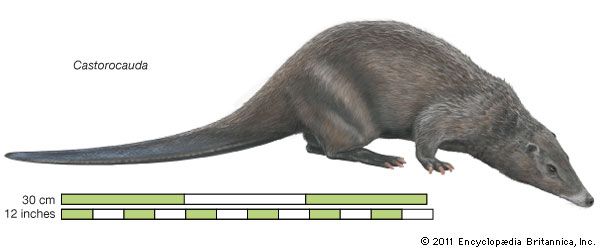
Initially identified through complex, modern-looking fossilized teeth, Docodon and its relatives are only distantly related to living mammalian lineages. The order Docodonta was geographically widespread, with fossils discovered in Europe, North America, and China. A notable member of this group is Castorocauda, a beaver-like, semiaquatic mammal that provides evidence of the early diversity of these creatures, including the presence of hair and specialized adaptations for swimming and digging. Another well-studied relative, Haldanodon, is known from a nearly complete skeleton that suggests it was a burrowing animal.12
What defines an animal as a mammal?
Mammals (class Mammalia) are vertebrate animals defined by several unique biological characteristics, most notably the nourishment of their young with milk produced by the mother’s mammary glands.3
Beyond this, mammals are distinguished by a suite of specialized features:
- Jaw and Ear Structure: The lower jaw consists of a single bone (the dentary) that hinges directly to the skull. Additionally, mammals possess three tiny bones in the middle ear that transmit sound.34
- Physiology: Mammals are generally endothermic (warm-blooded), a trait supported by hair for insulation and a muscular diaphragm that aids in respiration. Their mature red blood cells are unique among vertebrates because they lack a nucleus.35
- Reproduction: Most mammals are viviparous, meaning they give birth to live young. The exception is the monotreme order, which lays eggs.3
These traits evolved as an interrelated system, allowing mammals to be highly adaptable across diverse environments.35
How did early mammals adapt to the Jurassic environment?
During the Jurassic Period, early mammals occupied a subordinate ecological position, as dinosaurs and other archosaurs dominated terrestrial niches. To survive in this environment, early mammals remained small—typically no larger than squirrel-sized—and adapted to specialized lifestyles.267
Their survival strategies included:
- Ecological Specialization: While many early mammals were small insectivores or omnivores, some evolved distinct adaptations for specific environments. For example, the semiaquatic Castorocauda possessed a flat, scaly tail for swimming and limbs adapted for digging, allowing it to exploit aquatic and subterranean resources. Other taxa, such as Haldanodon, were specialized for burrowing.28
- Physiological Adaptations: Fossil evidence from Castorocauda reveals that these mammals had developed hair and an undercoat, which provided essential insulation.8
- Niche Partitioning: By remaining small and potentially adopting nocturnal behaviors—a common strategy among early mammals to avoid visual predators and harsh daytime temperatures—they were able to coexist alongside the dominant reptilian fauna of the era.279
What are the differences between docodonts and modern mammals?
The classification of docodonts, such as the genus Docodon, in relation to modern mammals is a subject of scientific debate. Whether they are considered true mammals depends on the definition used:
- Broad Definition: Docodonts are often included in the broad definition of mammals because they possess the characteristic mammalian jaw joint, where the lower jaw consists of a single dentary bone that hinges directly to the squamosal bone of the skull.1
- Strict Definition: Under a more restrictive definition—which limits “mammals” to the most recent common ancestor of living monotremes, marsupials, and placentals and its descendants—docodonts are classified as Mammaliaformes. This clade includes mammals and their closest extinct relatives, but excludes groups like docodonts from the strict mammalian lineage.113
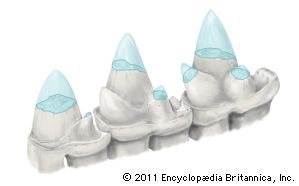
While docodonts exhibit complex molar structures that resemble those of modern mammals, they are only distantly related to living groups. In contrast, modern mammals share a specific evolutionary history and physiological traits, such as specialized brain structures and reproductive strategies, that distinguish them from these early, specialized forms.113
Sources
- Docodon — Encyclopædia Britannica
- Castorocauda — Encyclopædia Britannica
- mammal — Encyclopædia Britannica
- mammal - The evolution of the mammalian condition — Encyclopædia Britannica
- mammal - Skeleton — Encyclopædia Britannica
- mammal: Top Questions — Encyclopædia Britannica
- Jurassic Period - Vertebrates — Encyclopædia Britannica
- Jurassic Period - Paleoclimate — Encyclopædia Britannica
- Jurassic Period - Jurassic life — Encyclopædia Britannica
- A Journey Through Time Since the Precambrian - Jurassic Period: 201.3 million to 145 million years ago — Encyclopædia Britannica
- Animal - Rise of vertebrates — Encyclopædia Britannica
- bat - Activity patterns — Encyclopædia Britannica
- Morganucodon — Encyclopædia Britannica
- perissodactyl - Teeth — Encyclopædia Britannica
Published on · 3 min read