Stegosaurus
The Stegosaurus is famous for the large, triangular bony plates lining its back. While early theories suggested these plates provided physical protection for…
How did the plates on Stegosaurus’ back function, and what were their purpose?
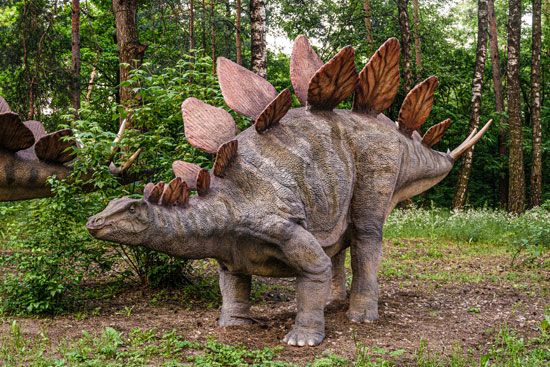
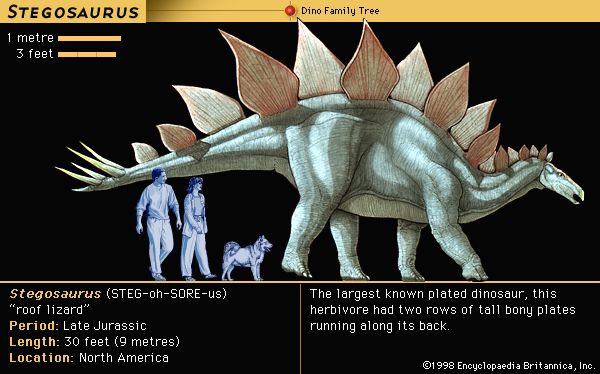
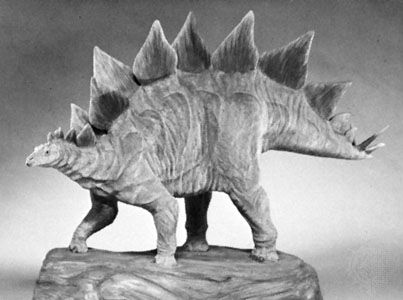
The Stegosaurus is famous for the large, triangular bony plates lining its back. While early theories suggested these plates provided physical protection for the backbone and spinal cord, modern research indicates they were arranged in an alternating pattern along the spine rather than in parallel rows.1
Regarding their function, the most prominent hypothesis suggests the plates served as tools for thermoregulation. Because the plates contained numerous blood vessels, they may have acted as radiators to release excess body heat or as solar panels to absorb heat from the sun.1
However, this theory remains debated. Because other related dinosaurs lacked such elaborate structures or possessed different arrangements, some paleontologists argue that the plates were primarily used for display or species recognition. Ultimately, while the plates were likely multifunctional, their exact purpose remains a subject of ongoing scientific investigation.1
How has our understanding of Stegosaurus changed since its first discovery?
Our understanding of the Stegosaurus has evolved significantly since its initial discovery in 1877, shifting from early assumptions to more nuanced scientific interpretations.12
Plate Arrangement and Function
For many years, paleontologists believed the Stegosaurus possessed two parallel rows of plates that served as protective armor for its backbone and spinal cord. However, reexaminations of specimens since the 1970s have led to the consensus that the plates were arranged in an alternating, staggered pattern.12
The discovery that these plates were highly vascularized—containing numerous blood vessels—prompted the hypothesis that they functioned as thermoregulation devices, acting as radiators to dissipate heat or as solar panels to absorb it. While this remains a popular theory, it is debated because other stegosaur species lacked such elaborate structures, leading many researchers to favor the idea that the plates were primarily used for display or species recognition.12
Anatomy and Misconceptions
Early interpretations also gave rise to the famous misconception that the Stegosaurus possessed a “second brain” due to an enlarged cavity in the sacrum region of the spinal cord. Modern science now suggests this space was likely used for storing glycogen, a common feature in many living animals, rather than for neurological processing.1
What role did Stegosaurus play in its ecosystem during the Late Jurassic period?
During the Late Jurassic period, Stegosaurus occupied a niche as a large, quadrupedal herbivore. Its role in the ecosystem was defined by its specialized feeding habits and its interactions with the environment and other dinosaurs.52
Feeding and Diet
Stegosaurus possessed a small, narrow skull with weakly developed, leaf-shaped teeth. Because its mouth was poorly equipped for processing tough vegetation, it likely fed on low-growing shrubbery, such as cycads and conifers, which were abundant in the Jurassic landscape. Given its massive bulk, it is hypothesized that Stegosaurus relied on a specialized digestive tract containing fermenting bacteria to break down cellulose-rich plant tissues, as it lacked the complex dental batteries found in later herbivores.26
Defensive and Social Role
As a member of the Thyreophora group, Stegosaurus was an armored herbivore. Its primary defensive adaptation was the set of long, pointed bony spikes on its tail, which likely served as a weapon against predators. The large, vascularized plates along its back may have played a role in thermoregulation, though many paleontologists also suggest they functioned as display structures for species recognition within its habitat.572
How does Stegosaurus compare to other members of the Stegosauridae family?
Stegosaurus is the most well-known member of the Stegosauria family, but it exhibits several distinct characteristics when compared to its relatives:
- Plate Arrangement: While many stegosaurs featured symmetrical, paired plates, Stegosaurus is unique for its alternating, staggered row of large, diamond-shaped plates along its back. Other genera, such as Kentrosaurus, possessed more symmetrical plating or a combination of plates on the front half of the spine and spikes on the rear half and tail.12
- Size and Morphology: Stegosaurus was among the largest of the group, reaching lengths of up to 9 meters (30 feet). In contrast, other members like Kentrosaurus were significantly smaller, measuring less than 2 meters in height and 3.5 meters in length.12
- Thermoregulation: The high degree of vascularization in the plates of Stegosaurus led to the hypothesis that they functioned as cooling vanes. This feature is considered peculiar to Stegosaurus; other stegosaur taxa lacked these specialized structures, suggesting that for most members of the family, plates and spikes were likely used for display or passive defense rather than thermoregulation.2
Sources
- Stegosaurus — Encyclopædia Britannica
- dinosaur - Stegosauria — Encyclopædia Britannica
- dinosaur - American hunting expeditions — Encyclopædia Britannica
- dinosaur - Reconstruction and classification — Encyclopædia Britannica
- stegosaur — Encyclopædia Britannica
- Jurassic Period - Paleoclimate — Encyclopædia Britannica
- A Journey Through Time Since the Precambrian - Jurassic Period: 201.3 million to 145 million years ago — Encyclopædia Britannica
- dinosaur - The plant eaters — Encyclopædia Britannica
Published on · 4 min read