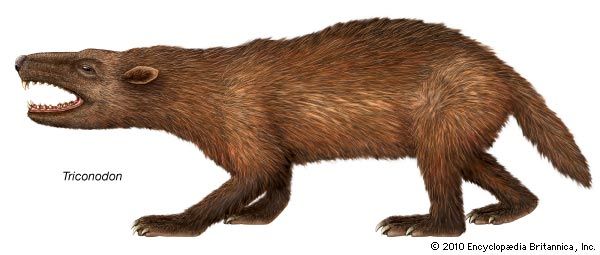
Triconodon
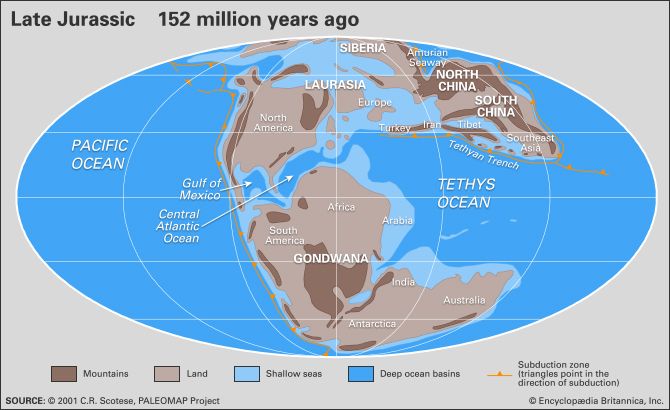
Triconodon is a genus of extinct mammals that lived during the late Jurassic Period, approximately 161 million to 146 million years ago.
What is Triconodon?
Triconodon is a genus of extinct mammals that lived during the late Jurassic Period, approximately 161 million to 146 million years ago.1
These animals were relatively large for their time, reaching the size of a domestic cat, whereas most other early mammals were significantly smaller. The genus is named for its distinctive molars, which feature three cone-shaped cusps. Given their strongly developed canine teeth, it is likely that Triconodon functioned as an active predator. While they possessed a smaller brain than most modern mammals, they are representative of the triconodonts, a group known from fossils discovered across North America, Europe, Africa, and China.12
What were other mammals like during the Jurassic Period?
During the Jurassic Period, mammals were a diverse and widespread group, though they remained relatively small and occupied niches distinct from the dominant archosaurs (dinosaurs, crocodiles, and pterosaurs). While often overshadowed by these larger reptiles, early mammals exhibited a variety of specialized adaptations.45
Diversity and Adaptations
Jurassic mammals were not merely uniform, shrewlike creatures; they evolved to fill various ecological roles:4
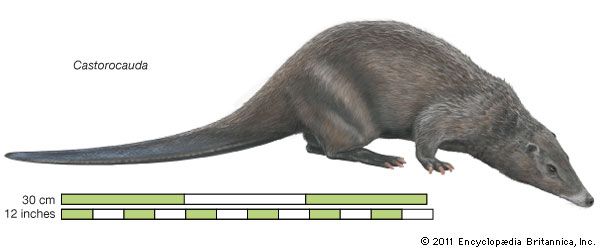
- Semiaquatic Specialists: The genus Castorocauda, a beaverlike mammal from the Middle Jurassic, is the largest known Jurassic mammal, weighing up to 800 grams. It possessed a flat, scaly tail for swimming and adaptations for digging, with teeth suggesting a fish-eating diet.4
- Generalists and Insectivores: Other taxa included small insectivores like Ambondro and generalists such as Haldanodon, which resembled modern opossums.4
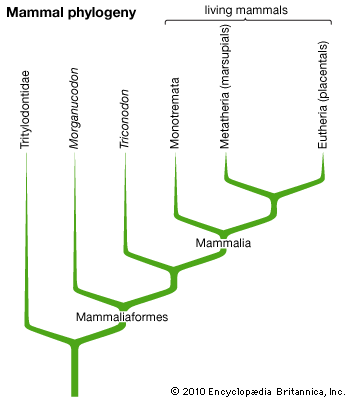
- Early Mammaliaformes: Animals like Morganucodon, which lived near the Triassic-Jurassic boundary, were tiny, insectivorous, and possessed defining mammalian traits such as hair and a specialized jaw joint.6
Evolutionary Context
By the start of the Jurassic, the “mammal-like reptiles” (synapsids) that dominated the Triassic had become rare and small, typically no larger than squirrels. Jurassic mammals were generally omnivorous or insectivorous, and their evolution included significant skeletal changes, such as the transition of posterior jaw bones into the middle ear.56
How do scientists determine what an extinct animal ate?
Scientists use several methods to determine the diet of extinct animals, relying on both direct physical evidence and inferences based on anatomy.
Anatomical Analysis
The most common method involves studying an animal’s teeth. Dental morphology often reveals dietary specializations:
- Carnivores: Sharp, pointed cusps are adapted for tearing flesh.10
- Herbivores: Specialized cheek teeth with complex patterns or grinding surfaces help process tough plant material.10
- Omnivores: Often possess bunodont molars with low, rounded cusps.10
- General Body Plan: Features such as jaw structure, neck length, and limb type (e.g., hooflike feet) provide clues about whether an animal was a browser, grazer, or predator.9
Direct Evidence
In rare cases, scientists find direct proof of an animal’s last meal:
- Stomach Contents: Fossilized remains found within the abdominal cavity, such as pine needles in a hadrosaur or lizard bones inside a Compsognathus, offer definitive evidence.911
- Coprolites: Fossilized excrement often preserves undigested fragments of bone or plant material, providing a snapshot of an animal’s diet.1211
- Gastroliths: The presence of “stomach-stones” can indicate a digestive system adapted for grinding fibrous plant matter.9
What are the main differences between early mammals and modern ones?
The distinction between early mammals and modern ones is defined by significant evolutionary shifts in anatomy, physiology, and reproductive strategies.
Anatomical and Skeletal Changes
A primary diagnostic feature separating early mammals from their ancestors is the structure of the jaw and ear. In early forms like Morganucodon, the jaw joint was formed by the dentary and squamosal bones, a trait that distinguishes them from other vertebrates. Over time, accessory jawbones migrated to the middle ear to become auditory ossicles, a process that parallels the development seen in modern mammals. Additionally, modern mammals possess a highly developed neopallium in the cerebrum, which facilitates complex learning and adaptive behavior, whereas early mammals had significantly smaller brains.1516
Physiological and Reproductive Advancements
Modern mammals are characterized by a suite of interrelated systems that support high levels of activity, including:
- Endothermy: The ability to maintain a constant body temperature, supported by hair for insulation.417
- Circulatory Efficiency: A four-chambered heart and non-nucleated red blood cells.417
- Respiratory Specialization: A diaphragm and a secondary palate, which allow for simultaneous breathing and feeding.417
Reproductively, most modern mammals are viviparous, with placental mammals utilizing a placenta for extended fetal development, and marsupials relying on a unique strategy of premature birth followed by development in a pouch or on the mother’s body.181917
Sources
- Triconodon — Encyclopædia Britannica
- triconodon — Merriam-Webster
- triconodont — Merriam-Webster
- Morganucodon — Encyclopædia Britannica
- Castorocauda — Encyclopædia Britannica
- A Journey Through Time Since the Precambrian - Jurassic Period: 201.3 million to 145 million years ago — Encyclopædia Britannica
- Jurassic Period - Vertebrates — Encyclopædia Britannica
- mammal: Top Questions — Encyclopædia Britannica
- dinosaur - The plant eaters — Encyclopædia Britannica
- mammal - Teeth — Encyclopædia Britannica
- coprolite — Encyclopædia Britannica
- stomach — Encyclopædia Britannica
- Origins of agriculture - Research techniques — Encyclopædia Britannica
- dinosaur - The flesh eaters — Encyclopædia Britannica
- mammal - The evolution of the mammalian condition — Encyclopædia Britannica
- perissodactyl - Teeth — Encyclopædia Britannica
- placental mammal — Encyclopædia Britannica
- marsupial — Encyclopædia Britannica
- mammal — Encyclopædia Britannica
- human evolution - Increasing brain size — Encyclopædia Britannica
- mammal - Nervous and endocrine systems — Encyclopædia Britannica
Published on · 3 min read