Moskva River
The Moskva River (also known as the Moscow River) is a significant river in western Russia that flows through the Moscow and Smolensk oblasts. Rising in the…
What is Moskva River?
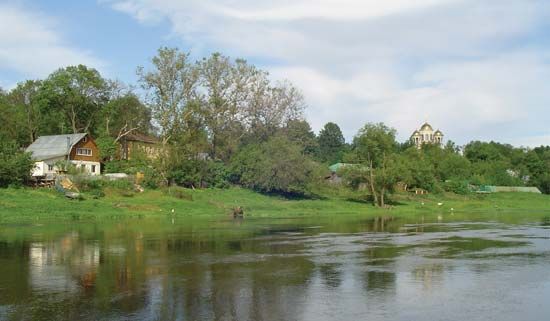
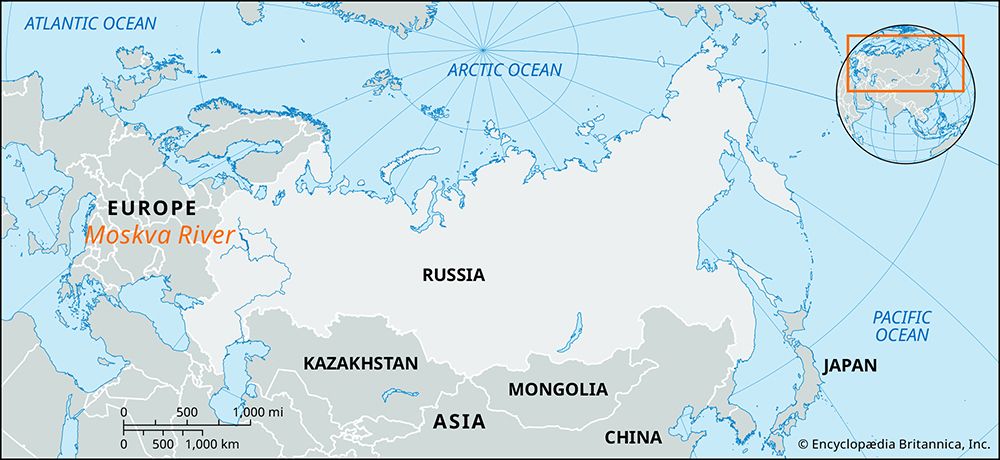
The Moskva River (also known as the Moscow River) is a significant river in western Russia that flows through the Moscow and Smolensk oblasts. Rising in the Smolensk-Moscow Upland, it travels 312 miles (502 km) in a southeasterly direction as a left-bank tributary of the Oka River, ultimately contributing to the Volga basin.12
The river serves as a vital water supply for the city of Moscow, which is built within its broad, shallow valley. While the river was historically the primary water access for the city, the construction of the Moscow Canal between 1932 and 1937 provided a deeper, more efficient waterway for larger craft. Today, the Moskva is heavily managed, with stone embankments, controlled channels, and winter ice-breaking measures to maintain its utility. Major cities along its course include Moscow, Zvenigorod, Voskresensk, and Kolomna.123
How does the Moscow Canal connect the city to the Volga River?
The Moscow Canal serves as a vital 80-mile (128 km) waterway that links Moscow to the Volga River at Ivankovo, north of the city. Constructed between 1932 and 1937 using forced labour, the canal was designed to provide a deep, navigable route for seagoing vessels, replacing the canalized Moskva River, which can only accommodate smaller craft.24
The canal runs northward from the Moskva River, passing through the Khimki and Ucha reservoirs and cutting through the Klin-Dmitrov Ridge to reach the Volga. It features 11 locks and maintains a minimum depth of 18 feet (5.5 m), significantly improving Moscow’s connectivity to the Volga basin and, by extension, all the seas bordering European Russia. Beyond its role in transportation, the canal and its associated reservoirs are essential to the city’s water supply, providing a reliable surface source for the capital.423
What role did glaciers play in shaping the landscape of Moscow?
During the Pleistocene Epoch, the advance and retreat of glaciers played a fundamental role in shaping the landscape of Moscow. These glacial movements deposited a thick mantle of boulder clays, sands, and gravels across the region.3
The Moskva River subsequently carved its wide, sinuous valley into these glacial deposits, creating a series of four distinct terraces. Much of the modern city is built upon the third and most extensive of these terraces, which rises 100–115 feet (30–35 meters) above the river.3
Glacial activity also influenced the city’s topography beyond the river valley. To the north, the landscape slopes toward the Klin-Dmitrov morainic ridge, a feature formed by glacial debris. Additionally, the Teplostanskaya Upland in the southwest—which contains the city’s highest point—is covered by glacial morainic material overlying Cretaceous rocks. These geological foundations provided the basic relief upon which the city has developed over centuries.3
What are the Sparrow Hills and why are they significant?
The Sparrow Hills—also historically referred to as the Vorobyëvy Hills or the Lenin Hills—are a prominent geographical feature located in the southwest of Moscow. They consist of a steep cliff formed where a sweeping bend of the Moskva River has cut into the edge of the Teplostanskaya Upland, an area characterized by glacial morainic material overlying Cretaceous rocks.3
The significance of the Sparrow Hills lies primarily in their topography. As one of the few notable elevations in an otherwise relatively flat landscape, they provide panoramic views of the city, making them a well-known vantage point. While there is a popular legend that Moscow was built on seven hills, this is considered an exaggeration; the Sparrow Hills represent one of the few genuine upland areas within the city’s limits, standing in contrast to the city’s broader, shallow river valley.3
Sources
- Moskva River — Encyclopædia Britannica
- Moscow Canal — Encyclopædia Britannica
- Moscow - City site — Encyclopædia Britannica
- Moscow - Waterways — Encyclopædia Britannica
Published on · 3 min read