Moulin
A moulin (French for "mill") is a nearly cylindrical, vertical shaft that extends through a glacier and is carved by meltwater from the glacier's surface.…
What is moulin?
A moulin (French for “mill”) is a nearly cylindrical, vertical shaft that extends through a glacier and is carved by meltwater from the glacier’s surface. Also known as a glacial mill, these features are noted for the thunderous sound of the water funneling into them.1
When a glacier retreats, it may leave behind postglacial evidence known as a moulin pothole—a giant kettle scoured into the bedrock by rocks and boulders transported by the falling water. Unlike typical fluvial potholes, these can be found on hilltops and steep slopes, often occurring without the linear alignment associated with stream-carved features.1
How does meltwater affect the speed of a glacier?
Meltwater plays a critical role in the movement of glaciers, primarily by facilitating sliding at the glacier’s base.23
For glaciers that are at the melting temperature at their base, meltwater acts as a lubricant between the ice and the underlying bedrock. This process is influenced by the basal water pressure; as this pressure increases, the sliding speed of the glacier typically rises. In some cases, glaciers may not slide on rigid bedrock at all but instead “ride” on a layer of water-charged sediment, which can lead to unsteady or even chaotic flow behavior.23
The impact of meltwater on speed is most pronounced in thick, temperate glaciers where high subglacial water pressures allow for rapid movement. For example, glaciers that terminate in the ocean often experience very high sliding rates because the subglacial water pressure must be high enough to counteract the pressure of the surrounding seawater. While the exact mechanics of how sliding varies with the amount of basal water remain a subject of ongoing study, it is clear that the presence and pressure of meltwater are fundamental factors in determining how fast a glacier flows.32
What is the difference between a moulin and a crevasse?
While both features are found within glaciers, they differ significantly in their formation and structure:
- Moulin: A moulin is a nearly cylindrical, vertical shaft carved by surface meltwater. It acts as a conduit for water to flow through the ice, often creating a thunderous sound as the water funnels downward. Its postglacial legacy is often a deep, circular “moulin pothole” scoured into the underlying bedrock.6
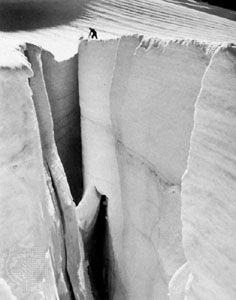
- Crevasse: A crevasse is a fissure or crack in the ice caused by the physical stress of glacial movement. Unlike the cylindrical moulin, crevasses are linear, ranging up to 20 meters wide and 45 meters deep. They are categorized by their orientation to the glacier’s movement, such as transverse crevasses or marginal crevasses, and can close up as the glacier moves over different gradients.1
In short, a moulin is a water-carved vertical pipe, whereas a crevasse is a stress-induced fracture in the ice.
How do scientists study the bottom of a glacier?
Scientists employ a variety of direct and indirect methods to study the base of a glacier and its internal dynamics:
- Borehole Drilling: Researchers drill deep vertical boreholes through the ice to reach bedrock. By monitoring the deformation of these holes over time, scientists can analyze how the glacier moves and slides at its base.78
- Tunneling: Lateral tunnels are sometimes excavated directly into the ice, allowing for direct observation of the glacier’s internal structure and its contact with the underlying surface.78
- Geophysical Surveys: Techniques such as seismic surveys and gravimetric surveys are used to determine the dimensions and depth of ice sheets, helping to map the topography of the bedrock beneath the ice.9
- Radar Sounding: This method is used to measure the thickness of glaciers and ice caps, providing a clear view of the ice-bedrock interface, particularly in cold glaciers where the ice is below its freezing point.798
- Core Analysis: By extracting ice cores, scientists can analyze annual layers and oxygen isotope ratios to understand the history and age of the deepest, oldest ice layers.98
Sources
- moulin — Encyclopædia Britannica
- glacier - Glacier hydrology — Encyclopædia Britannica
- glacier - Glacier flow — Encyclopædia Britannica
- glacier - Response of glaciers to climatic change — Encyclopædia Britannica
- glacier - Flow of mountain glaciers — Encyclopædia Britannica
- crevasse — Encyclopædia Britannica
- hydrologic sciences - The movement of glaciers — Encyclopædia Britannica
- Earth sciences - Glacier motion and the high-latitude ice sheets — Encyclopædia Britannica
- glaciology — Encyclopædia Britannica
- Earth exploration - Remote sensing — Encyclopædia Britannica
Published on · 3 min read