Kettle
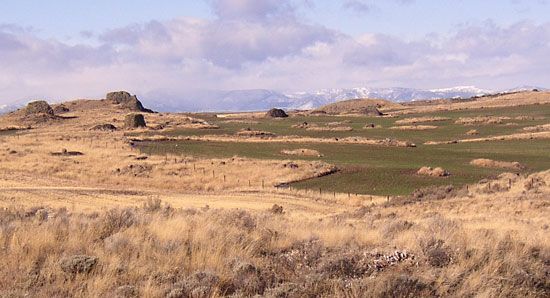
In geology, a kettle is a steep-sided depression found within glacial outwash or other glacial drift deposits. These features are typically circular, though…
What is a kettle in geological terms, and how is it formed?
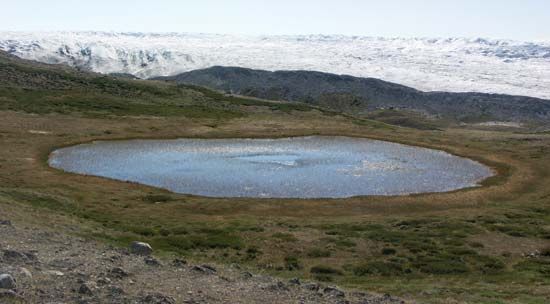
In geology, a kettle is a steep-sided depression found within glacial outwash or other glacial drift deposits. These features are typically circular, though they can appear distorted or branching depending on the shape of the original ice mass. When these depressions fill with water, they are referred to as kettle lakes.12
Kettles are formed through the melting of detached, “stagnant” blocks of glacial ice that have become wholly or partially buried by sediment. This process occurs in two primary ways:12
- Partial burial: An ice mass is partially covered by debris, and as it melts, surrounding sediment slumps into the space left behind.1
- Complete burial: An ice mass is entirely covered by outwash or till; when it eventually melts, the overlying sediment collapses to create the depression.1
These ice blocks can remain insulated under a mantle of debris for hundreds of years before melting. When large numbers of kettles occur together, the resulting landscape of mounds and basins is known as kettle and kame topography.21
How do kettles contribute to the formation of kettle lakes?
Kettles contribute to the formation of kettle lakes by acting as the physical basins that collect and hold water. The process occurs as follows:15
- Creation of the Basin: Kettles are steep-sided depressions formed when blocks of stagnant glacial ice, which have been partially or completely buried by glacial outwash or till, eventually melt. As the ice disappears, the overlying or surrounding sediment collapses into the void, leaving behind a hollow.15
- Water Accumulation: Once the ice block has melted, these depressions remain in the landscape. If the basin is deep enough to reach the local water table or if it collects sufficient surface runoff and precipitation, it fills with water to become a kettle lake.51
Because these basins are created by the melting of isolated ice masses rather than by traditional stream erosion, they are often found in groups within areas of glacial deposition, sometimes creating a landscape characterized by a mix of mounds and water-filled basins.15
How do kettles differ from other glacial landforms like moraines or eskers?
Kettles differ from other glacial landforms like moraines and eskers primarily in their physical structure and the process of their creation. While moraines and eskers are typically positive relief features (mounds or ridges), kettles are negative relief features (depressions).2
- Kettles: These are steep-sided depressions formed when stagnant blocks of ice, separated from an active glacier, are buried by till or outwash. When the ice eventually melts, the surrounding sediment collapses, leaving a hollow that may become a kettle lake.2
- Moraines: These are accumulations of debris, often composed of unsorted till, deposited directly by a glacier. They typically mark the former margins or positions of an ice sheet.2
- Eskers: These are long, sinuous ridges of stratified sand and gravel. They are formed by streams flowing within subglacial or englacial tunnels; when the ice melts, the sediment that filled these channels is left behind as a linear ridge.2
In essence, while moraines and eskers represent the material left behind by ice or meltwater, kettles represent the voids left behind by the disappearance of the ice itself.2
What role do kettles play in the study of glacial geology?
In the field of glacial geology, kettles serve as significant indicators of past glacial activity and environmental conditions. Their presence and distribution provide geologists with critical insights into the behavior of retreating ice sheets.21
- Reconstructing Glacial Landscapes: Kettles are formed when stagnant blocks of ice, detached from an active glacier, are buried by till or outwash. The resulting depressions, often found in groups, help geologists identify areas where ice masses persisted long after the main glacier had retreated.21
- Identifying Pitted Landscapes: When a large number of kettles occur within an outwash plain, the area is classified as a “pitted outwash plain.” This classification helps researchers map the extent and nature of glacial deposition in a specific region.2
- Paleoenvironmental Records: Many kettles evolve into kettle lakes. The sedimentary records preserved at the bottom of these lakes act as archives of environmental history. By analyzing sediment cores, geologists can study pollen, fossils, and chemical traces to reconstruct past climates and ecological changes that occurred following the retreat of the ice.78
Sources
- kettle — Encyclopædia Britannica
- glacial landform - Glaciofluvial deposits — Encyclopædia Britannica
- kettles — Merriam-Webster
- kettle — Merriam-Webster
- lake - Basins formed by glaciation — Encyclopædia Britannica
- glacial landform - Glaciolacustrine deposits — Encyclopædia Britannica
- lake - Clastic sediments — Encyclopædia Britannica
- lake - Sediments and sedimentation — Encyclopædia Britannica
Published on · 3 min read